State legislature must help fill CMS teacher pay gap, Mecklenburg leaders say
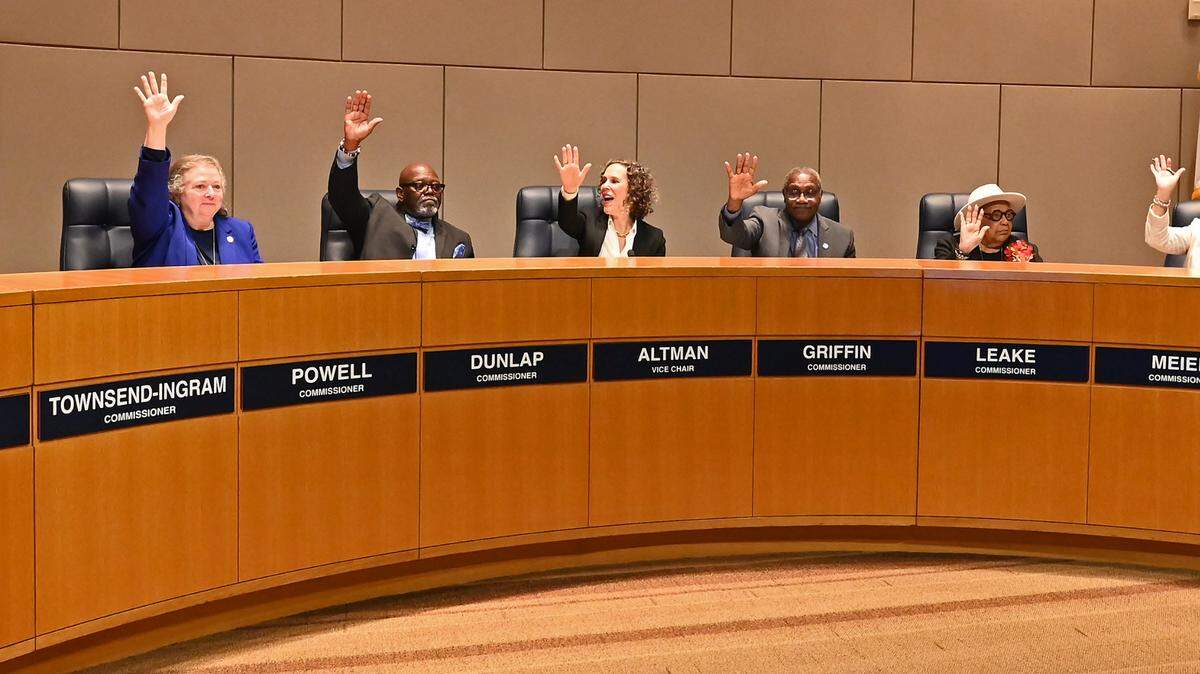
Local governments — including Mecklenburg County, Charlotte-Mecklenburg Schools and the city of Charlotte — need to coordinate lobbying efforts to press Raleigh for higher public education funding, county leaders say.
“Alignment of our legislative agendas to lobby Raleigh is going to be critical,” Mark Jerrell, chair of the Mecklenburg County Board of Commissioners, said Thursday at a joint meeting with the CMS school board. “Coming together is going to be critical.”
The boards held the meeting to preview each’s budget projections heading into 2026. In May, CMS Superintendent Crystal Hill plans to present the district’s budget proposal to the county commission for approval. Around 34% of CMS’ current operating budget comes from county funding, while 56% comes from the state and around 6% comes from the federal government.
CMS faces a budget squeeze, as the state legislature has yet to approve a new budget for this fiscal year, which began in July. Federal funding is uncertain.
“We want to be great even when funding is tight,” CMS Chief Financial Officer Kelly Kluttz told commissioners Thursday. She said that will involve the district “evaluating, reallocating and recycling” where it can.
A major concern for CMS, and for county commissioners, is teacher pay, which remains stagnant while the . N.C. General Assembly’s budget stalemate drags on.
North Carolina ranks 43rd in the nation for teacher pay, lagging behind neighboring states including South Carolina and Virginia. The Education Law Center recently ranked North Carolina at the bottom nationally in state funding effort for schools.
Educator pay in North Carolina is made of two main elements: the state base salary and the district supplement. The supplement is county-funded and added onto what the state provides. In CMS, even with the county supplement, educators don’t reach the local living wage — estimated at about $55,000 a year — until their 10th year in the district. Without the local supplement, NC educators don’t reach that benchmark until year 25 in the classroom.
To bring every teacher in CMS above the living wage, CMS leaders estimate it would take an additional $114 million, Kluttz said Thursday. But Hill assured commissioners she would not be asking the county for that kind of increase in May. That’s in part because the county can’t cover it.
“We know that the county cannot afford to fill that gap,” Mecklenburg County Manager Mike Bryant said. “And, the state still has that responsibility to fully fund teacher pay.”
Commissioners and school district leaders alike echoed that refrain Thursday: The state, they said, needs to step up.
“This really bad situation could be a lot better if the state would just do what they’re responsible for,” said Commissioner Elaine Powell. “We’re the economic engine of the state, and we’re being completely disrespected in this regard.”
CMS budget picture
CMS saw a 1.7% drop in enrollment between the beginning of the 2024-25 school year and 2025-26 school year, which will spell decreased funding from the state in 2027.
Meanwhile, the state has not given teachers raises, and the district could lose up to 60% of its Title II, III and IV funds from the federal government, according to the communication she’s gotten so far, Kluttz told the CMS board in December.
As a result of the impending budget squeeze, district leaders announced last month that CMS will cut back on new hires by about 10% next school year.
“We already know we’re not adding anything new this year,” Hill told the board. “We can’t afford to add any additional positions.”
Hill said she plans to propose a 5% increase to teacher supplements this year, just as she has in past budget cycles, and plans to continue to do in years to come. If approved, it would increase starting teacher pay in CMS by $398. This school year, starting teachers in CMS will make $48,943.
The budget talks come as educators around the state of North Carolina, including in Charlotte, took to the streets Wednesday to call for greater state investment in public education.
The effort was organized by NC Teachers in Action, a Facebook group that formed after an anonymous social media post went viral, causing some teachers to call out of work in protest in November. Leaders of the group estimated about 650 to 750 educators at around 52 schools in North Carolina, predominantly in Wake County, called out Wednesday.
Mecklenburg County budget projection
It’s not just CMS: The county’s purse strings are also looking tighter this year.
The county expects revenue growth of around 3-4% this year, county leaders said Thursday. If it were to continue to increase funding to CMS and county employee salaries at the rates it has in recent years — 4.4% and 5.5%, respectively — it would run into a shortfall of between $20.8 million and $36.3 million.
“An average of 3-4% of revenue does not keep pace with the demands,” Bryant said. “This isn’t to lower any expectations. Instead, it’s to present the reality.”
The county estimates it’s spending about $484 million this year to cover “lack of sufficient funding” from the state. Over $429 million of it is for CMS.
CMS expenses currently account for about 36% of the county’s spending, equal to $893 million. The bulk of that goes toward the district’s operating budget, which includes expenses like staff salaries and benefits.
Bryant said county, city and CMS officials are working together to find ways to cut costs and use resources more efficiently.
“I’ve been doing this in terms of preparing county budgets in some shape or form for over 23 years. … The narrative hasn’t changed. We’re waiting on the state, waiting on the state, waiting on the state,” Bryant said. “We have the option to do nothing or do something. We want to do something, and that’s we’re trying to figure it out.”
This story was originally published January 8, 2026 at 10:06 PM.