What Elon’s full-time law school will — and won’t — mean for Charlotte region
With Charlotte slated to get its only full-time law program in 2027, one local higher education expert said he believes it will draw “highly, highly talented people to the Charlotte region.”
Charlotte is the largest U.S. city without a full-time law school. Prior to August, when Wake Forest University opened a branch of its medical school outside of uptown, it didn’t have a med school either.
But that hasn’t stopped the city’s growth. Between July 2023 and July 2024, an average of 157 people moved to the Charlotte area per day, according to the Charlotte Regional Business Alliance. That’s a 34% increase over the prior year. In 2025, Charlotte had the fourth-highest net gain of one-way U-Haul customers, the company said in its yearly growth index.
Elon University announced plans this month to open the city’s only full-time law program in 2027. It will be on the campus of Queens University in Myers Park, after Queens and Elon announced plans last fall to merge by August. Elon founded a small, part-time law program in Charlotte in 2024, but it’s been eyeing starting a full-time program in the Queen City for years.
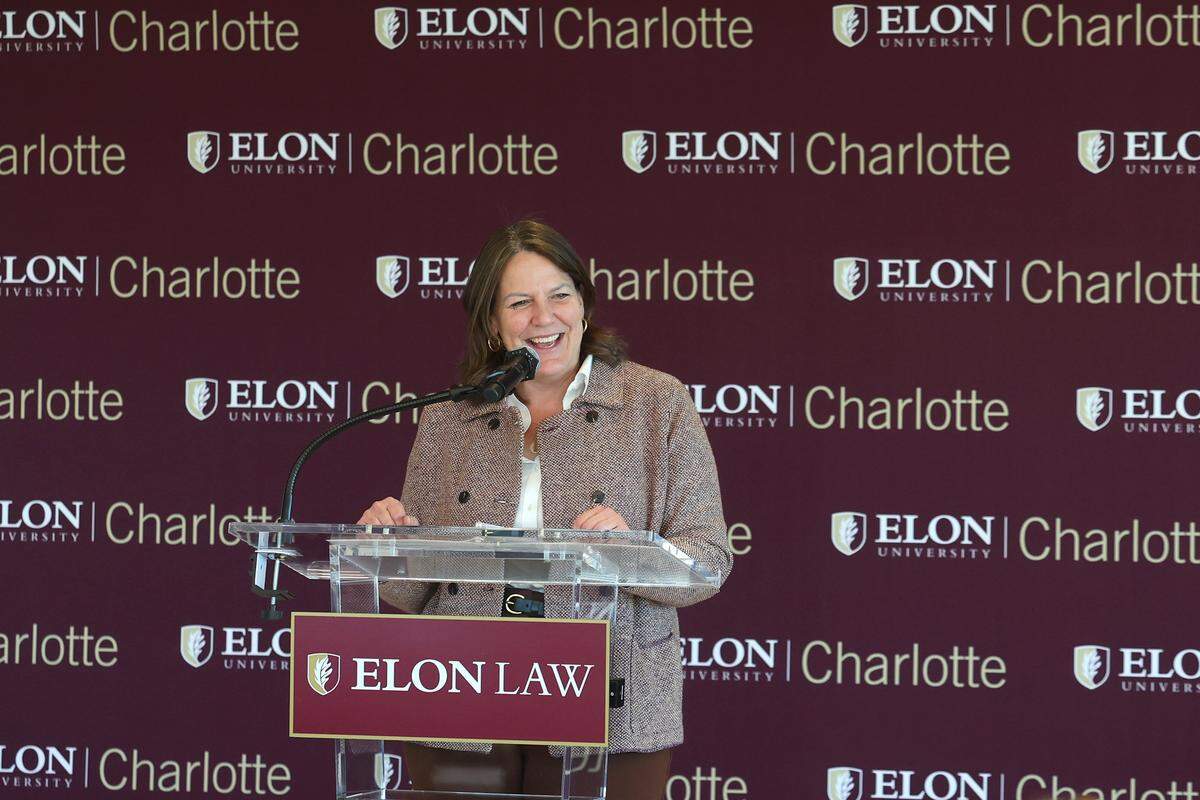
“We know this will strengthen Charlotte’s legal ecosystem. We’ve done the research,” Elon President Connie Book said earlier this month. “We know it will expand access to justice and prepare lawyers who understand this community because they are educated within it or from it.”
The city’s only previous full-time law program, the troubled, for-profit Charlotte School of Law closed in 2017 after 11 years of operation. It was put on probation by the American Bar Association and became the first accredited U.S. law school ever to be thrown out of the federal student loan program. But in 2017, the then-executive director of the Mecklenburg County Bar Association said that the city didn’t need a law school.
“I just don’t know of a lot of interest now in another law school in Charlotte,” Nancy Roberson, former executive director of the Mecklenburg County Bar Association, told The Charlotte Observer shortly after Charlotte School of Law closed. “It’s expensive, really expensive (to start one). A new school has to prove itself and we already have some excellent law schools in North Carolina. Going through the process in an ‘up’ market, that’s hard. Doing it during a soft market, that’s really difficult.”
Still, discussion of bringing a law school to the Queen City has persisted for decades, especially as the city’s growth has boomed, said Chris Marsicano, associate professor of educational studies at Davidson College. His work is focused on trends in higher education, including policy, finance, affordability and politics.
“Frankly, Charlotte School of Law shut down because it wasn’t achieving what it stated its goals were,” Marsicano said. “So, while it was a law school and it was in Charlotte, it was not exactly the highest quality institution, nor was it really helping the Charlotte legal market in ways we would hope a law school would do.”
Elon opened a small, part-time law program in Charlotte in 2022, but for the most part Charlotteans who wanted to become lawyers had to go elsewhere for school.
“It has been decades that people have been talking about getting a real deal law school and getting a place that offers a full-time, three-year degree,” he said. “So, with this school, we would expect that there might be more lawyers in town that are educated in town, and that helps people build networks in the legal community where they want to go. It also makes a great opportunity for Charlotte-based law firms to recruit from the local area so they’ll be able to build out that capacity.”
Marsicano said he believes that Charlotte has lacked a full-time law school despite having a wealth of higher education opportunities because of the specific missions of a lot of the institutions that already exist in the city.
For example, Davidson College is focused solely on undergraduate education. Johnson C. Smith University has graduate programs but was originally founded in 1867 with the mission of training teachers and preachers, to address the spiritual and educational needs of formerly enslaved people. Queens University of Charlotte was founded as a liberal arts undergraduate institution for women. UNC Charlotte was founded after World War II, specifically to meet the educational needs of returning veterans. And, while it’s grown to be much more than that, the UNC System already has operated its law school at Chapel Hill since 1845.
“While we have this wealth of higher education institutions, each of them’s mission and vision is not necessarily aligned with the creation of a full-time law school or even graduate programs, in most cases, until very recently,” Marsicano said. “That doesn’t mean that there isn’t a demand for it. The city has gotten big enough that there certainly is demand for it. ”
Cost of school and lawyer shortage
In general, North Carolina has a shortage of attorneys, especially in rural areas and especially public defenders.
Over the last 10 years, the number of private attorneys in Mecklenburg County willing to represent indigent clients has shrunken dramatically. Low pay and an increase in retiring attorneys are some of the main causes, Mecklenburg County Chief Public Defender Kevin Tully told The Observer in 2024. The result of a dearth of lawyers willing to represent indigent clients is long wait times for trials or settlements being forced through.
Elon’s full-time law school model is an accelerated one, aiming for students to complete the course of study in two and a half years instead of three. That could help cut costs for students, Marsicano said, allowing them to graduate with less debt.
“Elon is attempting to be very innovative here, and it’s going to bring a lot of attention for those who are cost-conscious and those who want to get out and go ahead and get to work,” he said. “That’s going to be really interesting to a lot of students and draw a lot of highly, highly talented people to the Charlotte region.”
Meanwhile, more than half the state’s counties were “legal deserts” as of 2023, meaning there were fewer than one lawyer per 1,000 residents.
Mary Pollard is the director of the North Carolina Office of Indigent Defense Services. She said that, while a law school in Charlotte might help produce more lawyers in North Carolina, it’s not going to get at the root of the problem when it comes to legal deserts in the state.
“In large parts of the state, people don’t have easy access to affordable lawyers for either civil needs or criminal needs,” she said. “And, I’m just not sure that a law school in Charlotte is going to solve any of those problems.
Pollard said she believes a solution lies in getting more affordable and flexible law school opportunities to people in rural areas.
“I think, to get lawyers into other parts of the state, we really need to be looking hard at how to make legal education accessible and affordable,” Pollard told The Observer. “I think there are people living in more rural areas that would want to come back and practice law there, and would be good lawyers, but they can’t afford to relocate to take on massive debt… And if they do, then they’re maybe tied to having to take a higher paying job in one of the urban areas.”