‘People weren’t paying attention’ so Charlotte teachers marched on Raleigh
They beat the sun there.
Car headlights sliced through the morning on University City Boulevard, pulling into a still slumbering parking lot around 5:30 a.m. A red Target emblem rose high above the street.
Charlotte-Mecklenburg Association of Educators vice president and art teacher Rae LeGrone stood with a clipboard, alongside Erin DeMund, a teacher at Oaklawn Language Academy who had arranged a similar, though smaller, demonstration a week earlier in Charlotte.
LeGrone and DeMund directed each attendee to one of three coach buses at the edge of the lot. And, as you might expect of people accustomed to wrangling schoolchildren, it was all meticulously planned.
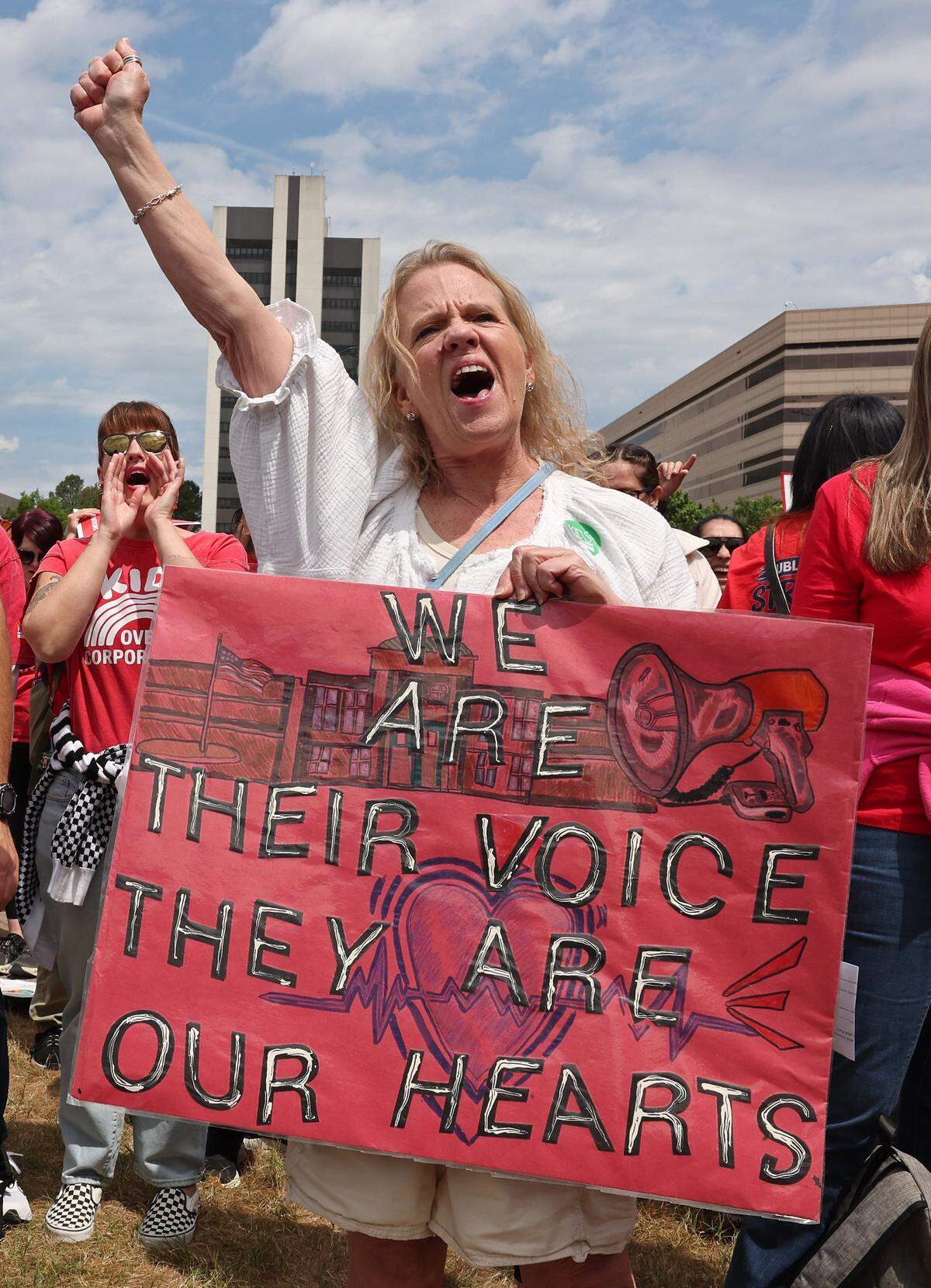
This was just one caravan of thousands of teachers from around the state that descended on Raleigh Friday for the “Kids Over Corporations” rally organized by the North Carolina Association of Educators. The aim was to push state lawmakers for more funding for public education, including higher teacher pay and more resources for schools.
In the preceding weeks, at least 20 of North Carolina’s 115 public school districts canceled Friday classes due to a high number of teachers requesting leave to participate in the protest.
Charlotte-Mecklenburg Schools was one of them. More than 2,600 of the district’s 9,000 teachers requested leave for Friday, according to public records.
One of NCAE’s goals Friday was to promote Senate Bill 943, filed Wednesday. The bill would cancel the state’s plans to reduce corporate income tax to 0% by 2030. Instead, it would raise it to 5%.
Demina Gaskin works in instructional support at Briarwood Elementary School in east Charlotte. For Gaskin, participating in Friday’s rally was never a question.
She said the lack of a state budget is the most challenging part of being a teacher right now.
“The budget not being passed impacts everything,” Gaskin said. “It affects where we live, what we eat, if we can afford gas or not… If you’re working a second or third job, you can’t show up as your best for your students.”
The context

North Carolina lawmakers still have not passed a state budget for this fiscal year, which began in July, amid an ongoing tax cut stalemate between the House and Senate. In the meantime, state employees like teachers have not gotten a raise this school year.
The two chambers sit far apart when it comes to raises for educators.
The House’s budget proposal includes an average raise for teachers of 8.7%, bringing beginning teacher pay to $50,000 and restoring increased pay for teachers with master’s degrees.
The Senate’s proposed raises for teachers are less robust, coming in at an average of 2.3% and bringing beginning teacher pay to $41,510. Its plan does not include increased pay for educators with master’s degrees.
The absence of a state budget, combined with increases to health insurance premiums and cost of living, means teacher compensation dropped 1% this school year, according to the “Highlights of the North Carolina Public School Budget” report released in March by the state Department of Public Instruction.
On Monday, North Carolina dropped in the national ranks for teacher pay: the Tar Heel state is now 46th in the country, according to the National Education Association. It also ranks last in the nation for the percentage of the state’s wealth that goes toward K-12 public education, according to a 2025 report from the Education Law Center.
Gaskin, like other longtime CMS educators, said she’s felt the mounting challenge of affording to live where she works during her 22 years in the district.
In another life, she would’ve been an attorney, she said, pushing her red, polka-dotted glasses up further on the bridge of her nose as the bus crossed into Raleigh. Her nails were long and pointed, painted alternating shades of green and pink.
“Being an educator just fits more,” she said. ‘I’ve always liked to help people.”
Advocating for better school funding scratches some of the itch for justice that made law appealing, she said. In fact, her determination to make a difference is what’s keeping her from considering leaving the classroom.
“I have grandchildren, so I know that their future is dependent upon it, and my students’ future is dependent upon it,” Gaskin said. “So, leaving wasn’t really an option for me. I’m in it for the long haul.”
It’s common for educators to have to work multiple jobs to afford to live in Charlotte. The living wage in Mecklenburg County is currently estimated around $53,100, according to the Massachusetts Institute of Technology Living Wage Calculator. Meanwhile, starting teacher salaries in CMS are around $48,900.
Caleb Soliday is in his first year as a full-time teacher in CMS. He teaches special education students and some English classes at Butler High School in Matthews. While he loves teaching, he’s considering leaving education. Soliday works about five jobs total over the course of the year to make ends meet.
Soliday is a South Carolina native, and he said he’s considered returning just across the border to work in his home state, where teacher pay is higher. He’s also considered going back to school and entering the ministry, he said with a turquoise cross hanging from his neck.
“Going grocery shopping once a month is not the vibe,” he said.

It’s a refrain teachers echoed throughout Friday. One said she’s been considering taking on a second job for the better part of three years. Another said she sells her plasma on the side to supplement her salary.
It’s about more than pay, though, Soliday said. It’s about making sure there are enough resources for students to get what they need.
“A lot of my students specifically couldn’t afford notebooks or pencils or anything like that,” he said. “So, I got those for them, but that also means I was broke again because I was supplying those things.”
For example, he thinks more support staff at his school could help curb recurring behavior problems in the classroom.
“That is one of the main reasons why I decided to come to this today,” Soliday said.
The march
The traveling protesters joined thousands of others dressed in red on Halifax Mall next to the state capitol Friday morning.
“Fund our schools!” they chanted as they snaked along a mile-long route through downtown Raleigh. “Education is a right! That is why we have to fight!”
Protesters carried myriad homemade signs, some tongue-in-cheek, some more solemn. “I’m on my lunch break from my second job,” one read. “Fund our future,” stated another. One group hoisted a set of fabric monarch butterflies into the air.
Beth Helfrich is a Democratic state representative whose district covers northern Mecklenburg County and rode the bus to Raleigh with CMS educators Friday morning. She’s served in the legislature since 2025, and her children attend a CMS elementary school.
As to whether the General Assembly will pass a budget during its current session, which began April 21, Helfrich didn’t have a firm “yes” or “no.”
“I wish I had an answer for you, and I think it’s incredibly disappointing that I don’t have that answer,” she told The Charlotte Observer. “It’s past the point where the cracks are showing, and so I’m hopeful that we see more movement over the next few weeks in the short session.”
Kendra Dixon is a CMS parent with two kids at Huntingtowne Farm Elementary School in south Charlotte. She’s seen multiple teachers from her kids’ dual language school leave in recent years and she worries that if nothing changes, they’ll lose more.
Dixon said, while some have argued that teachers are putting families and students in a bad position by calling out of work Friday, she thinks it’s necessary to see things improve.
“I don’t think it’s selfish,” Dixon said. “People weren’t paying attention before, so it had to be something disruptive… It had to say, ‘This is so big that teachers are willing to give up their day and go into Raleigh and march about it.’”

This story was originally published May 2, 2026 at 5:00 AM.