
Wake County hopes fining students will deter school threats
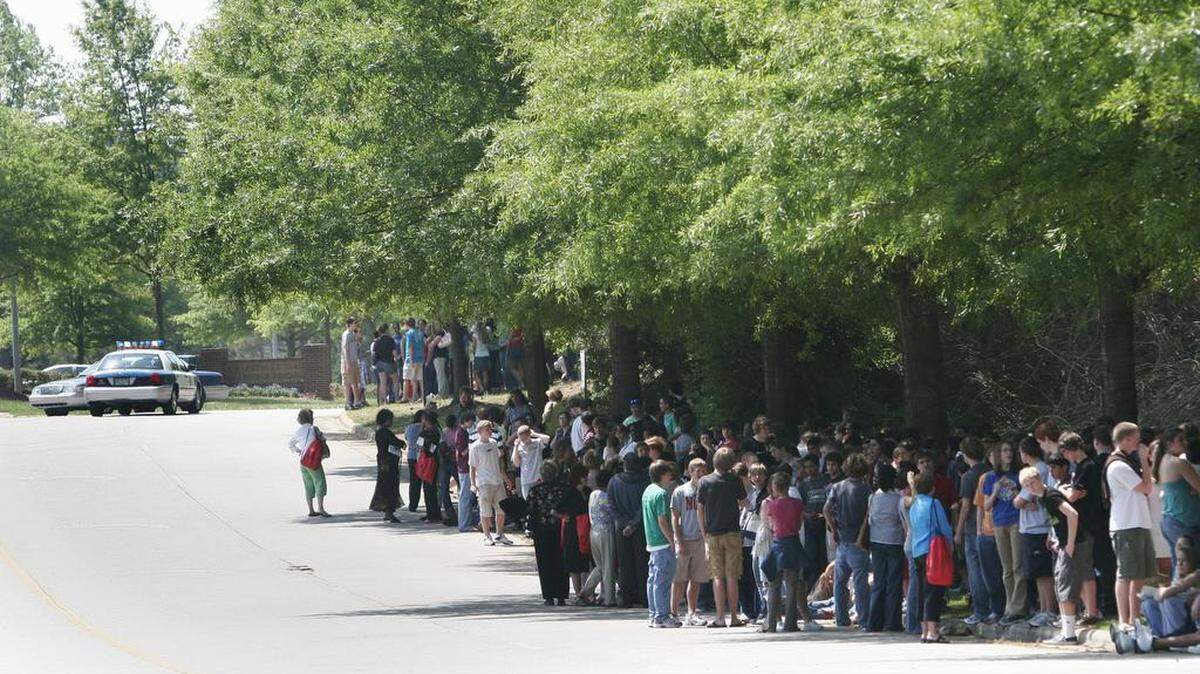
Wake County school leaders hope that threatening students with long-term suspensions and billing them for the cost of school evacuations will stem the rising number of threats of violence being made against schools.
Twenty-two threats were made against Wake County high schools and middle schools in October and November, resulting in four evacuations. In response, the school board gave initial approval Tuesday to changes in the Code of Student Conduct that would stiffen the consequences for making threats that lead to school evacuations.
Students could be required to make restitution for the disruption and cost of evacuations, either monetarily or through community service. Students could also receive long-term suspensions of more than 10 days from school.
“We’re trying to help our parents and our students understand – and particularly our students – that this is not fun and games,” school board Chairman Tom Benton said in an interview after Tuesday’s vote. “These kinds of threats have consequences for schools and at times can be expensive to the school system.”
But Brenda Berlin, supervising attorney for the Children’s Law Clinic at Duke University Law School, noted that students who make threats against schools already face criminal charges that could lead to restitution.
“It is very troubling when the school system is trying to impose its own system of investigation and punishment when one exists in the criminal justice system,” Berlin said in an interview Tuesday. “And there are safeguards in place in the criminal justice system to protect the innocent which don’t exist in the school setting.”
The policy change, which could get final approval Jan. 19, comes during a state of heightened fears after the recent terrorist attacks in Paris and in San Bernardino, Calif. On Dec. 15, all of the schools in Los Angeles, the nation’s second-largest school system, were closed because of a terrorist threat.
Locally, Raleigh Police Department records show that 14 bomb threats were made against schools between March and December. Six were made against Athens Drive High School.
“When our resources are deployed on a false call, that takes them away from other duties,” said Raleigh police spokesman Jim Sughrue. “That could play out in the form of having longer responses to other calls where people actually need police assistance and would also take officers away from proactive law enforcement patrols.”
Wake County’s experience is consistent with what school systems are seeing nationally, according to Ken Trump, president of National School Safety and Security Services, a consulting firm based in Cleveland, Ohio. There was a 158 percent increase in school threats across the country from Aug. 1 to Dec. 31, 2014, compared to the same period the year before, according to a study by Trump’s group.
Wake’s policy doesn’t list a specific restitution amount. Instead, it says the superintendent will pass on to the student and his or her parents any fee imposed by emergency responders. School officials say no agency has imposed a fee on the district, but Benton said the district has been put on notice that it could happen.
If no fine is imposed by an outside agency, the superintendent would calculate a standard restitution fee “to reasonably compensate for the cost and disruption of a campus evacuation.”
Trump questioned how Wake would be able to get the restitution fee paid on its own.
“The devil is in the details of implementation,” he said.
The policy says students who couldn’t afford to pay the fee could get a waiver and perform an alternative service.
Berlin said the policy is too vague. For instance, Berlin said there’s no details about how a family could prove they couldn’t pay or what would happen if they refused to pay.
Berlin doubted that Wake’s changes would have a deterrent effect on students.
“It doesn’t seem like this will affect children’s behavior and will be a punitive measure against parents,” she said.
T. Keung Hui: 919-829-4534, @nckhui
Transfer policy changes backed
The Wake County school board gave initial approval Tuesday to changes that will make it harder for parents to transfer their children into different schools this fall, especially if they’re trying to leave an under-enrolled school or get into a crowded school.
The revised transfer policy gives student assignment staff more authority to reject transfer requests. With requests that aren’t subject to automatic approval, staff would balance the best interests of the child versus the impact the transfer would have on the schools involved.
The new policy also expands the number of crowded schools that would be closed for transfer requests. An additional change would put students who have already transferred on notice that they’re subject to being reassigned, a situation they normally wouldn’t face.
Final approval is expected Jan. 19. The changes would go into effect with the early transfer period that starts in February.
This story was originally published January 6, 2016 at 7:00 AM with the headline "Wake County hopes fining students will deter school threats."