
Getting message out on $2 billion bond question
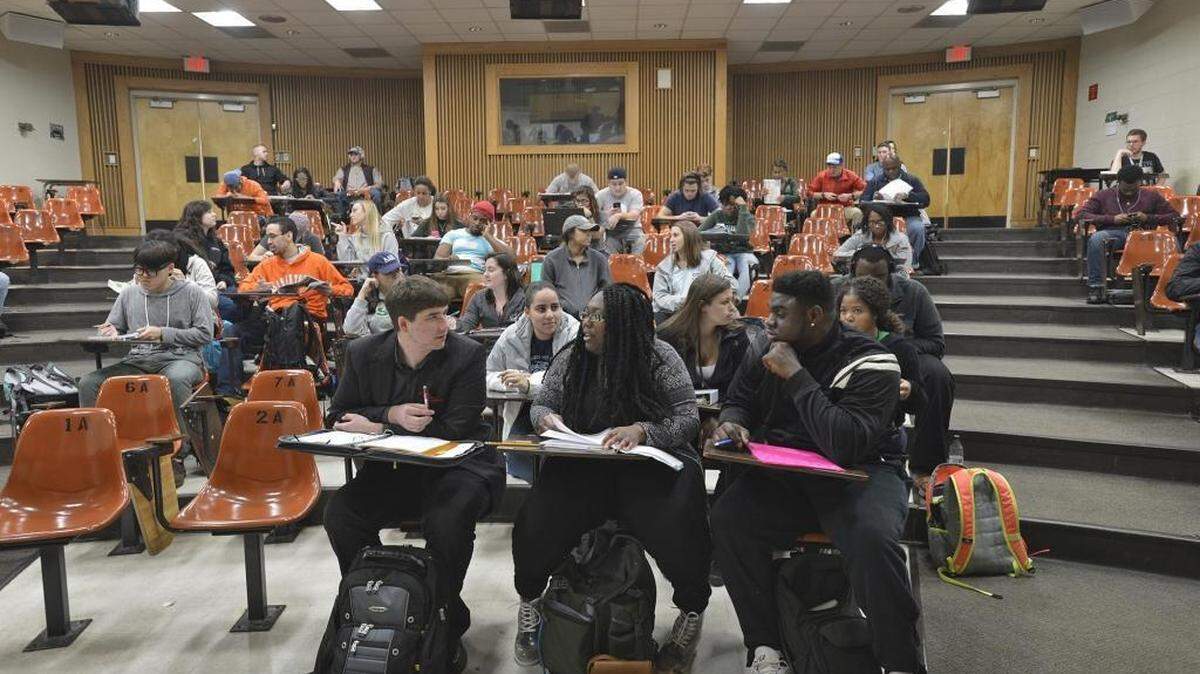
UNC Charlotte is the fastest growing campus in the UNC system, but students still learn chemistry and physics in a science building decades out of date.
The two-story Burson building also is cramped given the school’s swelling enrollment – from well under 11,000 students when the building opened in 1985 to nearly 28,000 this year. About 15,000 students take at least one science lab course at the school each year.
“You can only put so many sections of chemistry in a building designed for a much smaller enrollment,” UNCC Chancellor Phil Dubois said last week.
Lecture halls are dated with their rising rows of stationary seats, unlike modern halls where students collaborate in clusters.
The hoods that capture fumes in the chemistry labs are made of wood, where steel versions replaced them decades ago in other college chemistry labs.
To accommodate growth, UNCC has at least 200 fume hoods in Burson, a building designed for 50 of them, Dubois said. That also raises safety concerns, because the hoods block a professor’s view of students conducting experiments on the opposite end of the room.
When it opened, Burson “was a state-of-the-art building,” professor Bernadette Donovan-Merkert, chair of UNCC’s Department of Chemistry, said on a tour of the building last week. “But now things have changed.”
UNCC officials hope voters will agree with them on March 15 that UNCC needs a larger, updated sciences building.
On the primary ballot, North Carolina voters will be asked to vote yes or no on a proposal to allow the state to borrow $2 billion – with two-thirds going to the state’s public universities and community colleges. The rest would be spent on water and sewer projects, state parks and facilities for agriculture, public safety and the National Guard.
The higher education portion of “Connect NC” – $1 billion for the UNC campuses and $350 million for community colleges – is largely focused on buildings for science, technology, engineering and mathematics and facilities to train nurses and other health care professionals.
UNCC would get a $90 million sciences building.
Central Piedmont Community College would receive $9.6 million.
Part of CPCC’s money would build a second central energy plant at the central campus. The plant would meet energy needs of planned buildings being funded by 2013 Mecklenburg County bonds.
CPCC would use other state bond proceeds to buy land in the Elizabeth Avenue corridor for future expansion. Money would also build facilities for CPCC’s new truck driver training program at the Merancas campus in Huntersville.
“Central Piedmont would certainly put the bond proceeds to good use,” CPCC spokesman Jeff Lowrance said. “At the same time, we’re excited about the prospects of UNC Charlotte, because new facilities there will ultimately benefit many of our students, because many of them transfer to UNC Charlotte.”
At UNCC, demand for science instruction is directly related to enrollment growth, officials said. Of all the students who’ve declared majors at the school, half are in the STEM disciplines of science, technology, engineering and math, Dubois said.
But crowded and outdated science labs present what UNCC officials call a “choke point” in meeting demand for science graduates desired by employers.
Conditions are similar elsewhere in the state.
At UNC-Chapel Hill’s Berryhill Hall, headquarters of the state’s largest medical school, some classrooms resemble a 1970s-era high school chemistry lab – old-fashioned lab stations, chalkboards on the wall, sinks obsolete. One project would spend $68 million toward replacing the seven-story building.
The school is also cramped. It has been given the green light to expand its incoming class to 230 but can’t accommodate more than 180 in Berryhill.
“There’s a critical need for more doctors,” UNC Chancellor Carol Folt said. “They need to be outstanding doctors. We’ve got the capacity to do it, and we need to really improve the facility.”
Need questioned
The March bond referendum comes 15 years after North Carolina voters overwhelmingly approved $3.1 billion for the UNC system and community colleges. At the time, it was the largest higher education bond issue in U.S. history. The money unleashed an astonishing construction boom, with 728 projects across the state, adding 12 million square feet of space. Campuses were transformed, with new and renovated residence halls, classroom buildings, labs, libraries and student services buildings.
In 2000, a $4 million campaign paid for advertising to sell the bonds to the public with a statistic that got the attention of parents and grandparents: Universities were expecting a 30 percent surge in students at the very time that campus buildings were deteriorating from age and neglect. The bonds were approved by more than 70 percent of voters – a margin that even surprised proponents.
This time around, the situation is different. The state is recovering from a recession, and the public may not perceive a need after the building spree of the early 2000s, especially at a time when nearly half of UNC system students are taking some instruction online.
University enrollment has flattened in recent years, though some campuses, such as UNCC, have experienced huge growth – 142 percent since the Burson sciences building opened. Community colleges experienced a flood of students during the economic downturn, but overall enrollment has since declined.
Gov. Pat McCrory, who advocated for the bonds, has maintained that the borrowing won’t require a tax increase. And the state’s overall tax-supported indebtedness would remain flat, because North Carolina’s previous debt load steadily drops off after 2015.
Still, some in McCrory’s party aren’t sold on more borrowing. And a ballot with a competitive Republican presidential race is likely to draw a large turnout of conservative voters.
Rep. Michael Speciale, a New Bern Republican, wrote a commentary in the Beaufort Observer recently declaring the campus spending a waste of taxpayer dollars. “Wow! We have a GOP controlled state government!” he wrote. “What happened to the ‘conservative’ majority? What happened to ‘fiscal responsibility’? What happened to ‘smaller government’?”
Playing catch-up
But Robert Shackleford Jr., president of Randolph Community College, said the state’s 58 colleges are chronically underfunded. Some have heating and air systems that are 30 or 40 years old, he said.
“It’s not to put us way out ahead,” Shackleford said. “It’s to help us catch up.”
The $350 million for community colleges would be divided based on a formula, with amounts ranging from $2.7 million at Carteret to $12.6 million at Wake Tech.
For the universities, each campus would get one substantial project, though N.C. State stands to gain two – $75 million toward an engineering building and $85 million toward a plant sciences building.
Folt said the spending from the last bonds helped UNC ramp up its research enterprise. UNC now ranks in the top 10 nationally for research grants.
“A lot of that has to do with the changing face of the campus,” she said. “We’ve been able to stay cutting edge in science because we’ve been able to create cutting-edge buildings.”
Said UNCC Chancellor Dubois: “We’ve had great fortune at UNC Charlotte to accommodate students who want to attend the institution and would like to be in a position to continue to accommodate that growth.”
Joe Marusak: 704-358-5067, @jmarusak; Jane Stancill: 919-829-4559, @janestancill
Bond projects in the UNC system
A total of $1 billion would be earmarked for the UNC system’s 17 campuses. Here are the projects that would be funded:
▪ Appalachian State University: New health sciences building, $70 million
▪ East Carolina University: Life sciences and biotech building, $90 million
▪ Elizabeth City State University: Moore Hall and G.R. Little Library renovations, $13 million
▪ Fayetteville State University: Lyons Science Building renovation, $10 million
▪ N.C. Central University: New business school, $30 million
▪ N.C. State University: Engineering building, $75 million; Plant sciences building, $85 million
▪ N.C. A& T State University: Engineering building, $90 million
▪ N.C. School of Science and Math: N.C. School of Technology and Engineering in Burke County, $58 million
▪ UNC Asheville: Owen Hall addition and renovation, $21.1 million
▪ UNC-Chapel Hill: Medical education building replacement, $68 million
▪ UNC Charlotte: New sciences building, $90 million
▪ UNC Greensboro: Nursing school building, $105 million
▪ UNC Pembroke: New business school, $23 million
▪ UNC School of the Arts: Old Library and Performance Place renovations, $10.9 million
▪ UNC Wilmington: Allied health and human services/Nursing building, $66 million
▪ Western Carolina University: Sciences/STEM building, $110 million
▪ Winston-Salem State University: Sciences building, $50 million
The campaign
The campaign to reach voters about the March bond referendum has been relatively quiet until now. Last weekend, TV ads began.
Organizers had raised $1.5 million toward a goal of $3.3 million by the end of December, said Brad Crone, a consultant with the campaign. The money will be used for broadcast and digital ads and mailers. There will also be a heavy social media presence on Facebook and Twitter.
Beneficiaries of the bond are making the rounds, giving speeches to civic groups in communities around the state. A compressed schedule means supporters don’t have much time to raise money and make their case. The campaign will pick up intensity in the final three weeks before the March 15 vote.
“I’m cautiously optimistic,” Crone said.
The effort is being led by a bipartisan group, the Connect N.C. Committee, which is registered with the state Board of Elections. Unlike candidates’ campaign committees, a referendum committee is allowed to raise unlimited contributions from individuals and corporations. Another group, Connect NC Invest in Our Future, is registered with the secretary of state as a tax-exempt organization.
One question that has arisen is whether candidates can appear in ads for the bonds. Crone said the ads will not include candidates.
This story was originally published February 6, 2016 at 8:00 AM with the headline "Getting message out on $2 billion bond question."