
‘We do not want to be Americans’: Greenlanders on Trump comments, Vance visit
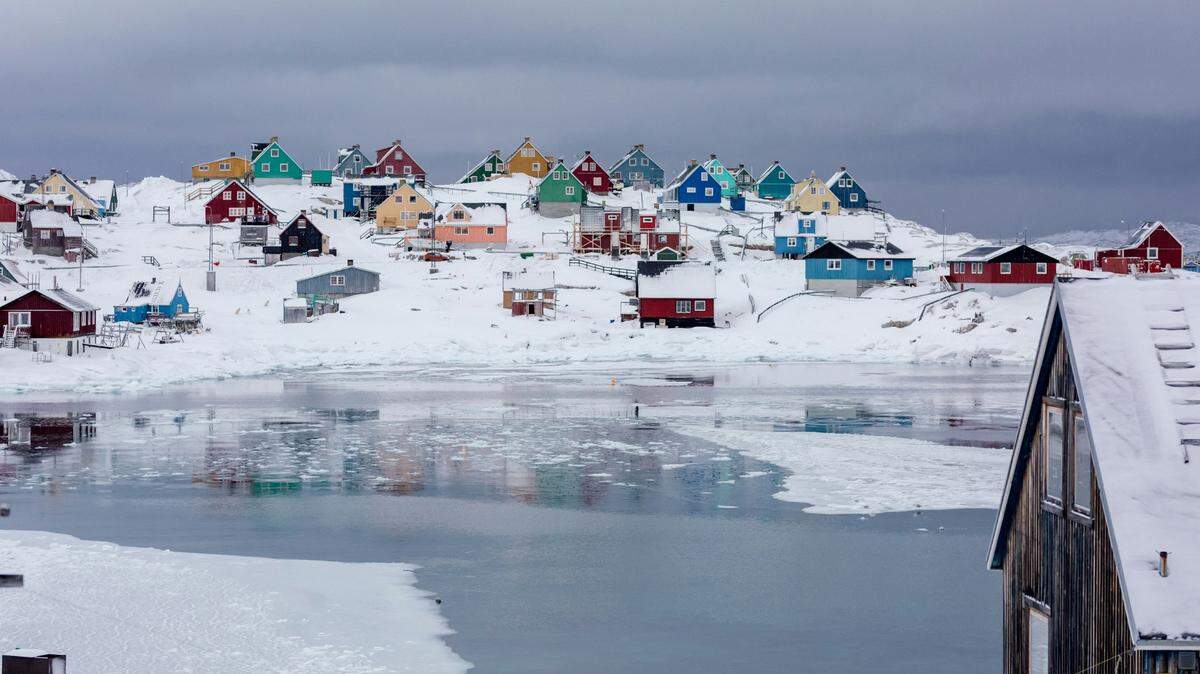
After decades spent amassing golf courses, mega-mansions and Manhattan skyscrapers, President Donald Trump is now setting his sights on what could be the biggest acquisition of his career: the world’s largest island.
He’s expressed a keen interest in obtaining Greenland — an 836,000 square mile semi-autonomous Danish territory — for the United States, marking an unprecedented bid for territorial expansion that would rival the Louisiana Purchase.
There’s just one problem. Most of the 56,000 people who live on the ice-covered Arctic landmass aren’t on board.
In interviews, Greenlanders expressed outrage at Trump’s heavy-handed overtures and delivered a blunt reply: “We do not want to be Americans.”
Reaction to Trump overtures
Reactions to Trump from Greenlanders have shifted over time. When he first talked publicly about acquiring the territory in 2019, it wasn’t taken too seriously.
“It was a joke, laughable even,” Anguteeraq Jessen Larsen, a 26-year-old fashion designer from Maniitsoq, told McClatchy News. “We didn’t make a big thing out of it.”
But, since returning to the White House, Trump has doubled down on his desire to annex the Arctic island — in addition to other territories — resulting in a growing concern.
In December, Trump wrote on Truth Social, “For purposes of National Security and Freedom throughout the World, the United States of America feels that the ownership and control of Greenland is an absolute necessity.”
Two months later, during his March 6 joint address to Congress — after supporting Greenland’s right to self-determination — he said, “One way or the other, we’re going to get it.” And, in a March 30 interview with NBC News, he refused to rule out the use of military force to acquire the territory.
The New York Times also reported on April 10 that the administration has moved forward with a “formal plan” — which does not include a military option — to obtain Greenland.
In response to these moves, apathy has given way to alarm.
“People have been moved,” Naleraq Eugenius, a 39-year-old theater technician from Nuuk, the territory’s capital, told McClatchy News. “Some are afraid, some are confused, but most of them are quite angry.”
“Many of us are very uneasy,” Bruno Josefsen, a 51-year-old municipal worker in Qaqortoq, told McClatchy News. “Trump and his administration are rude the way they behave towards us.”
This feeling that Trump has shown a lack of respect to the people of Greenland — and failed to take into account their opinions — was shared by others.
“It’s like we have no say,” Kim Andersen, a 34-year-old project manager from Aasiaat, told McClatchy News. “We have to just accept ‘the threat of annexation.’” He added: “I trust Trump enough that he won’t ‘rain fire’ upon us.”
Larsen said it is “ridiculous” how local residents are treated “like a Monopoly piece.”
Response to Vance visit
One of the biggest developments in Trump’s quest to appropriate Greenland came when Vice President JD Vance visited the island in late March — a last-minute trip that was slammed by Danish officials as “completely unacceptable.”
Speaking at a U.S. military base in Pituffik, Vance accused Denmark of underinvesting in the territory’s security, citing growing interest from China and Russia in Arctic sea routes and mineral resources.
“I think we do have to be more serious about the security agreement,” he said. “We cannot just ignore this place. We cannot just ignore the president’s desires.”
Some Greenlanders were not outright opposed to his visit in principle.
“I think it is ok to visit Greenland. It is (a) free democratic country. We have been political allies,” Sivalerak Terkilsen, a 44-year-old police officer from Nuuk, told McClatchy News, adding, “I think political leaders should talk about the security question.”
Others took issue with the vice president’s presence and rhetoric.
“Most of the people in Greenland were very against JD Vance(‘s) visit,” Eugenius said. “I know that they don’t have bad intentions, but treating Greenlandic people without respect is no diplomacy.”
Vance’s remarks about bolstering Greenland’s security came across as ironic given the threat it currently faces is from Trump himself, Larsen said.
“The ‘security’ they think of is they know Greenland (has) a lot of minerals and resources they can use,” she said.
“It could be more reassuring if Trump and his administration could say ‘we want to talk to you and cooperate with you’ instead of saying ‘we want Greenland here and now,’” Josefsen said.
Greenland’s future
So, what future do Greenlanders envision for themselves? Certainly not one with apple pie, the NFL and U.S. statehood.
“In my knowledge, and through talking to fellow Greenlanders, the opinion is that we do not want to be Americans,” Taatsi Berthelsen, a 37-year-old from Nuuk and the owner of tourism company Greenland Explorer, told McClatchy News.
“We have a similar lifestyle. Hunting and fishing is ‘freedom’ here,” Andersen said. But, he added, “I don’t want to be part of the U.S.”
Larsen was unequivocal: “To be a part of America? Never in a million years.”
A January poll, commissioned by the Danish newspaper Berlingske, bore out the same results, finding 85% of Greenlanders do not want to be incorporated into America. Just 6% said they favored joining the U.S.
Most of those interviewed, though, did express interest in political change — in the form of independence from Denmark. However, they acknowledged that this is a complex issue, given that over 50% of the island’s budget is contributed by the Scandinavian country.
In the territory’s recent parliamentary election, independence was the major campaign issue, with the business-friendly Demokraatit party — which supports Greenland breaking free from Denmark eventually — winning a plurality of voters.
“We want to seek full independence,” Berthelsen said. “In order to do that, we need way more investments in the country.”
“Independence doesn’t come overnight,” Larsen said, but it is “a wish for the future.”
Others suggested they would be open to working with the U.S. — to improve their economy and security — in order to attain their ultimate goal of independence.
But, the main point, Terkilsen said, is that these decisions are “up to people in Greenland, not Denmark or the U.S.”
This story was originally published April 18, 2025 at 10:04 AM with the headline "‘We do not want to be Americans’: Greenlanders on Trump comments, Vance visit."