Poisonous creature found with baby on its back is new Amazonian species. See it

For nearly 40 years, a new species of poison dart frog has been hiding in plain sight, misidentified in museum records and field observations as a related species.
Researchers have now confirmed the brightly colored, boldly patterned Ranitomeya hwata is a new species of poison dart frog from the Amazon rainforest stretching from western Brazil to southeastern Peru, according to a study published Oct. 6 in the peer reviewed journal Zootaxa.
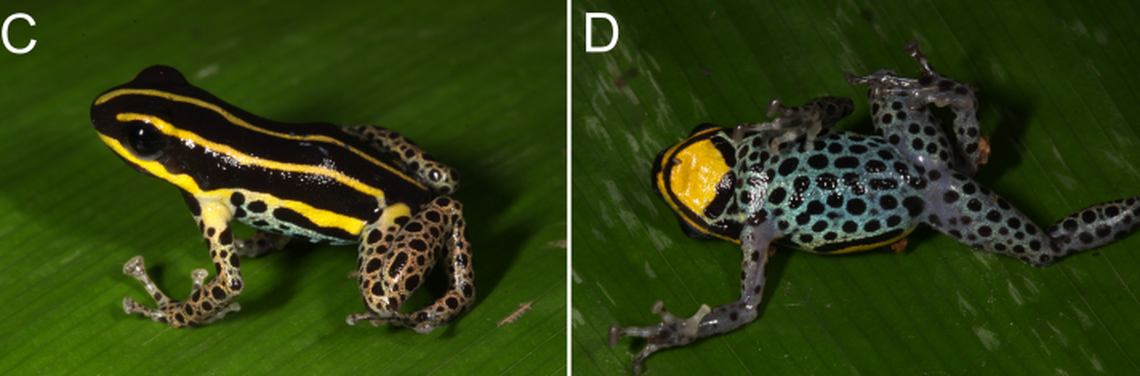
The new species is considered small, just over half an inch long, with fingers and toes ending in an expanded disc shape for grip.
In life, Ranitomeya hwata has a black dorsal surface broken up by bright yellow stripes and a solid yellow patch under its chin. Its legs are pale blue with black spots, according to the study.
For years, Ranitomeya hwata was misidentified as Ranitomeya sirensis, but key physical differences point to them being different species.
While they share many of the same colors and patterning, the most telltale distinction is the absence of a black and yellow patch on the bellies of Ranitomeya hwata, which is present on Ranitomeya sirensis, according to the study.
Researchers said the new species has a “noteworthy and unusual” lack of color pattern variation from frog to frog. In other words, they all look nearly identical, which is different from closely related species that show a higher degree of variability.
Ranitomeya hwata is named after the word used by indigenous populations for the native Guadua bamboo, with which the new species is strongly associated, according to researchers.

In the field, researchers encountered the poison dart frogs inside the water-filled culms, or hollow center stalks, of Guadua bamboo, often guarding egg clutches or moving their tadpoles, according to the study.
Unlike most other related species, male Ranitomeya hwatas are “polygynous and can recruit up to three females in the same culm, achieving multiple matings and optimizing the spawning site,” researchers said.
One male “nurse frog” was observed transporting a tadpole to a new culm to ensure dispersal and ultimately their survival, according to the study.
The species is abundant throughout its range, much of which is protected, so researchers recommended it be listed as Least Concern on the International Union for Conservation of Nature’s Red List, the study said.
The research team included Evan Twomey, Paulo R. Melo-Sampaio, Jason L. Brown, Santiago Castroviejo-Fisher, Giussepe Gagliardi-Urrutia, José M. Padial, Roberto Gutierrez Poblete and Juan C. Chaparro.
This story was originally published October 8, 2025 at 10:02 AM with the headline "Poisonous creature found with baby on its back is new Amazonian species. See it."