
Chief Justice Mark Martin warns that inadequate budget causes court delays
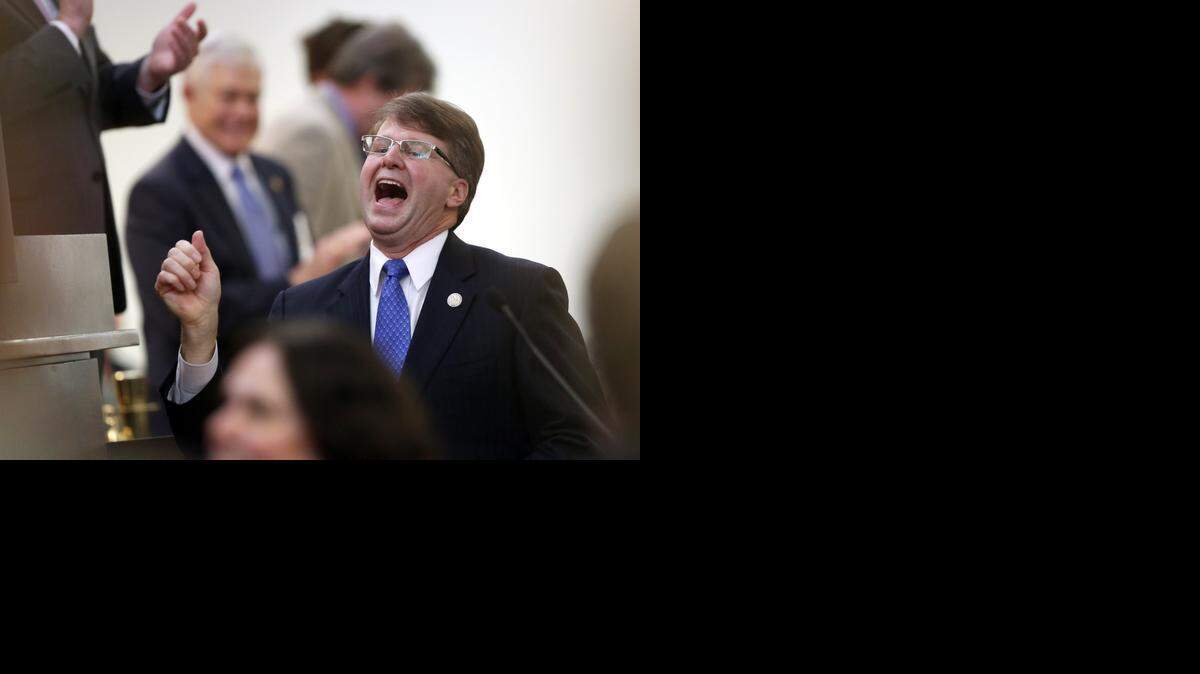
North Carolina’s top jurist Wednesday portrayed a judicial system increasingly strained by years of budget pressures and long delays in the delivery of justice.
“The resulting delays erode public trust and confidence in the integrity of the justice system,” Chief Justice Mark Martin told the General Assembly. “We all know that justice that is delayed is justice denied.”
In a “State of the Judiciary” speech, Martin spoke to an audience of lawmakers, jurists, law enforcement officials and Gov. Pat McCrory.
Martin, a registered Republican installed in January, pointed out that the system’s budget of $464 million is less than a third that of the Wake County public schools.
He described a system where lab results in DWI cases routinely take more than a year to process, where jurors are paid with money intended for staff, and where prosecutors turn to plea bargains to avoid the cost of a trial.
The woes of the system come as no surprise to lawyers who work with it.
“If the story of court funding was in the Bible, it would be the Book of Lamentations,” said Charlotte attorney John Wester.
Martin is reportedly asking for around $30 million to improve efficiencies and give pay raises to many of the 6,000 employees. Both Senate President Pro Tem Phil Berger and House Speaker Tim Moore suggested later that they’ll try to find it.
“I don’t think it’s unreasonable,” said Berger, a Rockingham County Republican. “The question is going to be, how are we going to find the resources?”
Martin said the system is understaffed by 536 positions, or about 9 percent. Much of the shortfall is blamed on the recession, but the system’s problems started even earlier.
In 2007, when Democrats controlled the system’s purse strings, North Carolina ranked 49th among the states in per capita spending on the judicial branch. By 2012, it rose to 45th.
Mecklenburg hit hard
Mecklenburg has felt the strains as much as any county.
Trial court administrator Todd Nuccio said the county, with 10 percent of the state’s population, has 16 percent of its violent crime and 10 percent of its property crimes. But it has only 7.4 percent of the state’s judicial positions.
After state lawmakers cut payments to court reporters in half during the last session, Mecklenburg lost two of its seven reporters, whose transcripts are essential as cases move through the system. Now, Nuccio said, courts are forced to ask some litigants to hire their own court reporter.
And while other states have moved to electronic filing, North Carolina’s system is stuck with technology from the 1980s.
“Not only are we cutting personnel and operating (costs), but we’re cutting technology at the same time,” Nuccio said. “So how can you ‘work smarter’?”
Andrew Murray, Mecklenburg County’s district attorney and president-elect of the state’s Conference of District Attorneys, made his own legislative rounds Wednesday. He told lawmakers the state must improve not only training and support for its prosecutors but the pay.
“I’m losing district attorneys because we’re not competitive,” Murray said, noting that the average new North Carolina prosecutor leaves law school with a debt of $120,000 for an average salary of $37,000.
Legislative leaders, he said, “certainly understand that public safety is important in this state, and they need to do something to bolster the needs of the district attorneys.”
Legislators sympathetic
Legislators appeared sympathetic to such appeals.
“There’s a lot of needs, no question,” said Republican Sen. Harry Brown of Onslow County, who chairs the Senate Appropriations Committee. “I think we (agree) that the court system needs some help.”
“We certainly want to be as responsive as we can be,” said Rep. Nelson Dollar, a Wake County Republican who chairs the House budget committee. “I think all of us share the chief justice’s concern.”
Martin told lawmakers that the system already has lowered costs through efficiencies that in some cases have benefited the public. He said the creation of special family courts, for example, has significantly shortened the length of cases in areas that have them.
“We have all learned to do more with less,” he said. “But while these efforts at efficiency and innovation in our justice system have helped ease the crisis, they are not enough.”
Morrill: 704-358-5059
Key numbers
$464 million
Annual budget of N.C. judicial branch
$1.5 billion
Annual budget of Wake County schools
2.2%
System’s share of state budget; lower than at height of recession
$80.6 million
Budget cuts over six years
1
Cents of every tax dollar that goes to judicial system
124
Days for the average civil case in District Court in 2008
216
Days for the average civil case in District Court in 2013
This story was originally published March 4, 2015 at 7:03 PM with the headline "Chief Justice Mark Martin warns that inadequate budget causes court delays."