
Charlotte didn’t get money for U.S. 74 pedestrian bridge. Here’s what’s planned instead.
The city had hoped to build a $16.7 million iconic pedestrian bridge over the U.S. 74 and Interstate 277 interchange to connect two segments of the Cross Charlotte Trail, but didn’t receive federal funding for the project.
Instead of a new bridge, pedestrians and cyclists will be able to use Central Avenue over the interchange.
Joe Frey, Cross Charlotte Trail senior project manager, said the city is moving forward with an alternate $4.2 million plan, which will build a protected, two-lane bicycle lane along the existing Central Avenue bridge and intersecting Prospect Street. That bike lane will become a greenway running from the end of Jackson Avenue, west of Central Avenue, to 10th Street.
.jpg "xclt (2).jpg")
Called the Seventh Street to 10th Street segment, the project will close a gap in the Little Sugar Creek Greenway, the county’s portion of the city-county partnership, that lies between Seventh Street and Greenway Crescent Lane near 12th Street.
Frey said the design stage of the segment is nearly finished, and real estate acquisition will begin this summer. Project construction should begin at the end of 2020 and finish by 2022.
Vivian Coleman, the Charlotte transportation planning program manager, said every year from 2016 to 2018 the city tried and failed to get federal funding from a U.S. Department of Transportation program — called the TIGER Grant and later the BUILD Grant — to pay for a new pedestrian bridge over the interchange.
Charlotte followed up with DOT on its denied 2016 application and learned the proposed bridge had received a high score, but the rejection ultimately came down to dispersing funds equitably across the country.
Frey said the Central Avenue plan will serve the same purpose as the original bridge idea in closing a trail gap, but he still hopes for an eye-catching, standalone bridge someday that would both provide Cross Charlotte Trail users with the best experience possible.
“That could have been a centerpiece in our business district, but I think this connection that we are building is very good and better than no connection, which is what we have now,” Frey said.
Greenway and parks advocates were excited by the idea of a standalone bridge when it first came up in 2016, said Doug Burnett, president of the advocacy group Greenways for Mecklenburg and former county park and recreation commissioner.
But he said the city’s department of transportation was always transparent about the TIGER grant being a “long shot” due to national competition.
Frey said the new plan for Central Avenue will not only provide a wide protected lane for cyclists to feel more comfortable, but it will also further separate the pedestrian sidewalk from car lanes, creating a safer experience for walkers and joggers.
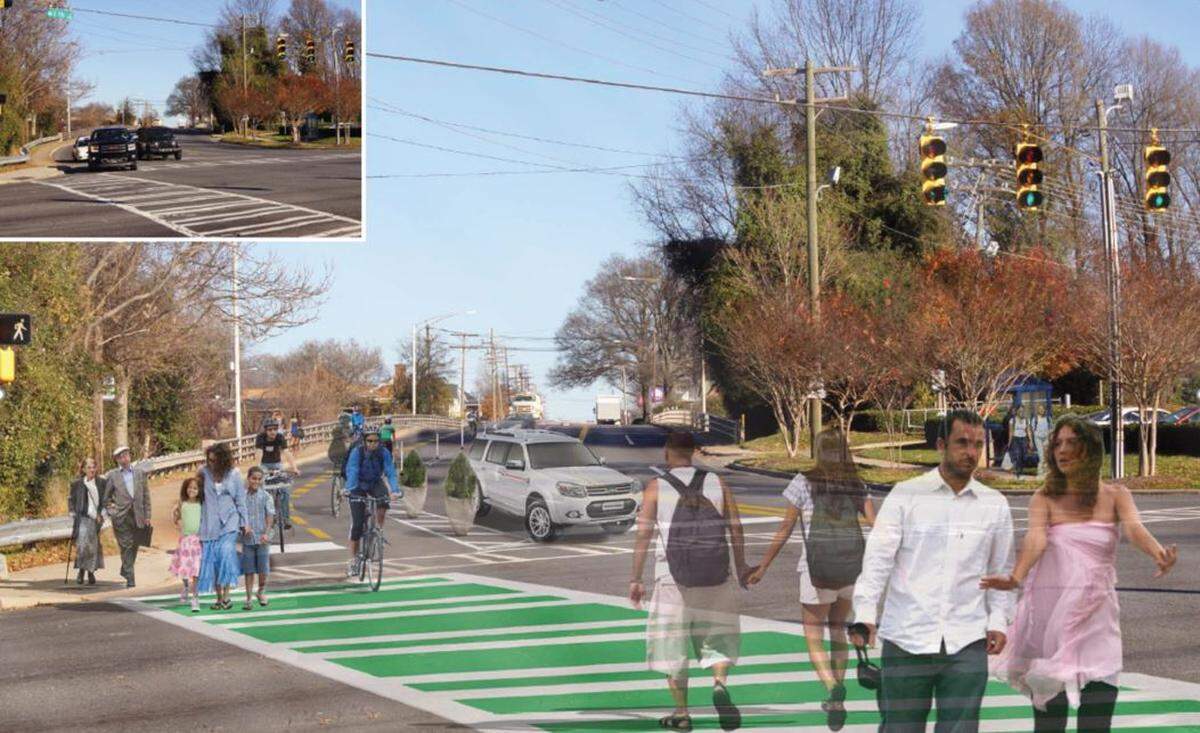
The plan also includes a small park at the end of Jackson Avenue. It will provide art, seating and a great view of the city skyline, Frey said.
Burnett said many of the planned Cross Charlotte Trail connections do not align with the original vision from 2012 of an off-street corridor, but he’s happy with any kind of connection between the fragmented trail segments.
The Cross Charlotte Trail has been one of the city’s signature projects since its conception over six year ago, expected to run 26 miles from Pineville to UNC Charlotte once completed and connect with other county trails to form 40 miles of continuous, connected greenways for pedestrians and bicyclists. But the trail’s future remains unclear since revelations of funding gaps on the city’s part earlier in the year.
In January, the City Council learned the original estimate of $38 million to complete the trail would only fund construction of 18 miles, covering about a third of the project’s total cost and leaving the city $77 million short on funding. The city blamed the miscalculation on poor budgeting during the project’s origins over six years ago, as well as rising land and construction costs.
But the City Council passed its 2020 budget June 10, allocating $54.4 million to fund five additional planned segments of the Cross Charlotte Trail, along with the $38 million already budgeted for the Seventh Street to 10th Street connection and three other segments.
Burnett said city or federal funding do not have to be the only options for funding pedestrian trail connections to uptown.
“I think it’s an excellent opportunity for the private sector to get engaged or to play a role in this with funding and sponsorship,” Burnett said.
Coleman said she does not yet know if the city will apply for the BUILD grant again for the Cross Charlotte Connector.
Burnett said he still thinks an iconic bridge connecting greenways could be in Charlotte’s future.
“I think it’s not an ‘if,’ it’s a ‘when’ — when and how that can be built,” Burnett said.