
City says it can afford $110 million MLS investment. But it wants the Panthers to stay.
Charlotte’s chief financial officer said Wednesday the city can “absolutely” afford to spend $100 million on a tourism-related project — just short of what the city has agreed to support in bringing Major League Soccer here.
The city won’t spend any hospitality funds, though, until David Tepper, the billionaire Panthers owners who led the push for MLS, assures Charlotte that the Panthers won’t relocate to South Carolina.
But already, it seems Charlotte’s investment might be too small, Tracy Dodson, assistant city manager and director of economic development, revealed Wednesday at the City Council’s annual strategy retreat in Durham.
She said the total investment may change depending on how much Tepper is relying on public dollars to help cover upgrades or an overhaul of Bank of America Stadium, where the soccer team is expected to begin play in 2021.
“We have different options of where we can get that money,” Dodson told reporters. “That is part of the discussion and the negotiations.”
But Dodson couldn’t say how much additional funding might be required.
CFO Kelly Flannery’s assessment of the city’s tourism revenues, drawing largely from hotel and motel occupancy taxes, confirmed that the Charlotte City Council has the financial resources to invest $110 million in MLS.
“You have plenty of money to make a monthly payment,” Flannery told council members, comparing any substantial investment to a mortgage with smaller, incremental payments stretching out over 20 or 30 years.
She later said the Convention Center Fund, a hospitality revenue stream that is expected to support soccer, will grow over time.
The current available fund balance is $41.7 million, according to Flannery’s presentation. That figure will increase to $101.9 million by 2024, and then surge to $251.5 million by 2029, the presentation showed.
The fund balance, Flannery emphasized, doesn’t represent the maximum threshold on the city’s spending on a given tourism project.
“I would say in short, we can afford some stuff in the Convention Center Fund,” Flannery told the City Council.
And she told reporters that Charlotte wouldn’t be opposed to exploring additional financing options for MLS-related projects.
City Council member Ed Driggs requested that Flannery provide more comprehensive information on Charlotte’s debt service capacity, seeking details that would extend beyond fund balances and instead incorporate a schedule of upcoming capital projects.
“I can feel an opportunity to get answers that we’ve had for a long time,” Driggs told Flannery, without mentioning MLS. “As a finance guy, I can’t reach any conclusions about what we can do and what we should do.”
Assurances from Tepper
Even after Charlotte and Tepper secured the team in December, the city has yet to determine how it will allocate Mayor Vi Lyles’ pledge to set aside $110 million in hospitality funds.
“I’m not insinuating we have an agreed-upon deal, but we do have an agreed-upon vision,” Dodson told the City Council. “We have a partnership, we have an alignment of long-term goals.”
Yet Dodson says the city needs a guarantee of Tepper’s long-term plans for the Panthers, as the team moves its practice facilities to Rock Hill.
“The goal is that we’re making an investment in MLS that is also going to make an investment in keeping the Carolina Panthers here,” Dodson told reporters.
It is also unclear when the public will be involved in offering feedback on the city’s investment, though Dodson said there will likely be a string of public discussion and votes.
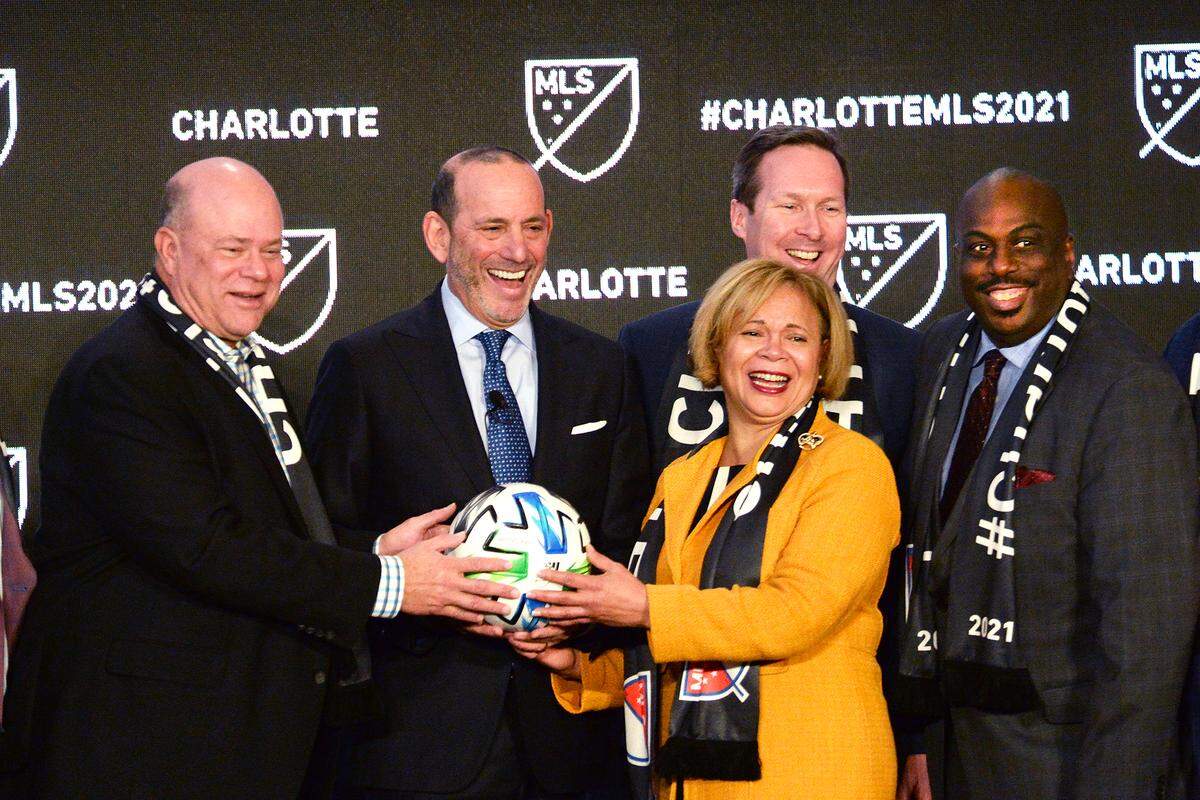
Lyles stressed Wednesday that citizen engagement will be critical to all agreements surrounding MLS.
The mayor also offered a clearer picture into the new entertainment district that would link uptown and the Gateway District. In a November letter to MLS Commissioner Don Garber, Lyles had promised the city would pursue “continued work” in that area.
“I’m thinking music, cultural arts, restaurants — all of the things that make it a fun place to be,” Lyles told reporters. “Something that’s 24 hours: Think about changing the juxtaposition of rolling up the sidewalks (at 5 p.m.) to how do we make it 24 hours.”
Eastland at the forefront
The former Eastland Mall site, where the soccer team will build its headquarters and practice facilities, is at the “forefront” of Charlotte’s immediate MLS priorities, Dodson said.
The property is favored to receive a significant investment from Charlotte, City Council member Matt Newton told the Observer Tuesday. The city bought the site for $13.2 million in 2012 and demolished the buildings.
Dodson said she plans to begin the rezoning process of the vacant 69-acre lot later this month. In a best-case scenario, Dodson said, that would lead to a zoning hearing in April, followed by a zoning decision in May.
At that point, the city could begin working with Panthers and Eastland’s master developer, Crosland Southeast. Several hundred homes and townhouses, open space, shops and restaurants are planned for Eastand — forging a concentrated effort to reinvigorate east Charlotte.
Newton, who represents east Charlotte, has urged fellow council members several times during their three-day retreat to take a vote on Eastland “as soon as possible.”
While Newton acknowledged MLS cannot be considered a “silver bullet,” he said the league would spur job growth and investment in his district.
“It behooves us to move forward expeditiously,” Newton told the Observer in an interview Tuesday. “For me, the sooner, the better.”
This story was originally published January 15, 2020 at 2:01 PM.