
‘The time is now’: County leaders want supermarkets to help with food access
Mecklenburg County commissioners passionately resolved at their annual retreat Thursday to try to collaborate with grocery stores that have long avoided locating in low-income neighborhoods.
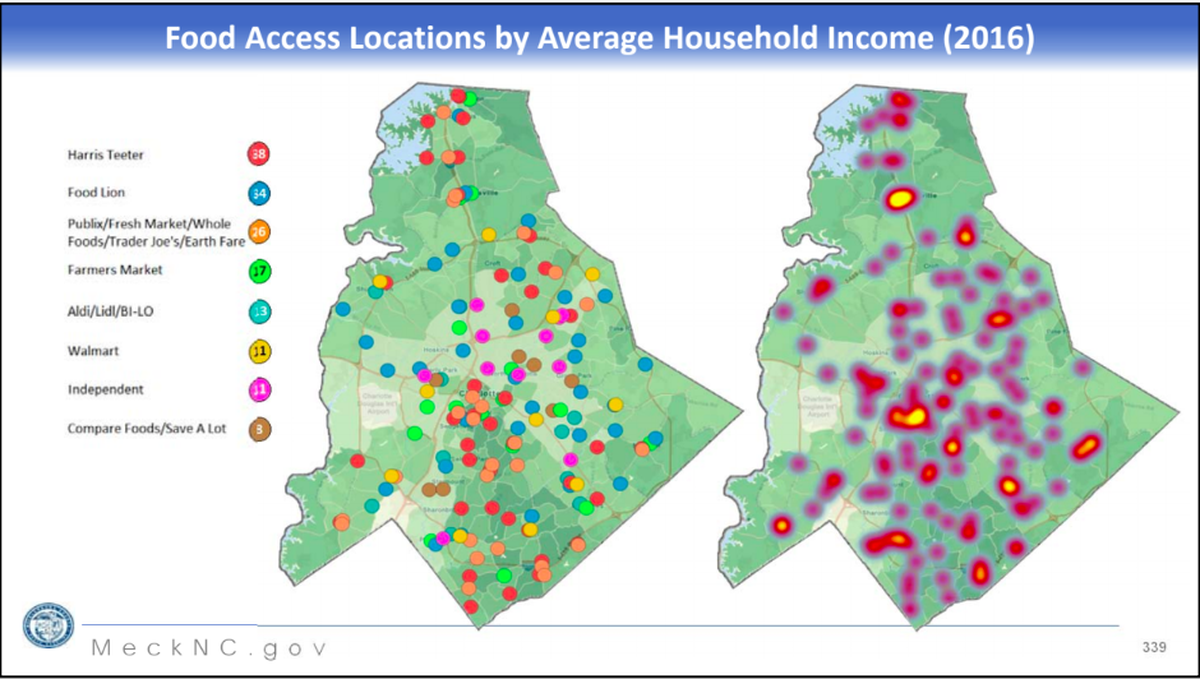
Chairman George Dunlap asked County Manager Dena Diorio to schedule a meeting with supermarket executives to determine what incentives may be necessary to encourage them to establish roots in Mecklenburg’s “crescent,” where food deserts are common.
In those areas, residents have low access to the healthy food found in supermarkets or large grocery stores, according to a definition from the United States Department of Agriculture.
“It’s just unacceptable...we have people who are starving,” Commissioner Mark Jerrell told his colleagues, forging one of the more emotional moments of the two-day retreat. “The corporate community — those that profit — have the responsibility to discuss what their contribution is to support people who are in the crescent.”
Diorio said that a meeting between the county and supermarket executives would represent the first of its kind. She said she plans to develop a combination of short-, medium- and long-term goals to address the commissioners’ renewed emphasis on food deserts.
“We’ll certainly follow up on that and see what options exist,” Diorio told reporters. “We’ve got our work cut out for us.”
But it is unclear what incentives the county could legally offer supermarkets, Diorio said, since potential partnerships wouldn’t represent a “standard economic agreement.”
Food insecurity
Mecklenburg County Public Health Director Gibbie Harris used the Beatties Ford Road corridor as an example of a food desert during a presentation to the commissioners.
“All you have to do is drive down Beatties Ford Road, and what do you see? You see fast food,” Harris said. “They’re concentrated there.”
In Mecklenburg County, nearly 15% of households experience food insecurity, which is considered reduced or disrupted eating patterns. That’s higher than the state’s average of 13.9%, as well as the national average of 11.1%, according to 2018 data from the USDA.
About 50,000 families in Mecklenburg receive food assistance benefits, Harris said. She outlined several food-intervention programs that are already active, including nutrition services for new mothers who are breastfeeding and the 18 community gardens with 400 plots scattered throughout the county.
And through a recent pilot program in Charlotte, Lyft provided $2 rides that allowed 75 participants to travel to grocery stores, food pantries and farmers markets.
‘Still in the desert’
Commissioner Pat Cotham said she believes 2020 is the year when the county leaders can finally make strides in alleviating food insecurity.
Cotham — who like Jerrell had spent the early morning hours Thursday participating in the “point-in-time count” to gauge the county’s homeless population — emphasized the urgent need to initiate “serious conversations.”
“We can talk about the data, but when you’re looking the person in the eye, you feel that empathy and you feel we have got to do something,” she said. “The time is now.”
Dunlap had also asked Diorio to explore what level of funding — if any — the county could allocate to subsidize grocery stores that may not see strong revenues come from food deserts, compared to those in higher-income neighborhoods.
“We understand that the bottom line is profitability,” Dunlap said.
Commissioner Vilma Leake, who regularly champions curbing the food deserts that persist in her district and throughout Mecklenburg, said she’ll be seeking “positive answers” from supermarket executives.
“Most of us came from the (food) desert, and a lot of us are still in the desert,” Leake told her colleagues. “All I ask you to do is to help my people come out of the desert — I beg you.”