Urban and rural NC were already divided. The 2020 election pushed them farther apart.
The two versions of North Carolina revealed themselves when Steven Greene went online the day after Election Night and pulled up a map of the state: blue for those counties that most supported Joe Biden and red for the ones that most supported Donald Trump.
At first glance, Greene, a political science professor at N.C. State, was not surprised by what he saw, because on Wednesday North Carolina’s presidential election map looked a lot like it did in 2016. Then Greene looked a little closer, at the numbers behind the colors, and it didn’t take him long to conclude that “everything got more” of what it already was.
“The Trump counties got more Trump, which are the rural counties,” Greene said. “The urban counties, the blue counties, got more Biden, more Democratic.”
Biden victories in North Carolina’s largest cities and counties were a foregone conclusion, and yet it was the margins that struck Greene. In 2016, Hillary Clinton won Wake, Durham and Mecklenburg counties combined by more than 338,000 votes. Four years later, Biden won them by more than 473,000 combined votes.
That trend continued throughout North Carolina’s next-largest cities and counties, where the places that most embraced Clinton in ‘16 only became more Democratic this year.
But another trend continued, too: the considerable advantage for Democrats in more urban areas disappeared completely in rural North Carolina, so much that Biden, like Clinton before him, failed to carry the state.
“It’s actually kind of astounding to me,” Greene said. “If you had told me that ... Biden would get these kinds of margins in urban counties, I would say surely the Democrats have won the state. But, clearly not. ... Basically everywhere else (was) enough for the Republicans, it seems.”
Overall, Biden won 25 of North Carolina’s 100 counties, with his margin of victory ranging from 197,437 votes (in Mecklenburg) to 27 (in Pasquotank). In those 25 counties, he built a margin of more than 717,000 votes. Trump won the other 75 counties by 794,000 votes. His slimmest margin of victory came in Scotland County, nestled between Rockingham and Lumberton near the South Carolina line, by 262 votes. His largest margin was in Randolph County, home of Asheboro and south of Greensboro, by more than 41,000.
Trump chipped away at his built-in deficit in urban areas with a 17,000-vote margin here (in Stanly County), a 5,000-vote margin there (in Duplin County), a 13,000-vote margin over there (in Harnett County). He won 58 counties by between 1,000 and 20,000 votes.
North Carolina’s urban-rural divide was clear long before Election Night. It is a divide built upon myriad socioeconomic factors, some easily quantifiable and some not. Poverty rates and education levels and population changes tell part of the story. The success or failure of local economies tells another. And yet it is more difficult to put numbers to the cultural differences and conflicting worldviews that define the two North Carolinas.
The 2020 election proved that the divide is only growing. There is little to indicate that it will narrow.
“The most likely place for it to start to narrow would be in some of the immediate suburbs of some of these urban counties,” said Sarah Treul, a political science professor at UNC-Chapel Hill. She was talking about places like Johnston County, which borders Wake, and Cabarrus County, which borders Mecklenburg
“I don’t see it changing, though, in what we would consider like the true rural communities and counties across North Carolina.”
A Democratic stronghold turns right
Donnie Beck took a bite of his grits and sausage while steam rose from his coffee mug on Thursday morning inside Betty Carol’s Diner, an old white rectangle of a building off East 2nd Street near what’s left of downtown Lumberton. Betty Carol Pittman, the owner of the place, isn’t much for talking politics because “politics and food don’t mix,” she said.
That didn’t stop Beck, though, from trying to explain what’s happened to Robeson County, where he’s lived almost all of his 69 years. Before the 2016 election, Robeson was among the state’s most reliably Democratic-voting counties. A Republican presidential candidate hadn’t won there since Richard Nixon in 1972. Voting Democrat was as much a part of the county’s identity as country farmland and the floodwater that had a tendency to spill out of the Lumber River during hurricanes.
“It was just passed on from generation (to generation) that you’re a Democrat,” Beck said. “They just beat it in your head — ‘You’re a Democrat.’ You registered Democrat, vote straight Democrat. That’s what was told to me; I think that’s what was told to my mother and that’s just the way it was in Robeson County.”
Beck voted for Barack Obama in 2008 but, disillusioned after Obama’s first term, he reluctantly supported Mitt Romney in 2012. By 2016, Trump’s populist messaging, his bravado, his battle cry of “make America great again” had won Beck’s full support. Throughout Robeson County, he was hardly alone.
In 2016, Trump won the county by 1,746 votes. This year, he won it by nearly 8,000. Both by percentage and raw number of votes, support for Trump grew more in Robeson than it did in any other North Carolina county. Pittman, the owner of the diner, has also spent her entire life in Robeson, and she thought she knew which way the county would vote in 2016.
“But then, when I went to the polls early, (it was the) first time I had really noticed people covering their ballot up,” she said. “I knew. I knew something was going to take place that was unexpected.”
Four years later, Robeson’s continued transformation from a blue county to red is no longer surprising. Though racially diverse — whites, Black people and Lumbee Indians all constitute roughly a third of the population — people in Robeson are bound by shared struggle. They live in one of the most economically depressed areas of the state. Just about every time there’s a hurricane the river floods, leaving behind more destruction and another hole to dig out of.
The support for Trump crossed racial lines inside the diner. Keith Page, who is Black and was working the grill, voted for Trump, same as Beck, who is white, and same as Arlene Morales and Peggy Locklear, two friends and members of the Lumbee tribe who stopped in for breakfast on Thursday.
“This lady here, she’s crazy about him,” Morales, 76, said of Locklear’s affinity for the president. “She wants to get a feel of that hair and everything.”
Morales conceded that she’d been raised to vote for Democrats and that “my daddy and mama were Democrats.”
“But now,” she said, “I guess I’m changing.”
It wasn’t just that she and her friend had come to embrace Trump, but now they also actively disdained the party they used to support. That was true for many around Robeson County and throughout this part of the state, where a common perception is that the Democratic party “has actually left the people,” said Kent Ward, another customer who lives in neighboring Bladen County.
Nearby, a man who’d walked into the diner wearing a face mask with Trump’s face printed on it said he “wouldn’t vote for Biden if he was running for dog-catcher.”
“I wouldn’t vote for him if he was handing out hundred dollar bills,” Locklear said.
The two Lumbee women appreciated Trump’s recent visit to Robeson County, where he tried to sell Lumbees on the idea that he’d support their continuing quest for federal recognition (Biden had expressed similar support weeks earlier, and the Obama administration supported federal recognition for the tribe). Ward and Beck, meanwhile, found hope in Trump’s America-first messaging. Both men could tell stories of lost work and closed factories and economic hardship.
Beck, a housing contractor, said he’d lost jobs throughout the 1990s to workers who’d arrived from Mexico and were willing to work for cheap. “They phased us Americans out,” he said. Ward, 60, lost his job in 2003 when a textile plant in Bladen County shut down and moved overseas. He’d made a good salary as the plant’s maintenance manager, he said, and he had good benefits. And then one day “it went to Pakistan,” he said.
Since, he’s been in and out of jobs and is now looking for work again. Ward and Beck and others who came through Betty Carol’s on Thursday look at the more urban parts of the state and don’t understand how people there could have supported Biden. Compared to Robeson County, places like Raleigh and Charlotte might as well be in a different country.
“The left has gone way left,” Beck said.
He comes to the diner three or four times a week, and said it’s home to the best breakfast in town. It has been here for 18 years and, for now, has survived hurricanes and now the pandemic. Betty Carol’s hasn’t changed much over the years, even if Robeson County has undergone a transformation unlike few places in the state. Beck doesn’t see it changing back any time soon.
“Robeson County will be red for a long time,” he said.
A neighbor to Wake, and its opposite
About 70 miles north along I-95, Johnston County was among the 22 in the state where Trump received a smaller percentage of the vote than he did in ‘16. In that one way, Johnston had something in common with Wake County, its neighbor to the northwest, and with Mecklenburg and Durham and others where support for Trump, whether large or small to begin with, decreased.
Trump still won Johnston with ease, by about 27,000 votes. His overall total in Johnston increased by 1,000 votes, thanks to growth and increased turnout. Johnston is among the kinds of counties that Treul, the UNC political science professor, most closely watched during this election, along with Cabarrus and Alamance.
All three share rural roots while bordering counties that are far more left-leaning. In Cabarrus County, home to the Charlotte suburb of Concord, support for Biden grew by 6.36% compared to that for Clinton. It was the highest increase in the Democratic vote among any North Carolina county. Johnston, meanwhile, still voted for Trump the way people in Wake did Biden.
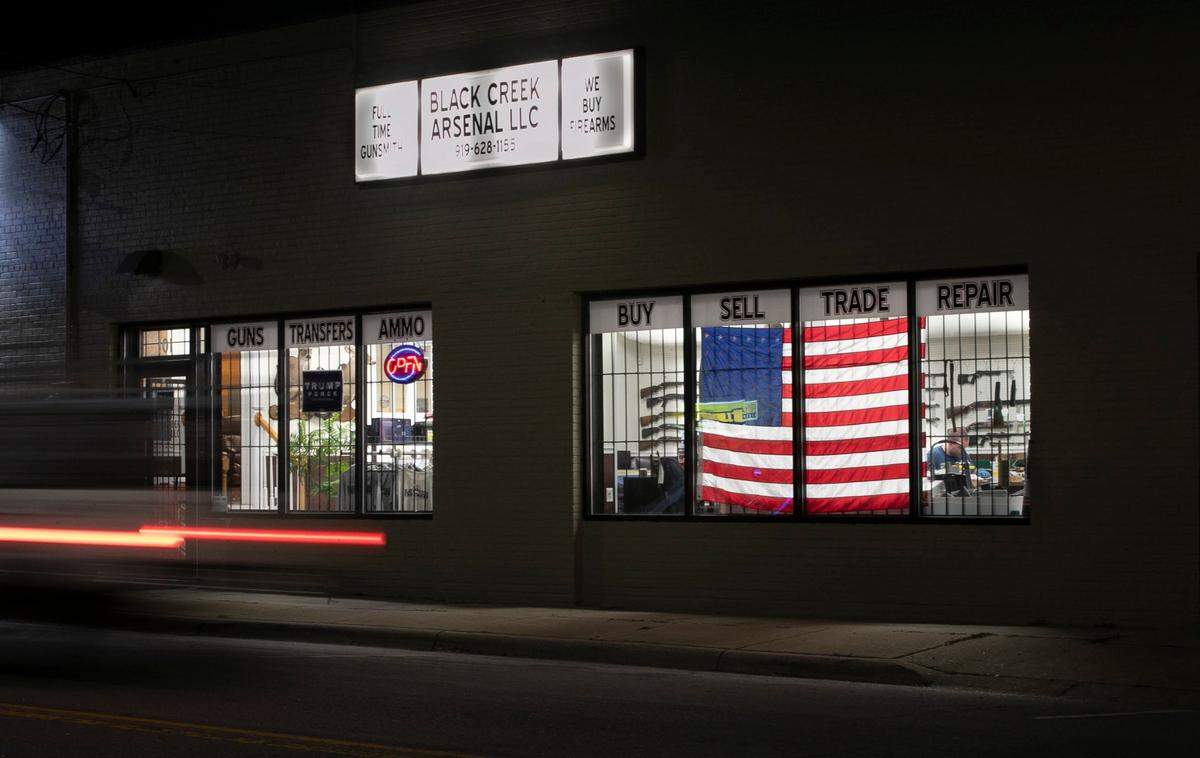
In the town of Four Oaks, toward the southern end of Johnston and not far from the interchange of I-95 and I-40, a sign on a marquee near the small downtown still reminded people to vote on Thursday night. Across the street, the lights of a gun shop illuminated the sidewalk outside, and in the windows a large American flag hung next to a Trump/Pence campaign poster.
In a neighborhood a few blocks away, a Four Oaks resident had erected in his front yard something of a shrine to Trump. In one part of his yard, Danny Elkins had staked down a large inflatable Stay Puft Marshmallow Man — the monster from Ghostbusters — and outfitted him with a 10-foot banner as a belt that said “TRUMP and KEEP AMERICA GREAT.”
On the other side of his driveway, Elkins had placed cardboard cutouts of Trump and the First Lady surrounded by campaign signage, illuminated by spotlights. It looked like a presidential nativity scene. Elkins built a wooden frame to stabilize the display, and he’d wrapped the wood in glossy gold paper as an homage. The final touch were the umbrellas over the cardboard cutouts.
“I thought well, you know what, you can’t have the president and the first lady out in the weather without having an umbrella over top of them,” Elkins said.
He’d been following the election count on a television inside, and Elkins, 48, said he was “a little anxious” about it. He’d admired Trump for decades and believed in his business prowess. When Trump began campaigning in 2015, Elkins began attending the rallies. He lived in Raleigh then, and placed a small Trump sign in his yard. When someone ripped it up, Elkins replaced it with a bigger one.
Elkins’ support of Trump has come with a cost, one he’s been willing to pay. He said family members stopped talking to him. He said seven or eight friends, some he’d known for more than a decade, did the same. One of them called Elkins, who is white, a racist.
“Which, I have never been racist my entire life, OK?” Elkins said.
In Johnston, no one gave him trouble for supporting Trump. In fact, he said he’d made lots of “Trump friends.” No one ever damaged what he’d built on his lawn. And when Elkins projected Trump’s rallies on an inflatable big screen outside, neighbors came to watch.
“You’d be surprised, the people that were walking up and down the streets that would stop and sit there and watch the rallies,” he said.
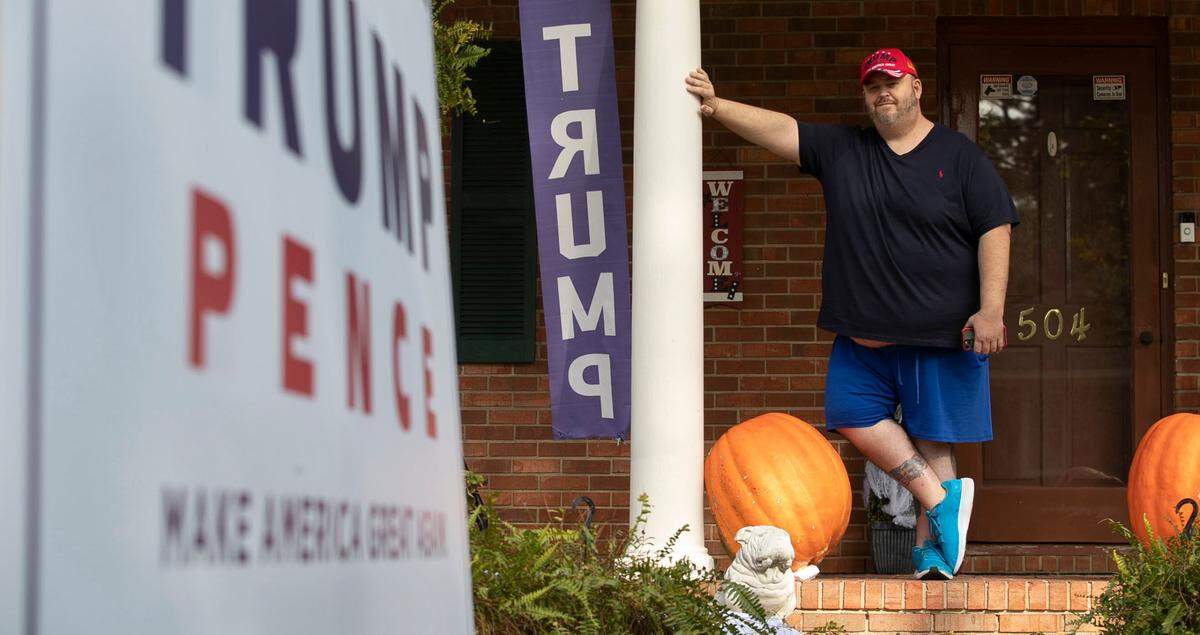
If Johnston County was shifting ever so slightly left, whether because people were moving here from Wake County or another reason, Elkins said he hadn’t sensed any change. And for those who were coming from Raleigh, he imagined some of them might be in store for “a rude awakening.” Elkins was speaking from his porch, where he’d covered his columns in Trump-themed banners.
A few blocks away a water tower rose above the trees, marking Four Oaks.
“If it happens,” Elkins said of the thought of Johnston becoming more liberal, “... it’s going to be a mighty long time.” He walked back inside, followed the voting count and hoped for what he’d consider to be good news.
In Durham, hope for change
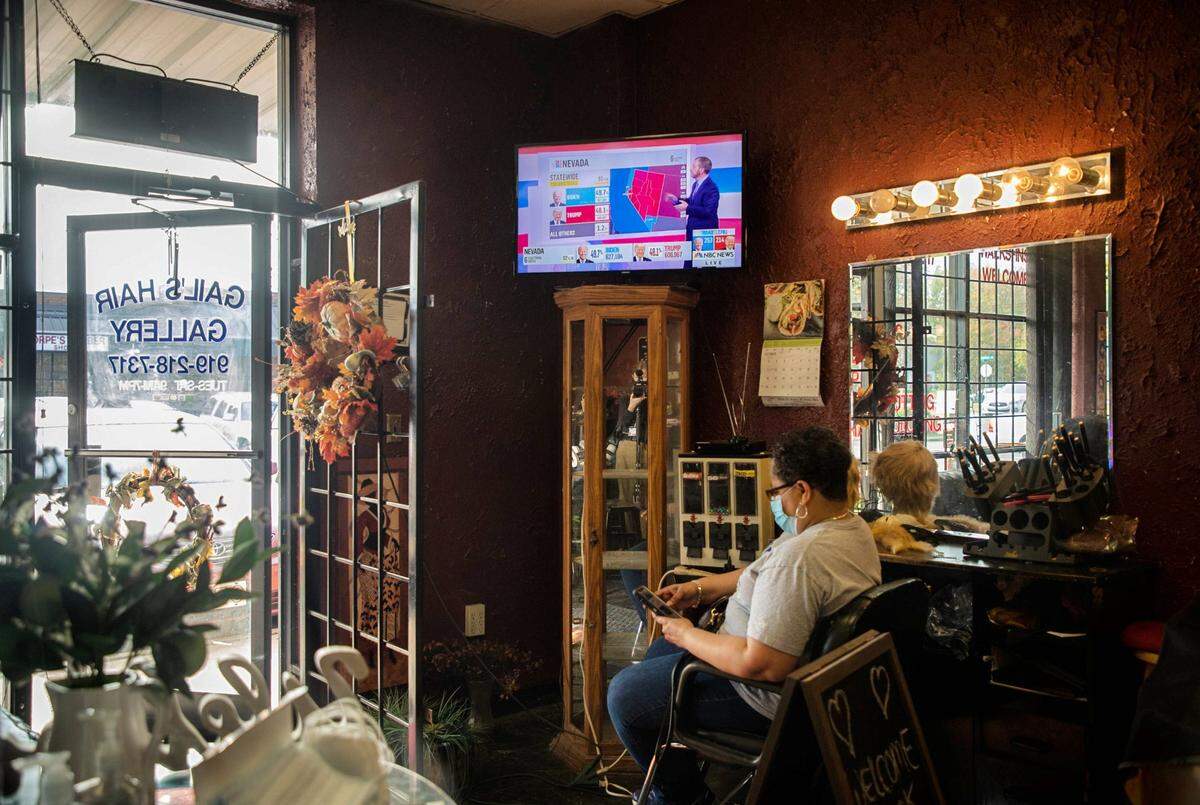
Gail Clay was following the election on television, too, and she’d turned it up loud — loud enough to hear while she washed a customer’s hair toward the back of her salon, and loud enough that the sound of punditry filtered into the parking lot outside. It was around noon on Friday, three days after the election, and on her way to work Clay received a text from her son.
He’d let her know that Biden had taken the lead in Pennsylvania; that it looked like he was on track to win Georgia, too. When she saw the news, Clay, the owner of Gail’s Hair Gallery, just south of downtown Durham, hurried into her salon and flipped on NBC.
“I was excited about getting here, cutting on the TV, where I can see and hear for myself,” she said, sounding happy. “Because Pennsylvania and Georgia have did a turn, where they were red and now they’re blue.”
Durham County has long been among North Carolina’s strongest Democratic counties, if not the strongest. In 2016, it was one of two counties in the state, along with Orange, where Clinton received more than 70% of the vote. This year, Biden received 80.56% of the vote in Durham County, which, by percentage, gave Biden his greatest margin of victory in the state.
Durham’s most politically minded citizens don’t have to work too hard to garner more Democratic support there, but they do have to work to get people to the polls. For a long time, Clay, who is Black, has tried to do her part to help her clients and neighbors register to vote. For the past 10 years, she worked the election at various polling places in town.
The turnout in Durham was strong this year, as Clay knew it would be, but she lamented why it wasn’t like that more often.
“We’ve needed those votes every year,” she said while she rolled a set of curlers into a customer’s gray hair. The customer, Mary Holt, is 88, and she and Clay spent most of their appointment talking about the election and Trump and wondering how it had all come to this, anyway: waiting out a close count, hoping once again for change.
Trump and his supporters had spent the past four years talking about making America great again, but neither Clay nor Holt saw any signs that such a thing had happened. In their minds, America had spent four years regressing.
“I truly believe that we all want a change,” Clay said, still working those curlers into Holt’s hair. “If you’ve been living here, you know it’s been better. This is the worst I’ve seen (the country) in my 50 years, and I’ve seen quite a few presidents.”
She’d owned her own salon for 18 years, she said, and she’d opened this one in something of a modern-day version of Durham’s Black Wall Street. The original, in the early 1900s, was downtown. This one, off of Fayetteville Street and not far from the campus of N.C. Central University, still made Clay feel as though she was honoring her roots.
Like a lot of stylists, she was also part therapist to her customers.
“I have clients that tell me how they can’t afford this and that,” she said. “The medicine goes up; they’ve been paying it comfortably, now it’s outrageous and expensive.”
Holt waited to speak her mind. When she did her voice came out loud and impassioned.
“I look at the everyday people, whoever they are,” she said. “They are suffering. We need insurance. We need food. These are people right here in North Carolina — you have these Republicans holding the big seats. They don’t care about the little people.
“Senior citizens can’t get Medicare, Medicaid. That’s not right. They work all their life so they can have something in their old age. ... Food stamps, no insurance. You’ve got this man, what’s his name? Tillis? That’s a disgrace, to send him back to Washington.”
If Trump’s messaging energized and connected with people in more rural parts of the state, it had the opposite effect throughout Durham and its namesake county.
In the Durham voting precinct that includes N.C. Central, which in the 1920s became the nation’s first state-supported liberal arts school for Black students, Trump received but one vote on Election Day. He received 10 or fewer votes at three other Durham precincts. Yet in the more rural parts of Durham County, outside of the city, Trump became more popular.
The women inside the salon couldn’t understand how anyone could support Trump — not in Durham and not in rural North Carolina.
“The president of the United States — Lord, it’s time for him to go,” Holt said. “And once he’s out, it’s gonna be hard on Biden. But he have to work at it, to try to bring the country back together. Cause the working man suffers. And it’s not good out here. It’s not good at all.”
Holt had been looking forward to this election for a long time. She’d been hoping it would result in change and less division.
“I think it’s the young generation that’s going to change things,” she said of reuniting a divided country. “They want to do it right, and I believe some of that old stuff is going to die out.”
Two North Carolinas, drifting apart
Since election results began posting on Tuesday night, officials in the North Carolina Democratic Party have been thinking about the same question that emerged four years ago. Now it feels more urgent for them: How does the party reconnect with more rural parts of the state?
Inside that diner in Robeson County, people spoke of the party with resentment. Some of them did feel left behind, and that was part of it, but another part was that disinformation had worked to divide. More than one person accused Biden of suffering from dementia. Others talked conspiracy theories. One man referenced a liberal plot to discard ballots cast for Trump.
Asked where he’d heard that, James Newton, 60, said his brother told him.
“He’s from Alabama,” he said. “They’ve caught them down there throwing them in the river.”
In theory the solution sounds simple enough for the Democratic Party when it comes to repairing its relationship with people throughout small-town North Carolina: “They would really like the Democratic Party to pay attention to ... white rural America in a way that they don’t think that party is doing a decent job of these days,” said Treul, the UNC professor.
Greene, the political scientist from N.C. State, noted that another problem for Democrats is that the party’s brand, especially surrounding social causes, “is repellent to more culturally conservative Americans, largely rural, largely white.”
Wayne Goodwin, the chairman of the North Carolina Democratic Party, acknowledged that the party has a messaging problem among rural voters. In an interview on Friday he said “there clearly needs to be more done” to reach people outside of the state’s urban centers. That has become more challenging in recent years, he said, while division has increased.
Goodwin ran this year for North Carolina Commissioner of Insurance, and lost to Mike Causey, a Republican. In Richmond County, where Goodwin is from, he was the only Democratic candidate to win among those running for statewide office. He could remember a time, in the not so distant past, when political support was more fluid and less tribal, but in the age of Trump “there’s been a seismic shift” in small-town North Carolina, and everywhere else.
“For rural North Carolina, it seems no matter how much messaging we in the Democratic Party have done on those kitchen table issues, that the Republicans, particularly Donald Trump, have still won with items that are very divisive,” Goodwin said. “It seems to exacerbate the tensions between rural and urban.”
Across the two versions of North Carolina this week, people followed the election count with dread or anticipation, depending largely on where they were.
Inside a diner in Lumberton, some people shuddered, in a literal way, at the thought of a Biden presidency.
Inside a salon in Durham, women waited with hope.
All the while red and blue North Carolina, already deeply divided, appeared to be drifting even farther apart.
Staff writer David Raynor contributed to this report.
This story was originally published November 7, 2020 at 1:15 PM with the headline "Urban and rural NC were already divided. The 2020 election pushed them farther apart.."