
‘Our authentic selves.’ State workers, others get protection from hair discrimination
Many Black women have a “hair story.” A story about a time someone came into their personal space to touch their hair. Or talk about their hair. Or tell them they needed to change their hair or style it a certain way.
For Tia Hall of Durham, it was when she was working on Wall Street in the 1990s. In front of a bank CEO, she and the few other Black women who worked there were told that “natural hairstyles would limit our ability to progress in the organization.”
For Shemekka Ebony Coleman of Raleigh, it was in a notary public class just a few years ago.
“I’m out doing my civic duty and a white woman came into my personal space to touch a headwrap she saw because it looked silky,” Coleman said.
She said Black women should be able to wear their natural hair without feeling judged or uncomfortable.
Hall said her experience on Wall Street felt very isolating.
“I did not have a body of people to lean into to fight that level of discrimination,” she said.
Hall does now.
Coleman is a co-founder of the CROWN Campaign, a national effort to change rules and laws in workplaces and schools to include hair and hairstyle as part of discrimination protections.
Support and action has reached North Carolina, starting with cities and counties. Orange County is the latest to add hair to discrimination protections, after Durham, Carrboro, Greensboro and Mecklenburg County. It has also reached the state level, with hair added to racial discrimination protections in the state and a new bill that could broaden protections.
A senator’s ‘hair story’
Sen. Natalie Murdock, a Durham Democrat, is one of the co-sponsors of a CROWN Act bill filed in February in the Republican-controlled North Carolina General Assembly. All the bill’s main sponsors are African American women and Democrats. Senate Bill 165/House Bill 170 had its first reading this past week, as all bills do, and was referred to committee, where its future is uncertain.
Does Murdock have a hair story?
Indeed.
People have tried to touch her hair “more times than I can count.”
It’s inappropriate, she said, when someone treats Black women’s hair “as exotic or unique. It’s just our hair.”
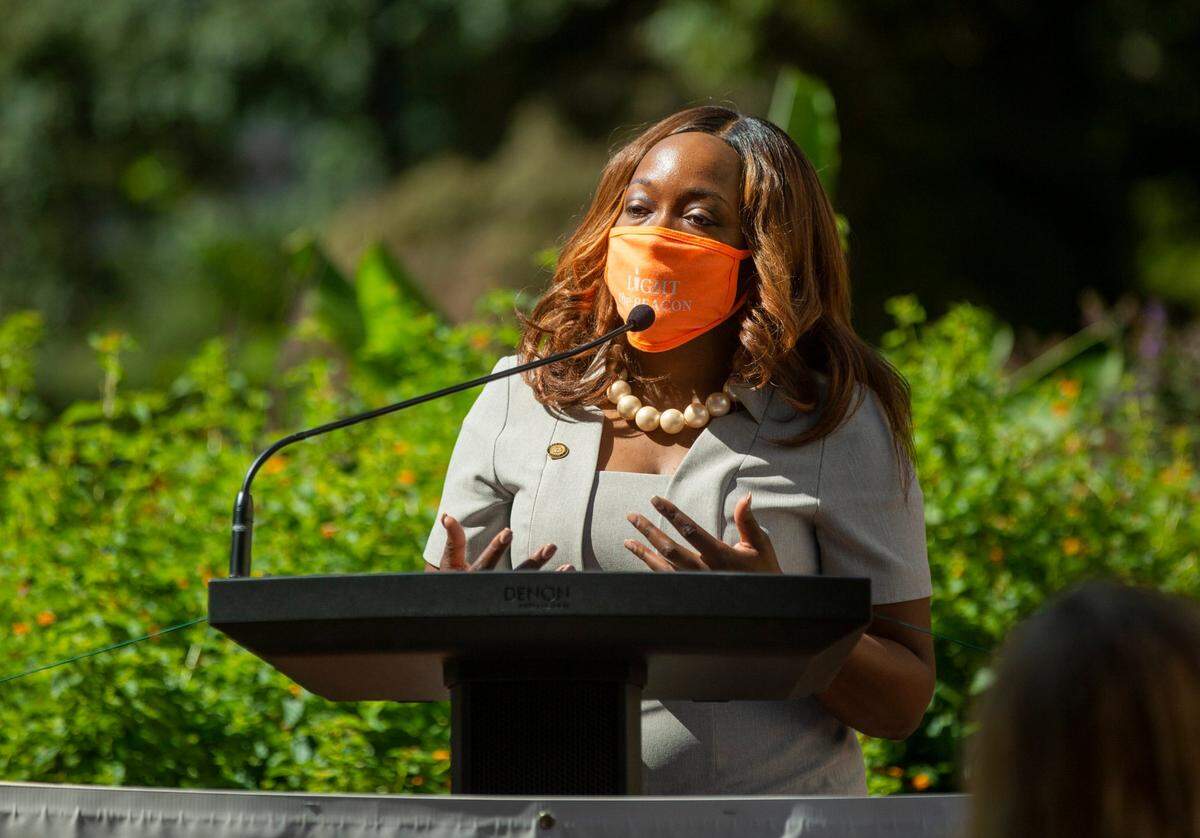
Support for the CROWN Act, which stands for Creating a Respectful and Open World for Natural Hair, is gaining traction at the local level in North Carolina. The city of Durham already passed a resolution, and other cities are, too. Republican-led legislation that banned cities from enacting local anti-discrimination ordinances expired in December 2020.
The CROWN Act itself is an initiative of the Dove company and CROWN Coalition “to ensure protection against discrimination based on race-based hairstyles by extending statutory protection to hair texture and protective styles such as braids, locs, twists, and knots in the workplace and public schools.”
In California’s state legislature, Senate Bill 188 became law in July 2019, stating that concerning discrimination, the definition of race included “traits historically associated with race, including, but not limited to, hair texture and protective hairstyles.”
Protections for state employees in NC
At the state level, North Carolina began the first day of Black History Month in February with a change in state agencies’ discrimination policy. The change was made by Gov. Roy Cooper’s administration following Murdock’s initial request and policy advisers agreeing it was in line with the administration’s goals.
Jill Warren Lucas of the N.C. Office of State Human Resources said adding the language about hair “was an affirmative step to emphasize protections available to employees under existing federal law, including the Civil Rights Act of 1964.”
She noted that the topic has been “gaining a great deal of momentum nationally” along with the recent action by local municipalities. The change impacts thousands of state employees at state agencies and the UNC system.
The state’s human resources office overhauled the Equal Employment Opportunity and Diversity Fundamentals training in 2020. State agency supervisors and managers are required to take the training within a year of being hired or promoted. If someone thinks they have been discriminated against at work, Lucas said OSHR recommends they discuss their concerns with their direct supervisor or manager, and if it is not resolved they can file a grievance.
The state’s human resources FAQ about race discrimination says that the discrimination prohibition does not apply to workplace requirements that are based on safety. There is a new question on the FAQ about discrimination based on hair texture or hairstyle. It says:
“North Carolina State Government affirmatively prohibits an employer from failing or refusing to hire or discharging any individual, or otherwise discriminating against an individual, based on the individual’s hair texture or hairstyle, if that hair texture or that hairstyle is commonly associated with a particular race or national origin.”
Aisha Powell works at East Carolina University. She said the CROWN Act is needed because the state’s human resources office doesn’t cover all North Carolina workers. She said it’s important that workers can refer back to policies in place and be able to show up to work “as natural as I want to be.”
Powell said it would be a “culture shift, showing that we are OK to show up as our authentic selves.”
Status of the bill
The North Carolina CROWN Act bill would bar discrimination in public and private workplaces. It states that: “No person, firm, corporation, unincorporated association, State agency, unit of local government, or any public or private entity shall deny or refuse employment to any person or discharge any person from employment because of traits historically associated with race or on account of the person’s hair texture or protective hairstyles.”
Murdock said that earlier in her career, she felt the need to wear her hair a certain way when she worked in a predominantly white environment in Western North Carolina. If you are the only Black woman in your department, you feel a need to fit in, she said. She said that in government, it is implied you are supposed to look a particular way.
But now, living in Durham and representing the Bull City in the state Senate, she is inspired by other Black women in politics who wear their hair as they please, like U.S. Rep. Ayanna Pressley of Massachusetts and Georgia politician Stacey Abrams.
Versions of the bill were filed in both the Senate and House.
One of the House sponsors is Rep. Kandie Smith, a Democrat and former mayor of Greenville.
“We’ve all heard the comments — can I touch your hair?” Smith said during a recent news conference with other CROWN Act supporters. It’s not OK, she said. Smith said that as elected officials, they are leading by example.
On Wednesday, Republican Senate leader Phil Berger told The News & Observer that he hadn’t seen the bill or heard much about it. He said he doesn’t think anyone should be hired or fired because of their hair unless there were safety reasons.
Smith, the state representative, said Wednesday that she was hopeful for the bill to move forward in the House after it was sent to the Judiciary committee.
Some bills are referred to legislative committees and never heard from again. Smith said she’ll continue to ask advocates to explain why the bill is important.
For more North Carolina government and politics news, listen to the Under the Dome politics podcast from The News & Observer and the NC Insider. You can find it on Spotify. Apple Podcasts. Stitcher. iHeartRadio. Amazon Music, Megaphone or wherever you get your podcasts.
This story was originally published March 5, 2021 at 12:36 PM with the headline "‘Our authentic selves.’ State workers, others get protection from hair discrimination."