
Donating to these NC campaigns? You’ll be giving again if you don’t uncheck this box
.jpg "This website raising money for U.S. Rep. Madison Cawthorn has a box checked for recurring contributions. Consumer advocates say this is a bad practice that could lead to donors unknowingly making additional donations.")
As U.S. Sen. Thom Tillis raised millions of dollars for his reelection effort last year, his campaign consultant said they made a concerted effort to avoid automatically signing up their donors for recurring contributions.
“It’s not a smart thing to do,” said Paul Shumaker, a veteran Republican campaign consultant in North Carolina.
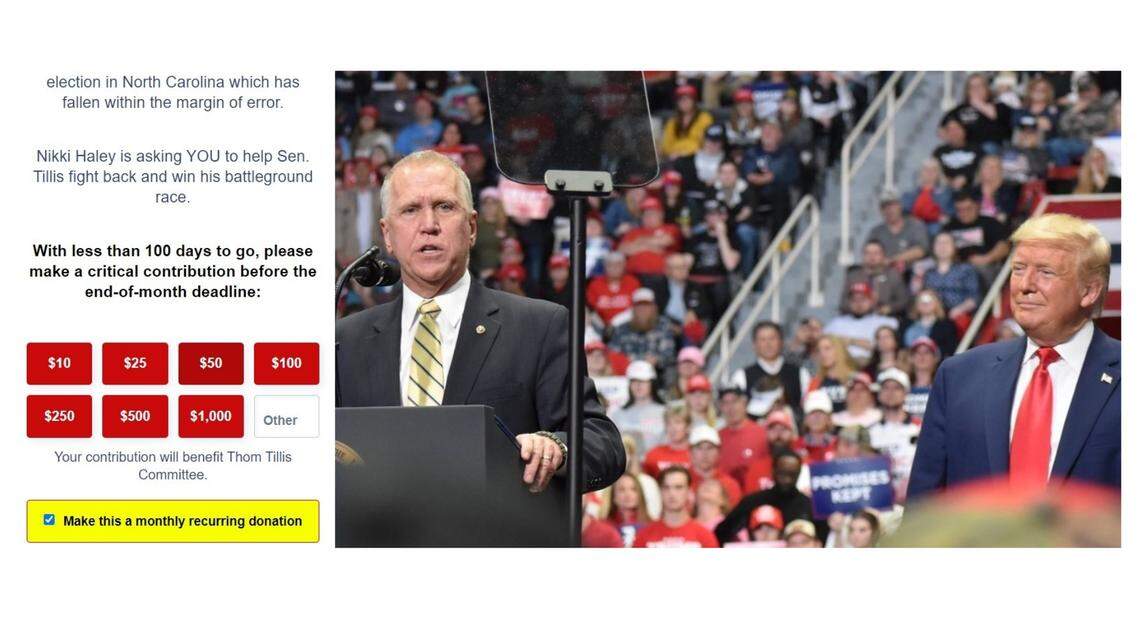
Still, two webpages seeking donations to support Tillis have an opt-in box checked to tap donors’ credit cards monthly for more contributions, unless they uncheck the box. One webpage was sponsored by former South Carolina Gov. Nikki Haley, the other by the Senate Leadership Fund, a super PAC aiming to keep that chamber in Republican hands.
Such websites remain up for Tillis and three other Republican members of North Carolina’s congressional delegation, even after the New York Times earlier this month reported on former President Donald Trump’s rampant use of the checked box, leading to a flurry of returned donations from people who said they had no idea they were on the hook to give repeatedly.
Freshman Rep. Madison Cawthorn, an Asheville Republican in the 11th district, is using two pages for his campaign with the boxes automatically checked for monthly recurring donations. One follows his push two weeks ago for turning Trump’s border wall into a national monument, which Cawthorn has dubbed the “Donument.”
Cawthorn’s communications director, Micah Bock, referred questions to campaign staff. He only provided an email address for contact. No one responded. He then suggested contacting WinRed, a for-profit company that processes donations for many Republicans.
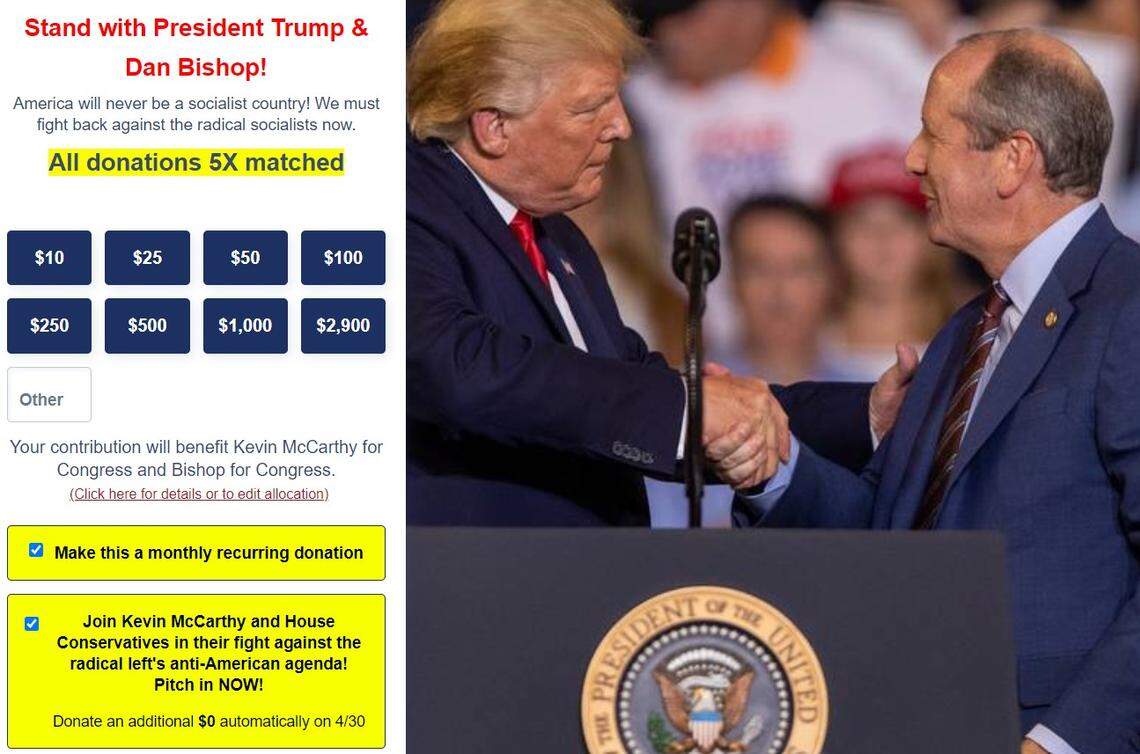
Rep. Richard Hudson, a Concord Republican in the 8th district, has a fundraising page with the opt-in box pre-checked for a monthly contribution. Rep. Dan Bishop, a Charlotte Republican, is raising money off of a webpage set up by House Minority Leader Kevin McCarthy’s campaign that has the box checked for monthly contributions, and a second pre-checked box that would draw another donation at the end of this month.
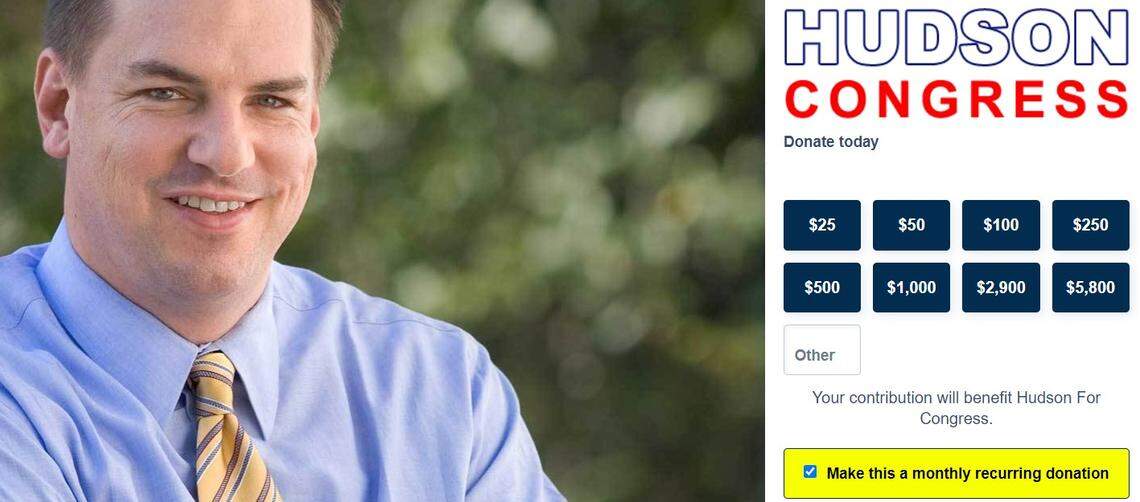
Hudson did not respond to requests for comment. Bishop said in an emailed statement that he had nothing to do with the fundraising page McCarthy’s campaign put up, and was unaware of any refund requests. The page said the contributions benefit Bishop and McCarthy. Bishop’s personal fundraising page leaves the opt-in box unchecked.
“The page you shared is not ours but from a committee associated with leadership fundraising,” said Bishop, who represents the 9th district. “We believe all donation mechanisms should furnish contributors’ clear information and flexibility and complete control over when and how much they contribute.”
Bishop did not respond when asked if he had the opportunity to review the fundraising page before it was posted, or if he would ask McCarthy to have it changed or taken down.
The New York Times reported how Trump’s reelection campaign ramped up the recurring donations to bring more money in. What started off as a box a donor had to uncheck to avoid making recurring donations every month morphed into additional check-off boxes for more donations.
The first change nabbed another donation on Trump’s birthday — June 14 — unless a donor removed the check from the box, the Times reported. Then, as Trump fell behind in fundraising to Joe Biden in September, two more boxes appeared. The first made the recurring donations weekly, while the second automatically drew another $100 on Sept. 29.
The Times found that Trump had to return a much higher percentage of donations than Biden, who won the election. The Times also found donors on limited incomes who unknowingly gave more than they realized, or could afford.
Consumer advocates say requiring people to opt out of recurring expenditures is a poor practice because they often don’t realize they are on the hook to pay more money. The better practice is to let donors check a box, or opt in.
Craig Holman, a lobbyist for Public Citizen, blamed the practice on WinRed, a for-profit company running many Republican websites, including Trump’s and those of Republicans in the North Carolina congressional delegation.
“It is both unethical and poor political practice to make donors feel ‘tricked’ or ‘scammed’ in their generous political donations,” he said in an email message. “This is unheard of in political circles prior to WinRed for the very reason that donors who feel duped once will not give again. It will alienate future donors to Republican candidates, but that is not of particular concern to the for-profit company seeking to make a buck today.”
WinRed officials did not respond to a News & Observer reporter’s email request for comment.
Thomas Germain, a journalist who covers technology and the internet for Consumer Reports, said he couldn’t speak to the specifics of the WinRed fundraising. But he said online systems have made making payments so much easier that consumers move through them too quickly without making sure they know what they are paying for.
“Consumer advocates argue that it should be perfectly clear to individuals when they are and aren’t signing up to make payments, or recurring payments in particular,” he said. “And the general position of people who focus on this issue is it behooves politicians or companies that are taking money from the public to make sure they are designing systems that aren’t pushing people to make choices that they aren’t aware of.”
Shumaker, who has been advising political clients since before the internet said he didn’t learn of the pre-checked boxes on sites fundraising for his client until The News & Observer pointed them out.
“We didn’t know they were doing it,” Shumaker said. “The amount of volume of dollars that are coming in off the digital world, it takes an extreme amount of good oversight by your compliance people. I can tell you what the compliance people hate the most are the refunds. The administrative side of it.”
But he didn’t think he’d be able to take the issue up with the leadership fund because that might be perceived as coordinating with a PAC which is supposed to be independent of candidates.
Democrats rely on ActBlue, a nonprofit, for fundraising. Their ActBlue websites require donors to check a box if they want to give recurring donations. All five of North Carolina’s congressional Democrats have their webpages set that way, as do the rest of the state’s Republican members of Congress.
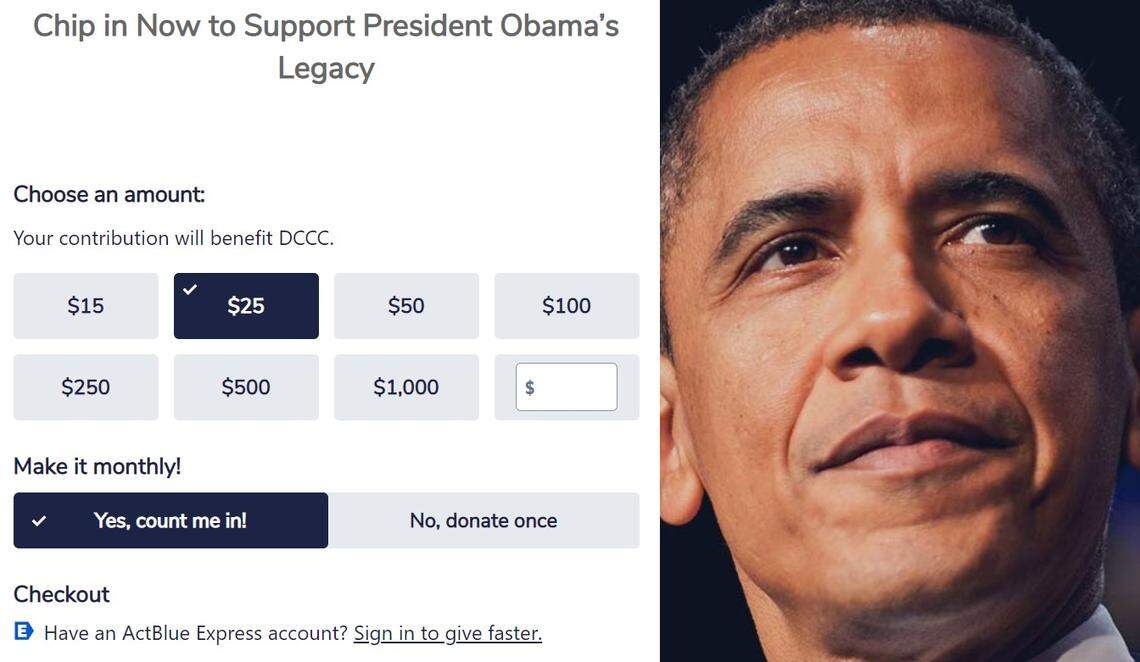
Not all of ActBlue’s fundraising pages are set this way. One for the Democratic Congressional Campaign Committee requires donors to uncheck the box.
Two other prominent North Carolina Democrats — Gov. Roy Cooper and Attorney General Josh Stein — have fundraising webpages that don’t have boxes checked for donors to opt in. In the race for the U.S. Senate seat opening up next year with Richard Burr’s retirement, none of the well-known candidates are using webpages with opting in as the default.
Shumaker said former Gov. Pat McCrory, a Charlotte Republican who announced his plans to run for the seat last week, was adamant about that.
“Gov. McCrory was saying yesterday, ‘God, absolutely make sure we don’t have those check boxes,’” Shumaker said.
This story was originally published April 20, 2021 at 5:30 AM with the headline "Donating to these NC campaigns? You’ll be giving again if you don’t uncheck this box."