
NC House passes budget with veto-proof majority. The Senate did, too.
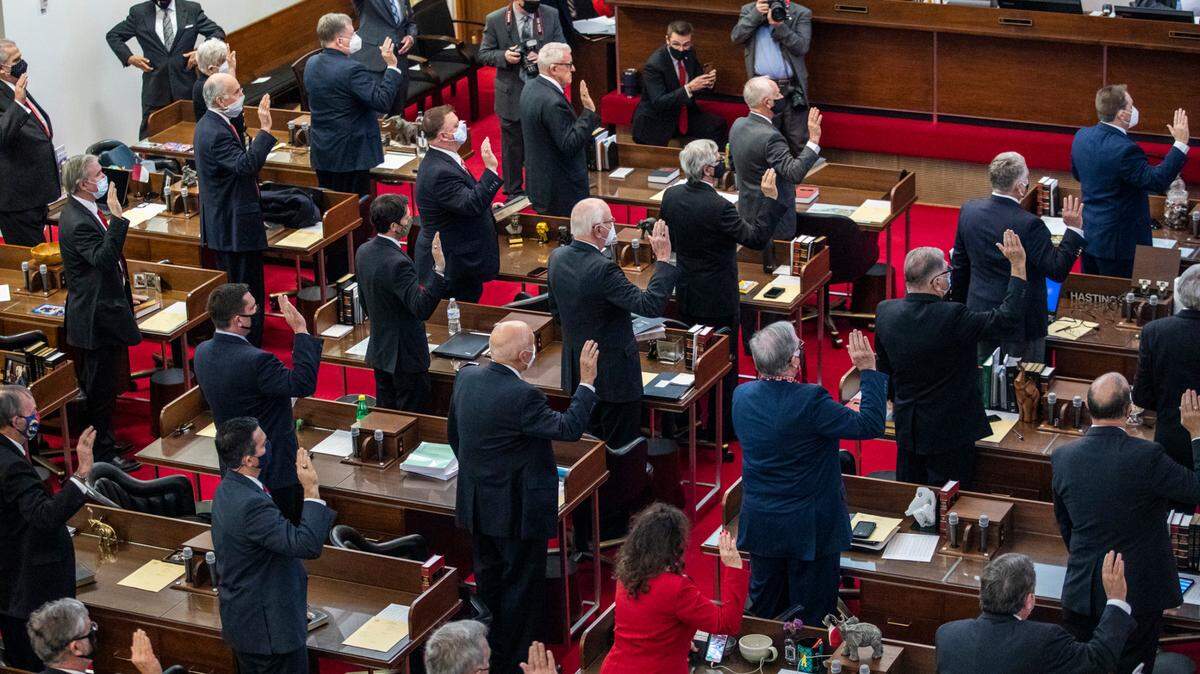
The North Carolina House passed its version of the state budget with a veto-proof majority on Thursday. So did the Senate’s version of the budget passed in June. The final House vote was 72-41.
That could mean the final version of the state budget that goes to the desk of Gov. Roy Cooper later this summer could — but not necessarily — also have a veto-proof majority. Cooper is a Democrat and both chambers of the General Assembly are Republican-controlled.
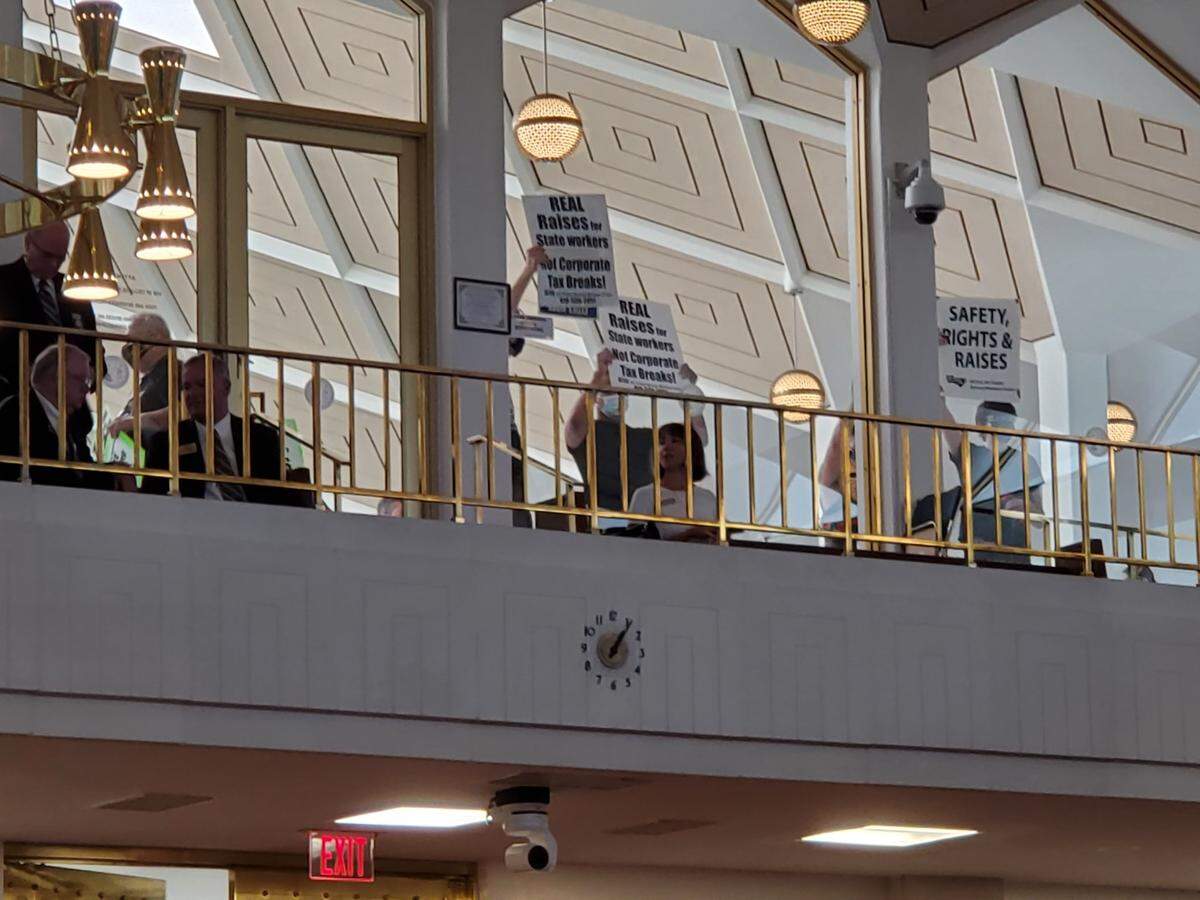
The third and final vote on its budget came Thursday afternoon after hours of debate that was briefly paused because of protesters shouting outside the gallery above the chamber.
House Speaker Tim Moore invoked a decorum rule and asked security to address the protesters. They held signs against the glass outside the third-floor gallery that said things like “Safety Rights & Raises” and “Real Raises for State Workers.”
The North Carolina Public Service Workers Union, UE Local 150, was one of the organizers of a rally and protest Thursday about the budget.
“The pandemic has led to an increase in mental illness,” Sekia Royall, president of UE150, said in a statement ahead of the protest. Royall, a state employee in the Department of Health and Human Services, said that state DHHS workers “care for some of the most vulnerable people in our society, yet the state budget priorities to do not recognize this. We are chronically underpaid” and that they deserved a real raise.
Surena Johnson joined the protest march from the Executive Mansion to the Legislative Building Thursday afternoon. Johnson was one of about a dozen protesters outside the gallery. She told The News & Observer that they had been monitoring what the General Assembly has been doing and they’re not happy with the people they elected. Protesters left after General Assembly Police and sergeants-at-arms spoke with them. Police carried zip-tie handcuffs. No one was arrested.
“There’s an excess of billions of dollars in the North Carolina budget, and what was written up is not going to take care of what we need as far as health care is concerned, affordable housing and livable pay raises,” Johnson said.
An imperfect budget passes
Rep. Donny Lambeth, one of the lead budget writers and a Winston-Salem Republican, said during the Thursday floor debate that the budget wasn’t perfect and there are even things in it that he doesn’t like. Still, he urged Democrats to vote for the budget along with Republicans.
House Majority Leader John Bell, a Wayne County Republican, said a perfect budget doesn’t exist. He praised the raises for teachers and other state employees in the budget, higher than previous years.
Democratic leader Robert Reives, of Chatham County, noted the thorough debate over two days and called it a “historic” budget by the nature of how much money they had to spend. He said there were some good things in it, and at this point, both chambers know lawmakers’ positions on the budget.
Reives said that lawmakers feel good about what they are supporting in this and other bills, but not necessarily every page of it. However he voted “no” on the budget, he said, because of some issues outweighing others.
The House passed the budget’s second reading vote on Wednesday with a 72-41 supermajority.
Earlier this summer, the Senate passed its budget — which was more austere in terms of raises -— with a veto-proof majority. The Senate budget included across the board raises of an average 3% for most state employees, including teachers.
The House budget reduces personal and corporate income tax rates. For raises, teachers would get an average of 5.5% raises and most other state employees would get 5% raises over the next two years. The House budget also gives eight weeks of paid parental leave to teachers who are new mothers, and raises the minimum wage of non-certified school personnel to $15 an hour.
The House budget spends $25.7 billion in taxpayer money over the next two years on tax cuts, teacher and other state employee raises, bonuses using federal funds, capital projects, infrastructure and broadband expansion.
Both chambers’ budgets spend federal American Rescue Plan Act funds on bonuses for government employees who worked during the coronavirus pandemic.
During debate Wednesday and Thursday, Democrats spoke against policy provisions in the budget that would limit the governor’s ability to issue executive orders and impact the office of the attorney general as well. Another provision in the budget would require teachers to post lesson plans online.
Democrats asked Republicans to address executive powers separate from the budget, but their amendment to remove it failed. The House budget would require Council of State concurrence on states of emergency and continuing orders than is already described in state law after a certain number of days. The Senate had a different version of emergency powers in its budget, so a new version could appear in the final budget. There’s also a separate bill about executive powers. North Carolina has been under a state of emergency first issued by Cooper in March 2020 for the coronavirus pandemic.
Earlier in the week, Bell told reporters that the House budget did not deal with emergency powers, and instead House leaders wanted to handle it within a separate bill. Bell told The N&O after the vote on Thursday that a subcommittee chair had inserted the provision, to his surprise. Regardless, the final compromise version of the budget may or not include a provision about the governor’s powers.
Senate and House budget plan
The Senate passed its budget in June 32-17, a veto-proof majority. While the chambers are majority Republican, a supermajority of three-fifths of lawmakers is required for veto overrides.
Next up is the Senate to take a procedural vote on the House budget likely Monday night, then both chambers move into the final negotiating process of a “conference” budget. Leaders have said that Cooper will be involved in those discussions, too, and that everyone wants the final legislation budget going to the governor’s desk to be one he signs into law.
Reives, who leads House Democrats, said during Thursday’s floor debate that he hopes to “sneak in at the kids’ table” and also be part of the final negotiations between Moore, Senate leader Phil Berger and Cooper.
The new fiscal year already started, on July 1. There could be a state budget by Labor Day.
This story was originally published August 12, 2021 at 3:43 PM with the headline "NC House passes budget with veto-proof majority. The Senate did, too.."
.jpg)