
Vaccines, masks, local control: How Cooper’s COVID strategy has changed with delta wave
Vaccine, vaccine, vaccine.
North Carolina Gov. Roy Cooper has doubled down and tripled down on his strategy for combating the delta wave of the coronavirus pandemic. There haven’t been any statewide restrictions for a month and a half. Those are local decisions now, as he focuses on one thing:
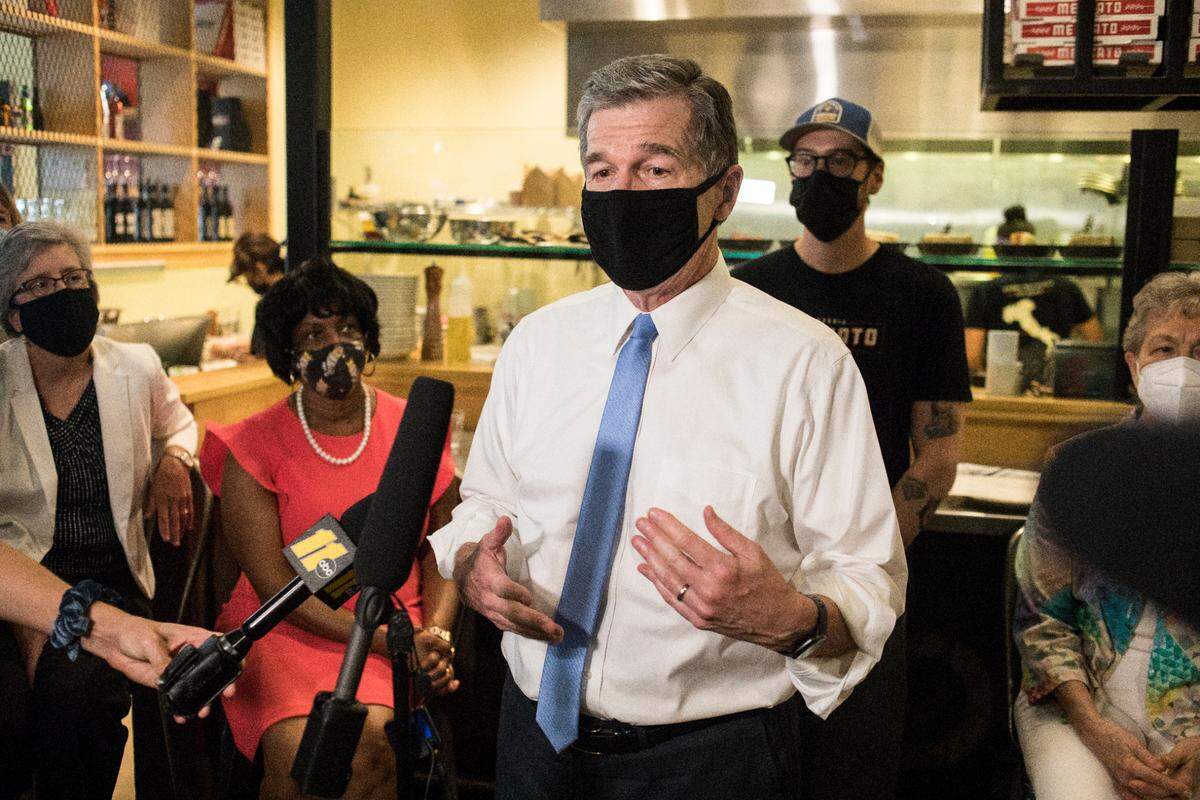
“Vaccination is the way to the other side,” Cooper said when he visited a restaurant in August that requires proof of vaccination for customers.
“The key to ending this pandemic, of course, is the vaccine,” Cooper said during a September COVID-19 press briefing.
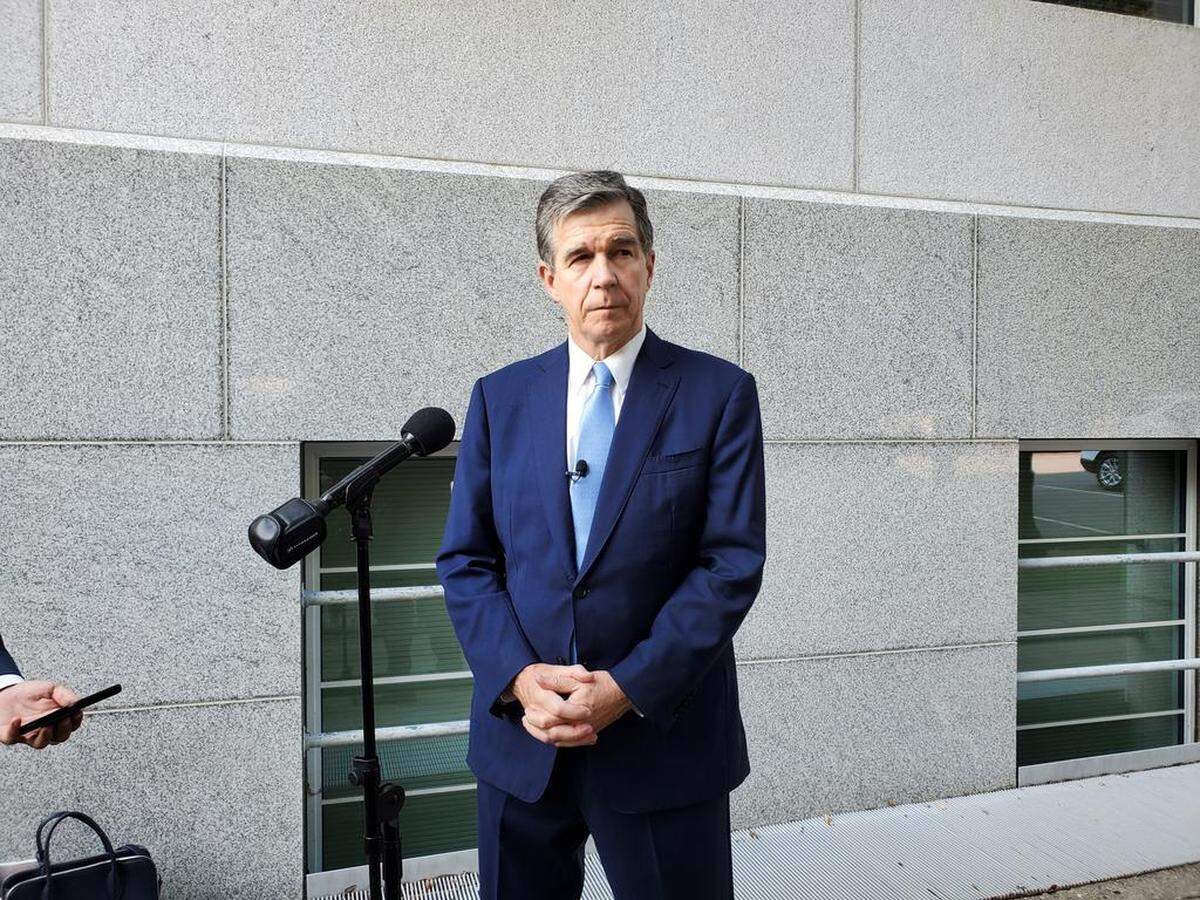
“We know that vaccinations are going to be the way out of this thing,” Cooper told reporters on Tuesday morning after a Council of State meeting.
“Every day that goes by showing this vaccination is safe and effective, more and more people are convinced. Every day that goes by [showing] that records are clear that most of the people in the hospital and the ICU are the unvaccinated people — that’s beginning to resonate with a lot of people,” he said.
Unlike President Joe Biden’s new rules for private employers, and unlike Cooper’s own orders earlier in the pandemic that restricted businesses and required masks statewide, the governor has now turned to local control — with the effect of moving the confrontations over policies away from the state’s seat of government in Raleigh.
Instead, the pressure has been on local school boards to require masks in schools, and a small but loud number of angry parents have been protesting local school board meetings, both in North Carolina and elsewhere. Local governments also make their own mandates around masks indoors — as Raleigh, Durham and Charlotte have — though encouraged by Cooper health officials.
The push by governors to get more people vaccinated has been mostly nonpartisan. The difference lies in rules vs. encouragement. Cooper’s gubernatorial colleague to the south, South Carolina Gov. Henry McMaster, a Republican, opposes vaccination and mask mandates, but still says vaccinations are the way out of the pandemic.
‘Leveling’ of cases
Cooper, a Democrat, was asked a question about the economy and his answer turned to — what else? — vaccinations. The economy in North Carolina, which is already good, will get better once the delta variant is pushed down, he said.
“You do that through vaccinations, and I’m going to keep talking about it because that’s the way out of this thing,” he said.
Everyone is frustrated with the persistence of the delta variant, including the governor, he says. But that elusive corner to be turned in the pandemic might be getting closer.
“What I’m encouraged about, as I’ve been talking to the health officials every day, is things seem to be leveling over the last few weeks, particularly with hospitalizations and ICU stays. Those are the two things that we watch,” he said Tuesday.
“So what we’re doing is being so focused on getting people vaccinated.”
The 55,000 state employees under Cooper’s jurisdiction are required to show proof of vaccination or be tested weekly. The state employees rules started this month, and vaccination rate data is due this week.
The White House announced vaccine mandates — that is, to require a policy of vaccination verification or regular testing — for employers of more than 100 people.
His strategy also includes a COVID-19 vaccine mandate for all federal employees and “millions of contractors that do business with the federal government” and for millions of health care workers.
Local vs. state
Aside from vaccinations, Cooper and N.C. Department of Health and Human Services Secretary Dr. Mandy Cohen continue to encourage masks, but not require them at the state level aside from in some government buildings.
At the urging of Cooper and Cohen, nearly all school districts require masks. Those that didn’t mostly changed course after spikes in cases. The COVID-19 vaccine is only available to people age 12 and older, so that leaves elementary students vulnerable to the virus.
“I think it’s politically smart,” said Chris Cooper, who leads the Department of Political Science and Public Affairs at Western Carolina University in Cullowhee.
“I think it’s a textbook Roy Cooper move, to kind of read the changing environment. He has read the shift in public opinion and read the shift in local government opinion and taken some of the pressure off of him,” the professor said.
Senate leader Phil Berger, an Eden Republican, has been choosy in what he supports and opposes in Cooper’s response. He opposed the governor’s 2020 restrictions on businesses, but has been generally supportive of other decisions including the vaccinations push. Berger recorded a public service announcement encouraging vaccinations and is vaccinated.
“You know it strikes me that the public has largely been supportive of the measures that have been taking place,” Berger told The News & Observer this past week. “I think the governor has looked at things — I haven’t talked to him about this, so this is just my surmise — and determined that the locals are in a better position to make decisions.
“It’s a big state, things may be a little different in different places,” Berger said.
On the day the Republican-majority Senate passed an emergency powers bill, Berger said that other than wanting to pass that bill — which requires concurrence from the rest of the Council of State on states of emergency longer than a week — he didn’t have “a particular problem” with Cooper’s current response.
House Bill 254, which would limit the governor’s powers in emergencies, passed the Senate and is on the House calendar for a final vote on Wednesday.
Cooper’s policy shift started in late July, when he let the last executive order with statewide mask requirements expire.
His public events shifted, too, as they had started to do at the beginning of the summer when vaccinations were widespread and the delta variant hadn’t spiked yet. Instead of just televised COVID-19 updates, nearly every week his public events took place at sites where he could watch people get vaccinated.
Cohen, who is the state’s top public health official and part of Cooper’s Cabinet, told reporters a few days ago that vaccinations and wearing masks indoors were the best way to combat risks in public. Asked if there should be rules about masks at places like college football stadiums where people are crowding together outside, Cohen again emphasized the first line of defense: vaccine.
In August, the governor visited a Carrboro restaurant where everyone was required to be vaccinated to enter.
Chapel Hill Mayor Pam Hemminger was there. She said Cooper’s approach letting local governments instill requirements wasn’t hard to do in her town.
Chapel Hill has a “community that trusts science,” she said, referencing it being home to UNC and UNC Health.
“They believe in being proactive and they wanted to be safe, so it was a little easier to get compliance in this community,” Hemminger said. Orange County has the highest vaccination rate in the Triangle.
School mask mandates
Some local decisions are less controversial than others.
Leanne Winner is executive director of the North Carolina School Boards Association.
“In the beginning it was very welcomed, there were a number of boards asking for that kind of authority,” she said in an interview about the governor’s policy shift from state to local decision-making on masks in schools.
Winner said that school boards wanted the flexibility to make their own determinations at the local level, and some relaxed rules even sooner than Cooper did.
“We are hearing some frustration now. I think there is a great deal of concern over the notion that they’re going to have to vote on this every month. I think you’re starting to see that play out,” she said. Winner mentioned the smashed window at an Iredell-Statesville Schools meeting, canceled board meetings in Moore County and a Johnston County protest this week.
“I think having to address this again every month for the rest of the school year is just going to exacerbate the situation,” Winner said. The governor signed into law a wide-ranging coronavirus schools bill that included the monthly vote requirement.
Chris Cooper, the Western Carolina professor, said that for the governor, letting there be local control is a win-win because he gets what he wants — masks in schools — without taking the political heat for it.
“He’s a careful politician. ... This plays right into the strategy. He’s moving before he needs to, and he’s reading the tea leaves well. It would be fascinating to see what he’d do if over 90 counties weren’t in agreement with him,” Cooper said.
For more North Carolina government and politics news, listen to the Under the Dome politics podcast from The News & Observer and the NC Insider. You can find it at link.chtbl.com/underthedomenc or wherever you get your podcasts.
This story was originally published September 15, 2021 at 12:31 PM with the headline "Vaccines, masks, local control: How Cooper’s COVID strategy has changed with delta wave."
.jpg)