Competitive elections for Congress in the Triangle? It could happen under GOP map
The North Carolina Senate’s redistricting committee passed a new congressional map along party lines Monday, setting the stage for it to pass the full legislature and become law as soon as this week. Unless the map is struck down in court, the districts lawmakers approve now will be used in every election for the next decade.
The Republican-drawn map would likely lead to Republican candidates winning 10 of North Carolina’s 14 seats in the U.S. House of Representatives if Democrats and Republicans split the statewide vote roughly 50-50 like they have in recent elections — according to at least one analysis of voting patterns in North Carolina.
That analysis of 2016 and 2020 election data compiled by Dave’s Redistricting App, a widely used redistricting website, showed that the map would likely have eight safe Republican seats, three safe Democratic seats and three competitive seats.
That means if Republicans have a strong year in the future, they could expect to win an 11-3 majority in the House delegation — and if Democrats have a strong year, Republicans would still expect to have an 8-6 majority.
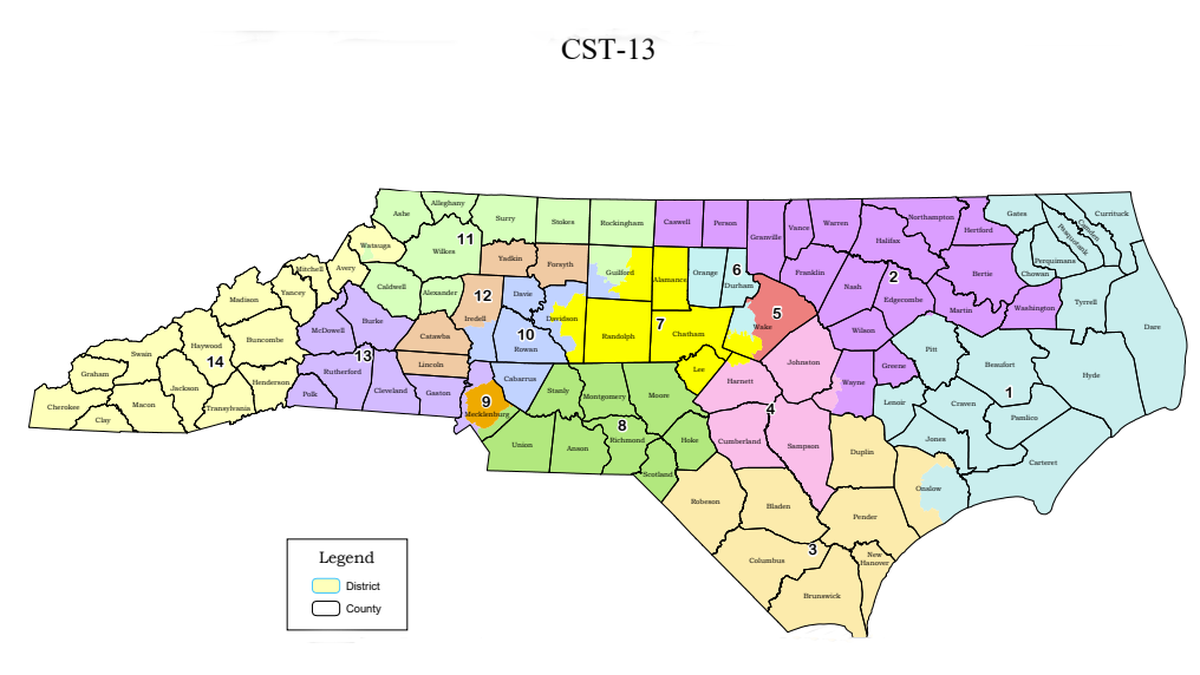
What it means for the Triangle
Of the three districts that would be competitive, according to the analysis, two are on the edges of and just outside the Triangle.
One would lean Republican (District 4) and one would lean Democratic (District 2). But either party could expect to be within five or six percentage points of winning either seat, according to the analysis.
The left-leaning district is currently represented by a Democratic incumbent, in Rep. G.K. Butterfield, but the right-leaning seat has no incumbent, meaning its primary elections in March could see hotly contested races from both parties as aspiring politicians eye a rare opening in Congress.
Another March primary to watch will be in the Durham-centric district currently represented by Democratic Rep. David Price.
The map keeps that district confined to all of Durham and Orange counties plus part of Wake County. Whatever Democrat runs in that district will almost certainly coast to victory, and Price just announced he’s not seeking reelection after three decades in Congress.
So the Democratic primary to replace him could draw plenty of candidates — and some have already announced, The News & Observer reported.
Finally, the southwestern part of Wake County is included in a safely Republican district that mostly covers rural areas closer to the Triad. It has no incumbent, so the GOP primary for that race could be an important race for Triangle residents to watch as well.
District 5
Raleigh and the rest of northern and eastern Wake County would be in this safe Democratic seat, which is currently represented by Democratic Rep. Deborah Ross.
Whether Ross or a different Democrat comes out ahead in the party’s primary this March, that person is almost certain to win the general election in the fall. It’s drawn to likely give the Democratic candidate a massive 27-point advantage.
But the fast-growing western Wake County suburbs would be split off from the rest of the county — and from each other.
District 6
Cary, Morrisville and Apex would be included in a district with all of Durham and Orange counties.
It would be a heavily Democratic seat, and could have a highly competitive Democratic primary this March, to pick who will replace Price. It would be expected to vote Democratic by roughly a 72-26 margin, according to the analysis.
District 7
Holly Springs and Fuquay-Varina would be split off into a third, safely Republican seat that’s mostly made up of agricultural areas in the central part of the state.
The district would stretch from the area near Wake Technical Community College’s main campus south of Raleigh, 100 miles west to Lexington, south of Winston-Salem. It would pick up more rural areas like Lee, Chatham, Alamance and Randolph counties along the way, plus some of the suburbs outside Greensboro.
That district could have a highly competitive GOP primary this March. There’s no incumbent in the district, and the incumbent who represents much of the area currently, Republican Rep. Ted Budd, isn’t seeking reelection since he’s running for U.S. Senate instead. Whoever wins the GOP primary will be a heavy favorite to win the general election, since that district is drawn to give the Republican candidate a 15-point advantage, roughly 57-42 according to the analysis.
District 4
To the south of Raleigh, the right-leaning district would create an intriguing opportunity for both political parties. The incumbent-free district covers all of Johnston, Cumberland and Sampson counties plus most of Harnett County and a sliver of Wayne County.
District 2
To the north and east of the Triangle would be the left-leaning but competitive District 2, currently represented by Butterfield. It would include every county that borders Orange, Durham and Wake counties to the north, and would stretch east through Rocky Mount, Wilson, Goldsboro and some more rural northeastern areas.
State leaders have previously drawn two minority-majority districts in North Carolina in an attempt to protect Black voting power, including this district.
But this year GOP lawmakers declined to use racial data when drawing the maps, and outside data shows Butterfield’s district would shift from majority-minority to majority-white under the proposed new lines.
The state NAACP has already sued over the decision not to consider where Black voters live in the new districts, asking a court to step in and stop the redistricting process now even before lawmakers pass a map.
“After drawing one unconstitutional redistricting plan after another in the last decade, the North Carolina General Assembly is acting now in an unlawful and unconstitutional manner by brazenly ignoring clear direction from the North Carolina Supreme Court on how to draw constitutional maps,” the lawsuit claims. “The (legislature’s) violations of the North Carolina Constitution necessitate court intervention now.”
For more North Carolina government and politics news, listen to the Under the Dome politics podcast from The News & Observer and the NC Insider. You can find it at link.chtbl.com/underthedomenc or wherever you get your podcasts.
This story was originally published November 1, 2021 at 4:58 PM with the headline "Competitive elections for Congress in the Triangle? It could happen under GOP map."