Control of NC Supreme Court hangs in the balance for 2022. See who’s running.
The North Carolina Supreme Court could swing from Democratic to Republican control in the 2022 elections — and the stakes are high, given some of the major political fights the court is expected to deal with in the near future.
Candidate filing for those upcoming elections began this week, and it provided a timely example of the political significance of the state Supreme Court: The justices delayed the March 8 election to May 17 due to an ongoing lawsuit that claims the maps Republican lawmakers recently passed for those races are unconstitutional gerrymanders.
The Supreme Court has a 4-3 Democratic majority. Two of its seven seats are up for election next year, both of which are held by Democrats. So if Republicans flip just one, they will have a 4-3 majority on the Supreme Court. If they flip both their majority will grow to 5-2.
In 2020, Republicans swept every judicial seat on the ballot for both the Supreme Court and the Court of Appeals. All came down to a narrow margin — particularly the race for chief justice, in which Paul Newby defeated incumbent Cheri Beasley by just 400 votes out of more than 5 million ballots cast.
The GOP is hoping to build on that momentum and take the Supreme Court majority next year, while Democrats are hoping to reverse course and prevent Republicans from flipping either of the seats up in 2022.
Big issues at stake in NC
Political cases are only a small percentage of what the Supreme Court deals with, in between their cases on everything from child custody to civil rights, contract disputes, death penalty appeals and class action claims. But given the high stakes and the fact that the judges are themselves politicians, the political cases tend to be among the court’s most high-profile work.
Some of the political cases that are either before the court now, or could be soon, include:
▪ Elections-related lawsuits over redistricting and voter ID.
▪ Whether actions taken by the legislature in recent years are even legitimate, since many of its members were elected in districts found to have been unconstitutionally gerrymandered.
▪ Voting rights for people with felony convictions.
▪ School funding, and whether the legislature can be forced to spend more money than its leaders want.
Judges are elected to eight-year terms, with only a small number of seats up for grabs in each election so that any changes are staggered instead of happening all at once.
Robin Hudson’s seat
One of the seats up in 2022 is held by Robin Hudson, a Democrat who has already announced she won’t seek reelection. Hudson is 70, and the state’s mandatory retirement age for judges is 72. So even if she won she’d only be able to serve a little over a year of her eight-year term.
“I would much prefer to spend my time devoted to the work of the court, without the distraction that a re-election effort requires,” Hudson said in a recent press release. She has been a judge for 20 years — first on the Court of Appeals and, since 2007, on the Supreme Court.
Lucy Inman, a Democrat, and Richard Dietz, a Republican, have filed to run to replace Hudson. Both are currently on the Court of Appeals — Inman since 2015 and Dietz since 2014.
Dietz graduated from Wake Forest Law in 2002, after which he clerked for two federal judges and then worked in the appellate practice of an international law firm, including arguing one case before the U.S. Supreme Court. He became a judge himself in 2014 when Republican Gov. Pat McCrory appointed him to fill an empty seat on the Court of Appeals. He then won election to the court in 2016.
Inman graduated from UNC School of Law in 1990 and clerked for former Supreme Court Chief Justice James Exum. She then worked as a civil litigator for firms in California and North Carolina. In 2010 she was named a special superior court judge by Democratic Gov. Bev Perdue, then won election to the Court of Appeals in 2014. She ran for a Supreme Court seat last year but narrowly lost, falling to Republican candidate Phil Berger Jr. by a margin of 50.7% to 49.3% of the vote.
Sam Ervin’s seat
The other seat up in 2022 is held by Sam Ervin IV — the grandson of the late Sen. Sam Ervin Jr. who was a key figure in the Watergate investigation that ultimately brought down President Richard Nixon.
Ervin filed for reelection Monday. He graduated from Harvard Law School in 1981, then worked in private practice in Morganton in the 1980s and ‘90s. In the early 2000s he served on the North Carolina Utilities Commission, as a nominee of Democratic governors Jim Hunt and Mike Easley. He was first elected to the Court of Appeals in 2008 and then to the Supreme Court in 2014.
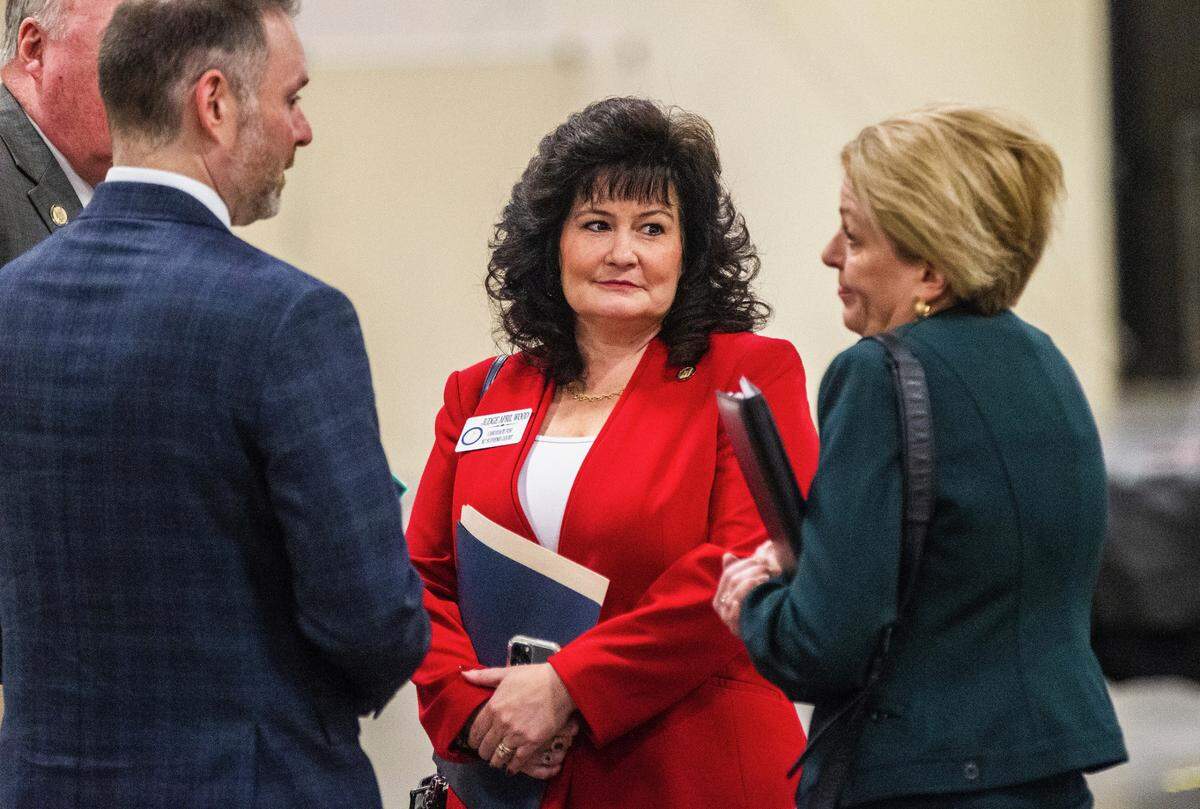
Two Republicans filed to run against him Monday — April Wood and Trey Allen — setting up a GOP primary in that race.
Allen, the only candidate so far with no experience as a judge, graduated from UNC School of Law in 2000, then joined the Marines as a JAG officer. He was honorably discharged after several years and went to work clerking for Newby, then an associate justice. Allen then went into private practice, largely focused on education law, and became a UNC Law professor in 2013. After Newby was elected as chief justice in 2020 he hired Allen for a top job in the state’s courts system, as general counsel.
Wood graduated from Regent University School of Law in 1997 and has been on the Court of Appeals since earlier this year. Although she’s new to the appellate courts, she has had a career as a trial judge. She served as a district court judge from 2003 until 2020, most recently in Davie and Davidson counties outside of Winston-Salem.
For more North Carolina government and politics news, listen to the Under the Dome politics podcast from The News & Observer and the NC Insider. You can find it at link.chtbl.com/underthedomenc or wherever you get your podcasts.
This story was originally published December 8, 2021 at 9:00 AM with the headline "Control of NC Supreme Court hangs in the balance for 2022. See who’s running.."