
Will new maps give Mecklenburg real races? Yes. Well, maybe.
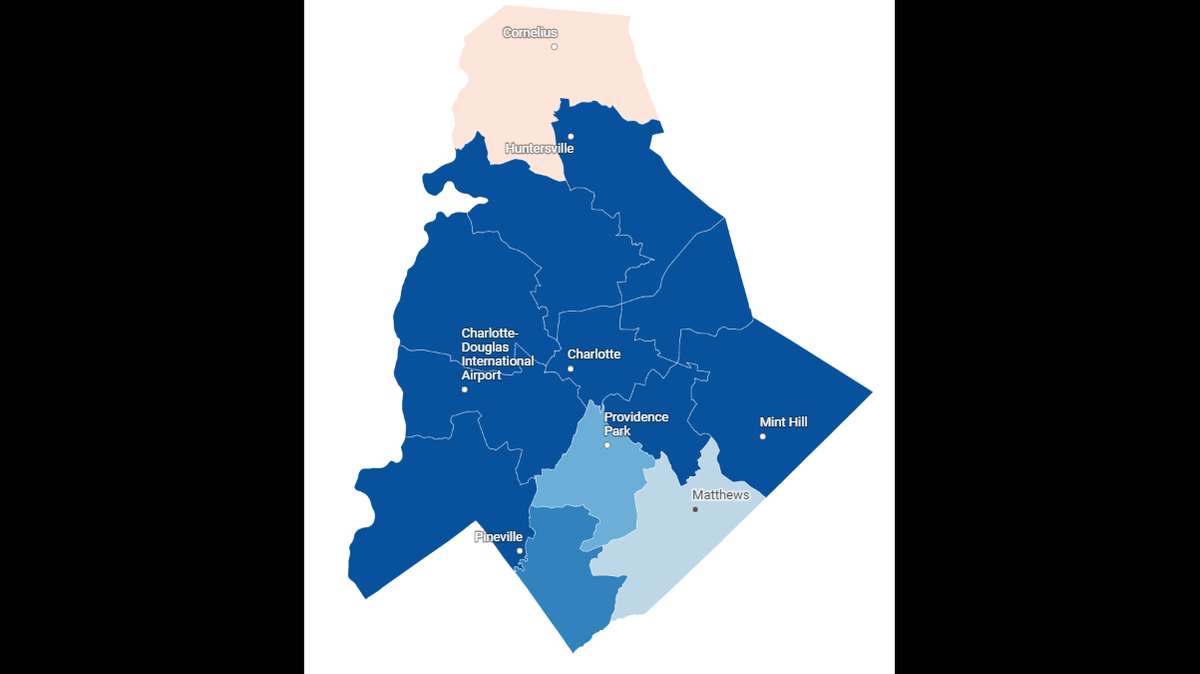
With new election maps, the race for an open congressional seat that includes part of Charlotte got more interesting this week.
Across three different political maps, it’s one of a handful locally where a shift in the power balance has potentially opened up.
Recently-struck down district maps drew what is now called District 14 as solidly Republican, leading to U.S. Rep. Madison Cawthorn to announce in November that he’d switch districts to seek a second term.
The previous version of that district included western Mecklenburg County and parts of Gaston and Rutherford counties.
The new map, though, pushes much further east into Mecklenburg County, making it more competitive for Democrats and more moderate. That could spell trouble for Cawthorn, an outspoken, anti-establishment lightning rod of a candidate, and might even push him to back to his safely-Republican home district in the mountains.
Lawmakers in the North Carolina General Assembly voted on three maps Thursday: one for the state Senate, one for the state House, and one for the U.S. House.
If the maps pass the muster of a three-judge panel — which is not a guarantee, and some people see it as unlikely — they’ll stand until 2030 and will help determine how much power each party has, both in Raleigh and in Washington.
This week’s development puts Cawthorn “in a tight spot,” said Charles Jeter, a former Republican state representative and Huntersville town board member.
Some moderate Mecklenburg County Republicans, who were taken aback by and upset by the notion of Cawthorn representing part of their county, are thrilled with the prospect.
“I think Cawthorn’s about to learn a hard lesson,” Jeter said. “Don’t pick fights you can’t win.”
Cawthorn hasn’t said what he’ll do.
“North Carolinians know Congressman Cawthorn has been a stalwart conservative voice in the U.S. House,” Luke Ball, a spokesman for his office, said in a statement to the Observer. “He will win another term in Congress no matter how the district lines come down.”
But in Mecklenburg County there’s more to the story than Cawthorn (and there’s more to Cawthorn’s story, for that matter).
Mecklenburg County’s Congressional Map
The map pushes the 14th district, which runs from central Rutherford County east into Mecklenburg, even further east into than it had previously. The further it goes into Mecklenburg, the more competitive it becomes.
It gives Democrats a shot where they were previously a significant underdog.
Along with potentially making things more difficult for Cawthorn, the district appears to open a door for Tim Moore, the speaker of the state House, who lives in Kings Mountain. Moore has not confirmed whether he will enter the race.
Jeter, though, has his suspicions.
“It doesn’t take a rocket scientist … to realize that this is a guy who looks like he’s gearing up to announce a run for Congress,” he said, pointing to the tenor of Moore’s social media accounts.
Moore was the first choice for some moderate Republicans near Charlotte, has attended Republican events in Mecklenburg County for more than a decade, and lives much closer to Charlotte than Cawthorn. All these factors could give him an edge in a competitive primary.
Cawthorn could go back to his home district, but that would come with some complications as well.
He’d be up against several Republican primary competitors who have began campaigning in that district soon after Cawthorn announced his departure. Among them are state Sen. Chuck Edwards, who has about $328,000 of cash-on-hand, and Bruce O’Connell, who made a $1 million loan to his own campaign.
Edwards “is an establishment figure with connections to the region, who has gotten endorsements from most of the major figures in the Republican Party in the district,” said Chris Cooper, a political science professor at Western Carolina University.
Additionally, Cawthorn would have to battle any resentment that voters might have about the fact that he left them.
“It’s kind of like going back hat-in-hand asking for forgiveness,” Cooper said.
Regardless of which path he chooses, the road to a victory at the polls this year could be more complicated for Cawthorn than it was just a few months ago.
“It seemed like (Cawthorn) had won, that he had pulled off this kind of audacious move,” Cooper said. “Now, I think it’s very much in question.”
Whether Cawthorn should have seen that ahead of time — that the maps would be redrawn, and not in his favor — is another question.
“I don’t understand for the life of me why he did this, other than the fact he just assumed he was untouchable,” Jeter said. “He had been knighted by the man down at Mar-a-Lago and he figured he could do whatever he wanted. I think he’s getting ready to learn a hard lesson: that doesn’t play in North Carolina.”
So how do Mecklenburg County Democrats feel about the new Congressional map?
The short answer: hopeful.
“The more Mecklenburg they give us the more competitive it’s going to be for us,” said Dan McCorkle, a Democratic political consultant in Charlotte. “I’m very confident we could win this thing.”
Whoever the Democratic primary candidates are, they need to be able to raise money quickly. The primary election is currently scheduled for May, and candidate filings are set to open next week. (Whether the primary will actually happen in May is questionable. It will depend on how the court reacts to this map.)
“It comes down to money, organization and name recognition,” McCorkle said. “You have to have that name recognition.”
McCorkle said he’s confident that there are candidates who can pull the fundraising off, and who have enough connections and status in Mecklenburg County to bring out voters in November for the general election.
He referenced some possibilities, including former state senator and current Charlotte City Council member Malcolm Graham; the mayor pro tem of Charlotte’s City Council, Julie Eiselt; and former Congressional candidate Dan McCready.
U.S. Army veteran Josh Remillard has already been campaigning for this district with the stated goal of unseating Cawthorn. He has raised more than $330,000 so far.
State senator and former U.S. Senate candidate Jeff Jackson said he won’t run for Congress.
“It’s not time for a novice,” McCorkle said. “It’s got to be someone that’s experienced at not just running, but at winning.”
“If we can get that kind of person, I think we are in great shape.”
Mecklenburg County’s state Senate Map
The new state Senate map has only one competitive district in Mecklenburg, the one belonging to Jackson.
Jackson won’t be running for reelection. Instead, he endorsed state Rep. Rachel Hunt.
Candidates aren’t able to file until Feb. 24. One other Democratic candidate, Lisa Ellsworth, has also filed and lives in the same district that Hunt is now running in. Ellsworth is a two-time president of the Democratic Women of Mecklenburg County and also carries an endorsement from Jackson.
On the Republican side, the only person to file for that district so far is Scott Stone, a former state representative who served in Mecklenburg County from mid-2016 through the end of 2018. He also ran for lieutenant governor in 2018, but Mark Robinson won in a landslide.
The other five N.C. Senate seats that include parts of Mecklenburg County, lean strongly Democrat or Republican and are considered less competitive.
State Sen. Natasha Marcus will be safe in the new map. In the old draft, which the state Supreme Court ruled unconstitutional, she was put in a district that included Iredell County, which likely would have driven her out of office.
Aside from her own political security, though, Marcus said Republicans “refused to make the map fair.”
She said the map puts one Democrat out of office and puts many other members in more difficult districts, even in Democratic strongholds like Wake County.
“The remedial map fixed the double-bunk that had impacted me, so it is better for me personally,” Marcus said in a statement to the Observer. “But that’s not enough. I have always believed that the need for fair maps statewide is more important than my personal situation. So, I voted no on the map, along with all of my Democratic colleagues (in the state Senate).”
She said she hopes and believes the court will reject the map next week.
Mecklenburg County’s state House Map
The newest state House map gives Republicans potentially a few more options in Mecklenburg. The district belonging to Rep. John Bradford, the sole Republican in the county’s current delegation, leans slightly Republican, according to past election results.
As an incumbent, he’s likely to hold on to that seat.
One other district is close when it comes to partisan leanings. A third is competitive but leans Democratic, and a fourth is competitive but will likely go to a Democrat — at least, based on past election results.
Republican Bill Brawley will be making a bid for District 103, which leans slightly Democratic. Brawley served in the state House from 2011 through 2018. He ran again in 2020 but lost in the general election to Hunt, the representative now running for state Senate.
District 104, which leans Democratic but is still competitive, also has a Republican who already filed: Donald Pomeroy. He ran for state House in 2020 but lost to Rep. Brandon Lofton, a Democrat, in the general.
Currently no one has filed to run in District 105. That district is likely to be won by a Democrat, though some of it is represented by a Republican in the Charlotte City Council.
Are these maps doomed anyway?
No one knows for sure, but some people from both parties believe so.
Marcus said she hopes the court rules against the map.
Gov. Roy Cooper, in a fundraising email Thursday night, called the maps “ultra-partisan” and said Republicans “have proven they’ll do anything they can get away with to ensure that some votes count more than others and Democratic candidates won’t stand a chance.”
McCorkle, the Democratic political consultant from Charlotte, said he hopes the maps stand.
In that opinion (though maybe not for the same reasons), he’s found common ground with Charlotte attorney and Republican consultant Larry Shaheen.
It’s worth noting that both Shaheen and McCorkle might have financial interests in seeing the maps stand should they choose to manage or work with campaigns for anyone running for those offices. Still, their opinions represent a significant chunk of those of political insiders — from both sides — who hope the court approves the maps.
Shaheen’s position mirrors that of many Republicans: The system is lopsided in favor of Democrats; North Carolina’s redistricting process has become less about voter representation and more about politics; and, particularly in Mecklenburg County, the maps are gerrymandered to favor Democrats.
“The Democrats will not be satisfied until the map that’s drawn elects more Democrats than Republicans, no matter what (past) election results are,” Shaheen said, referring to the Congressional map.
Within Mecklenburg County, Shaheen said he expects there to be three winnable districts for Republicans: one that’s already held by a Republican in north Mecklenburg, and two in south Charlotte.
It’s possible, if not likely, that Republicans continue with just one member in the delegation, he said.
“What is occurred in North Carolina is nothing short than a judicial coup,” he said.
Mecklenburg County went 31.6% for Trump in 2020, according to data from the state Board of Elections. In 2016, in went 32.9% for Trump.
Under the new maps, Republicans theoretically stand a chance in five of the county’s 19 General Assembly races — about 26% of the total. The chances of them actually getting five seats, Shaheen said, aren’t high.
So, if you go just by presidential election results, Mecklenburg County will likely be disproportionately represented by Democrats under the new General Assembly maps.
For U.S. House, it breaks down like this: six seats are safely Republican, four are safely Democratic, and four are toss-ups.
In the map that the court ruled unconstitutional, 10 districts were safely Republican, three were safely Democratic and one was a toss-up.
To McCorkle, that’s a significant-enough improvement.
“Any Democrat that complains about this? Come on,” he said. “This is 10 times better than it was from 2012 onward.”
On a 6-4-4 split, “We’ll take it,” he said. “You know why? That means it’s a level playing field.”
McCorkle added that Democrats may not win every district, but that “it’s up to us” to get the best candidates running the best campaigns.
“Right now we have serious competitive districts throughout North Carolina, and that is a victory for the voters,” he said. “The voters are going to actually decide who represents them.”
This story was originally published February 18, 2022 at 1:39 PM.
.jpg)