Both sides in NC gerrymandering case proposed new election maps. Here’s how they differ
Both sides in North Carolina’s nationally watched gerrymandering lawsuit have now proposed the new political district maps they want the court to pick, and a decision is due Wednesday.
The fast-tracked schedule for this case is in place because the 2022 primary elections are just a few months away, on May 17, and candidate filing is scheduled to begin on Thursday. Potential candidates need to know what the districts look like to figure out where they want to, or even can, seek election.
When the N.C. Supreme Court struck down the maps the Republican-led legislature drew last year as unconstitutional partisan gerrymandering, the judges ordered the legislature to try again. And it did, passing replacement maps last week. But the court also allowed the left-leaning groups that won the lawsuit to submit their own proposed maps, which they did last week as well.
Now it’s up to a lower court — specifically, the three-judge trial panel that originally heard the case — to analyze all the different maps and figure out whether to accept the legislature’s new districts, and if not, which other replacements to go with.
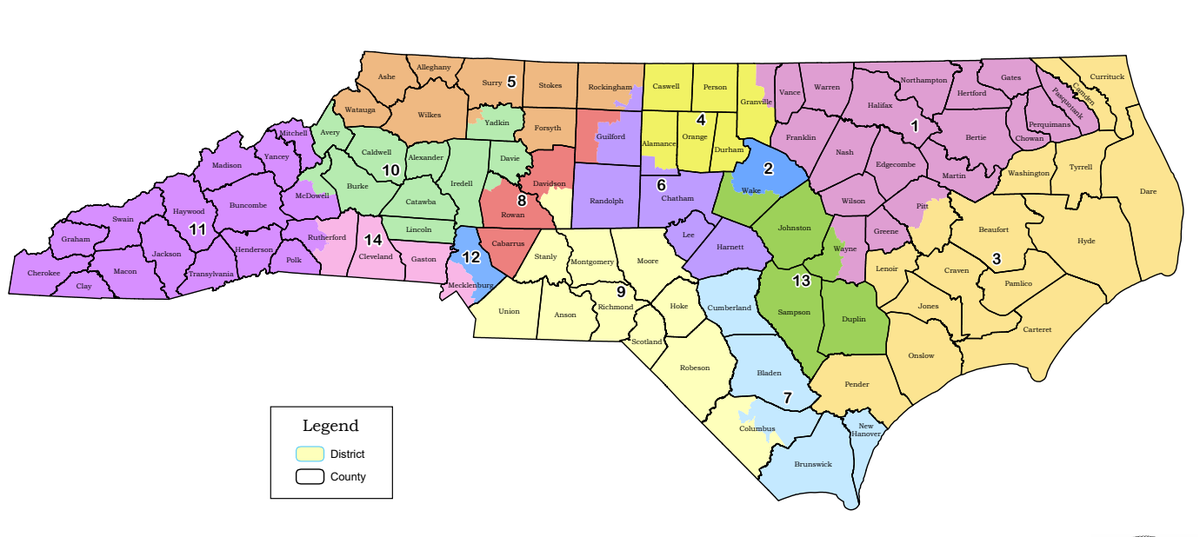
So what do all the different maps look like? Here’s a brief rundown of the versions for North Carolina’s 14 U.S. House of Representatives districts, the 120 N.C. House districts and the 50 N.C. Senate districts.
For reference, there are maps submitted by the legislature (NCGA), and plaintiffs known as the N.C. League of Conservation Voters (NCLCV) and as the Harper plaintiffs. There is also a third plaintiff, Common Cause. That group didn’t submit its own map but instead suggested some tweaks to the maps the legislature passed.
Congress
The most high-profile of the three maps is the one that needs to be drawn for the U.S. House seats. Republicans are only a few seats short of retaking the House majority nationally, so how North Carolina votes this November could go a long way toward determining which party controls that chamber for the second half of Democratic President Joe Biden’s first term.
▪ NCGA: This map is considered a 6-4-4 split: Six safe Republican seats, four safe Democratic seats and four competitive seats. It could swing anywhere from 10-4 in favor of Republicans to 8-6 in favor of Democrats. Election data from 2016 and 2020 shows a likely 8-6 split in favor of Republicans.
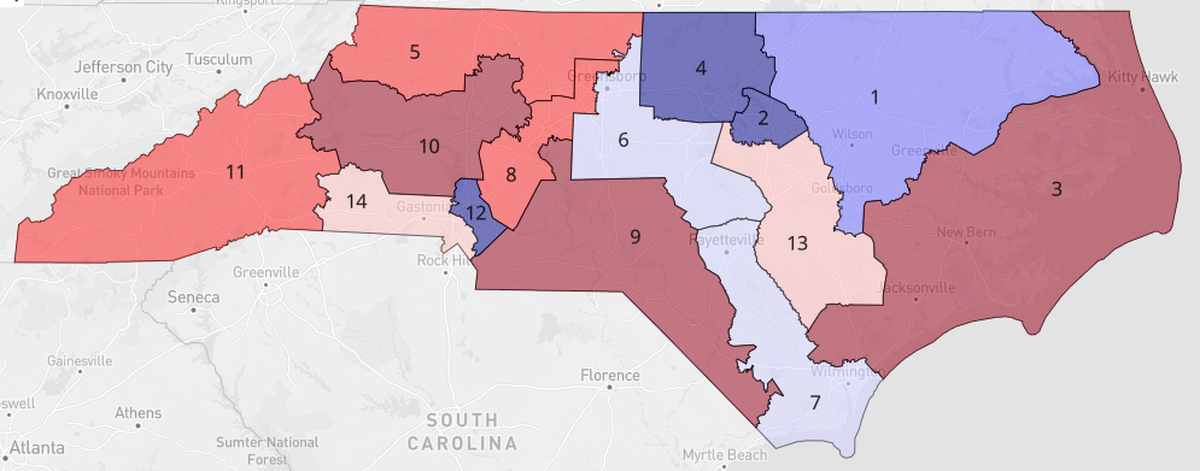
▪ NCLCV: This map also has at least four highly competitive seats, plus three others which might become competitive in outlier years for one party or another. Election data from 2016 and 2020 shows a likely 8-6 split in favor of Democrats.
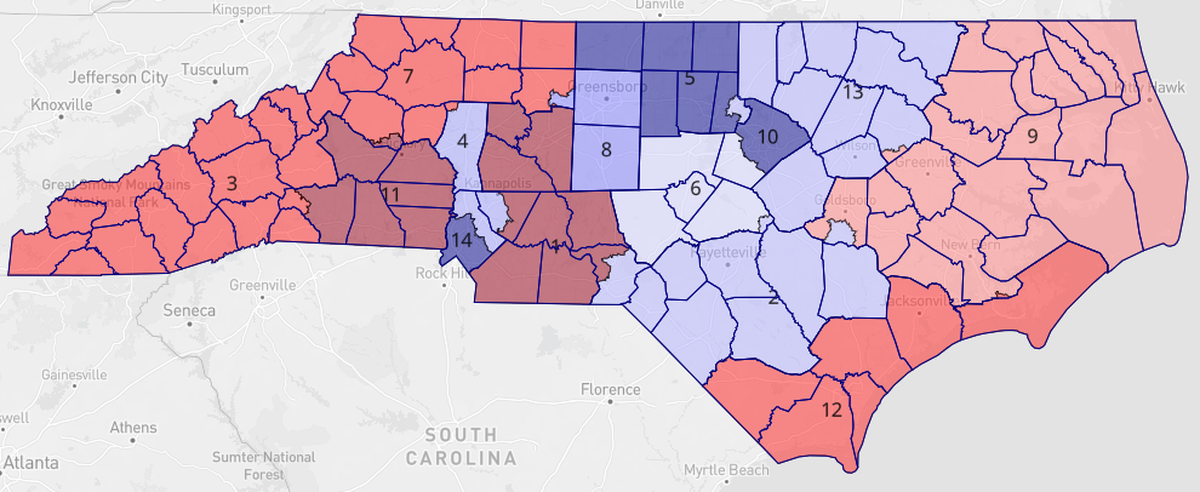
▪ Harper: In this court filing, the plaintiffs also used 2016 and 2020 election data analyzing their proposed map, but did it slightly differently from the analysis by the other two. Their filing says that the way the NCGA map is drawn, Republicans would likely expect to win an 8-6 advantage if the statewide vote was split 50-50, whereas the Harper map would likely create an even 7-7 split under the same 50-50 statewide vote.
It also says the dropoff in the NCGA’s congressional map is steep: The plaintiffs claim the GOP-drawn map would give Republicans a 10-4 advantage in a scenario in which Democrats had a narrow statewide loss with around 47% or 48% of the total vote, while their own maps would likely create either a 7-7 split or an 8-6 Republican advantage in the same scenario.
NC Senate
This chamber has 50 seats, and in case of a tie, the deciding vote is cast by the lieutenant governor. That is currently Republican Mark Robinson. So even in the case of tie, at least until Robinson’s term ends in 2024, Republicans would essentially still control the Senate. Democrats would need 26 seats to pass their agenda.
NCGA: In 2020, when Democratic Gov. Roy Cooper won statewide with close to 52% of the vote, he also would’ve won 25 of these proposed Senate districts. But in that same election, when Republican President Donald Trump won the state with just under 50% of the vote, he would have won 28 of the districts. An analysis of election data from 2016 and 2020 shows Republicans would likely be expected to win a 27-23 majority under their proposed new map.
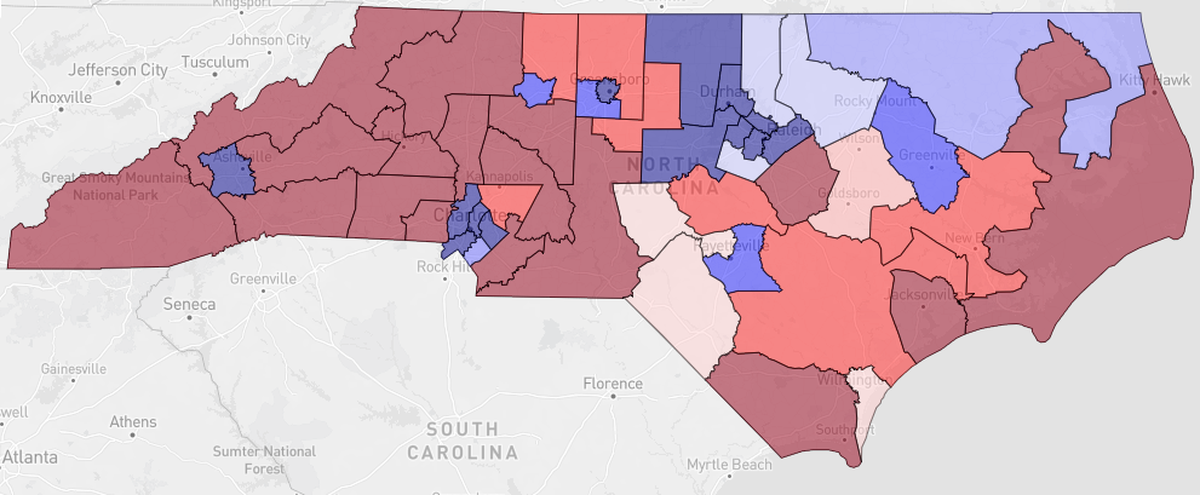
NCLCV: An analysis of 2016 and 2020 data shows Republicans would likely win a 26-24 majority with the NCLCV map. The analysis shows this version might have a few more competitive seats than the NCGA version.
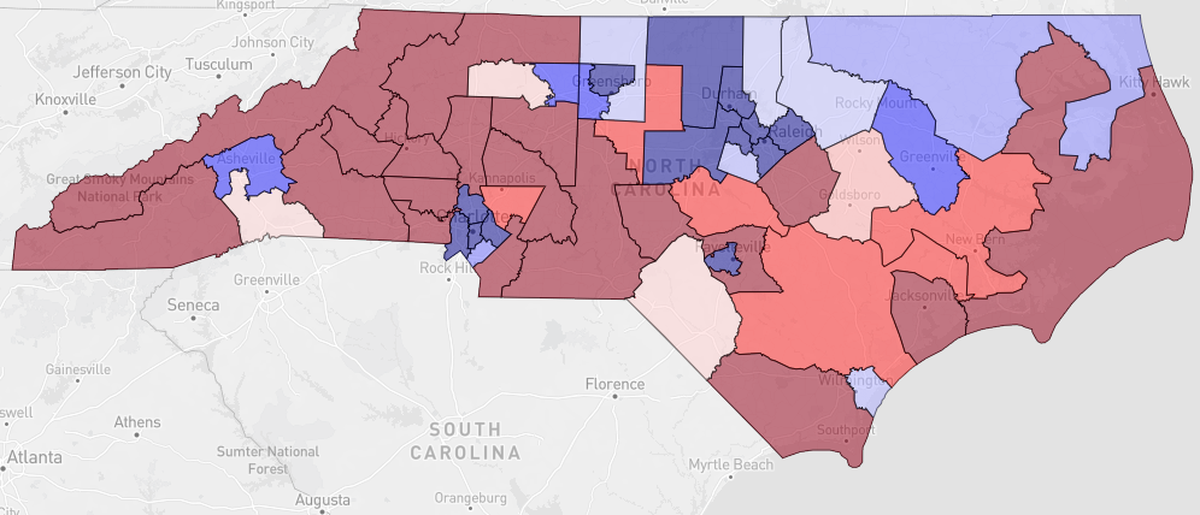
Harper: As with the congressional map, the immediately available analysis for the Harper group’s Senate map showed how its map would perform under a variety of election outcomes, instead of combining all that data into a single aggregate analysis like others’ maps. And it shows essentially a tossup. Consider two close elections, both barely won by Democrats in nail-biter statewide elections: The 2016 governor’s race, won by Cooper, and the 2020 attorney general’s race, won by Josh Stein.
Even though both elections were essentially 50-50 tossups, Stein in 2020 would have won 24 of the 50 Senate seats in this version of the map, but Cooper in 2016 would’ve won 26 — a majority for Democrats. The difference comes down to slightly different voting patterns each time. In 2020, when Cooper won by a larger margin, 27 of these proposed districts would likely have gone Democratic.
NC House
Unlike in the state Senate, there’s no tiebreaker in the House, so either party needs at least 61 seats to control the 120-seat chamber.
NCGA: In 2020, when Cooper won the statewide vote by almost 5 points — 51.5% to 47% — Cooper would’ve won 62 of the proposed 120 House districts. But in that same election, Trump would’ve won 63 of the 120 seats — showing that there are several highly competitive districts that voted Republican for president but Democratic for governor. An analysis of election data from 2016 and 2020 shows Republicans would be likely to win a 63-57 majority under their proposed new maps — although some of the districts might be very close, separated by just a few hundred votes.
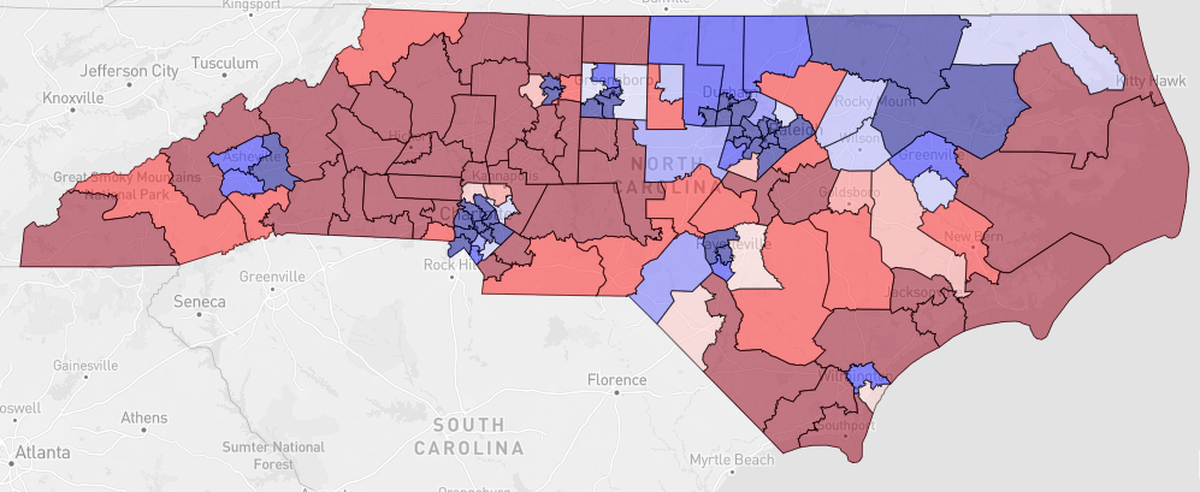
NCLCV: This version of the map is fairly similar in its outcome to what the NCGA passed. An analysis of election data from 2016 and 2020 shows Republicans would be likely to win a 62-58 majority, but just like in the other version, there are several seats so competitive they could easily flip back and forth.
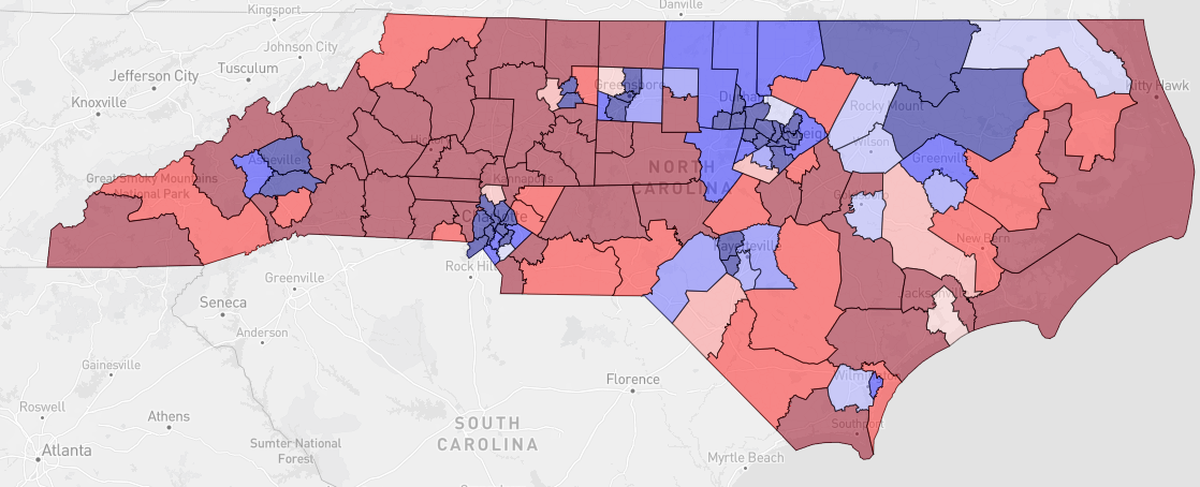
Harper: The Harper plaintiffs didn’t propose a House map, after the NCGA’s version passed almost unanimously last week, in a final vote of 115-5.
For more North Carolina government and politics news, listen to the Under the Dome politics podcast from The News & Observer and the NC Insider. You can find it at link.chtbl.com/underthedomenc or wherever you get your podcasts.
This story was originally published February 22, 2022 at 4:44 PM with the headline "Both sides in NC gerrymandering case proposed new election maps. Here’s how they differ."