Lawmakers say NC needs a new plan for paying teachers. But how will change happen?
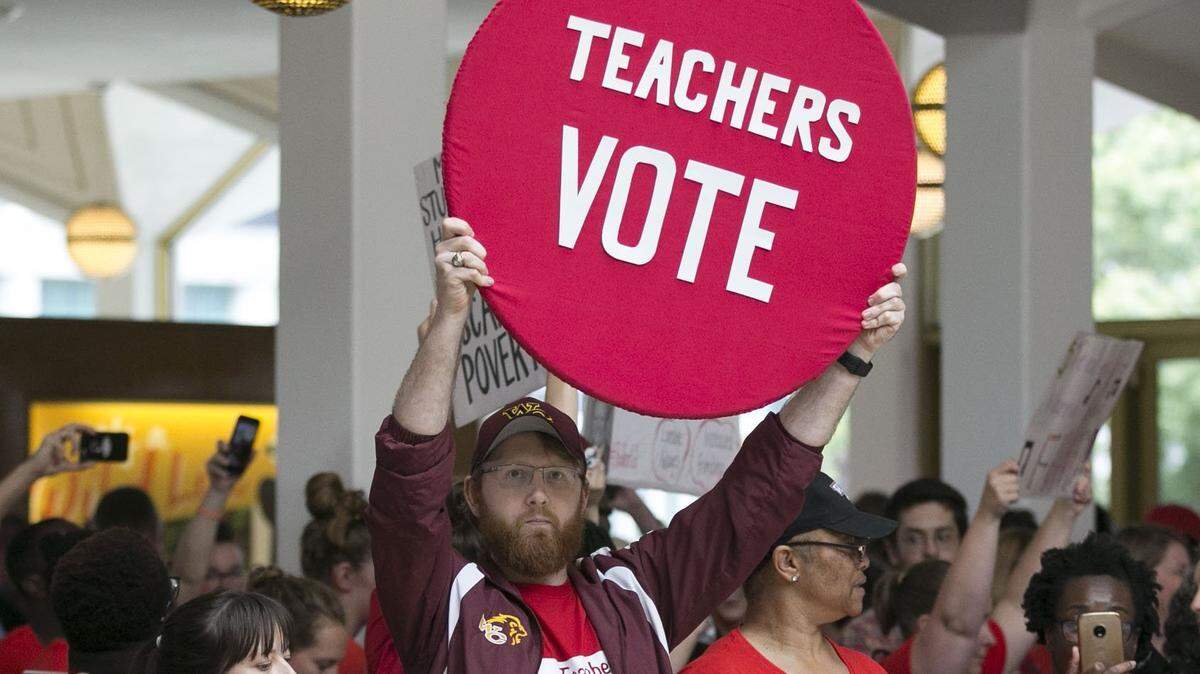
North Carolina is lagging in how it pays teachers compared to other professions and states, leading state lawmakers to say Monday that the compensation system needs to be improved.
A state legislative committee heard a presentation Monday showing how the state’s public school teachers take longer than other state-funded fields to reach the top of the pay scale. In addition, new teachers receive less in benefits than neighboring states.
The presentation came after state lawmakers approved a budget in November that provides teachers an average pay raise of 5% over a two-year period. Rep. John Torbett, a Gaston County Republican, said lawmakers shouldn’t be “thumping” their chests at the pay raise, considering how much fuel, rental, health care and other costs have gone up.
“The 5% increase really is a negative by the time everything else comes out,” said Torbett, senior chairman of the N.C. House Committee on an Education System for North Carolina’s Future. “We’re fully extremely cognizant of all that.
“So one of the key things that I think was touched on earlier is we need to come up with a better source, or a better plan, for compensation for teachers to bring them up to a professional level that we all know they have risen to professionally.”
The committee is charged with coming up with recommendations for changing how to run the system that educates 1.5 million public school students.

Teachers take longer to max pay scale
North Carolina teachers now start at a state base salary of $35,460. They get annual state raises for their first 15 years, then less frequent raises after that. The scale tops out at $52,680, but school districts often supplement the state’s pay.
Additionally, state lawmakers set aside $100 million for a new teacher salary supplement for 95 of the 100 counties.
A recent report from the National Education Association estimated the average teacher salary to be $54,863, ranking North Carolina 34th in the nation. The state Department of Public Instruction has a higher estimated average salary of $55,905.
At 15 years, teachers approach the maximum of the state’s salary schedule but don’t reach the maximum level until their 25th year. From years 15 to 24, teachers don’t get an annual increase in the state pay scale.
In contrast, the State Highway Patrol, State Bureau of Investigation and Alcohol Law Enforcement officers and probation, parole and corrections officers reach the top of the state pay schedule after six years, said Timothy Dale, principal fiscal analyst for the General Assembly’s Fiscal Research Division.
Dale said assistant and deputy clerks of court as well as magistrates reach the maximum pay in the state pay scale when they have 13 to 18 years of experience.
Benefits less for new teachers
In terms of benefits for new teachers, North Carolina provides less than the neighboring states of South Carolina, Virginia, Tennessee and Georgia, according to David Vanderweide, a principal fiscal analyst for the Fiscal Research Division.
Vanderweide said the biggest difference is the lack of subsidized dependent health insurance provided to North Carolina teachers.
The benefit system is heavily focused on retirement, according to Vanderweide. Most teachers reach the maximum value after 30 years, but they lose pension value if they stay on after that point.
“If you’ve taught here for 20 years, it provides an enormous incentive to stick around until 30 years,” Vanderweide told lawmakers. “If you’ve been here 30 years, it provides an incentive to leave.”
Teachers in counties along the state’s western border who have vested their North Carolina pension benefits are leaving to work in South Carolina to join their pension system, according to Rep. David Willis, a Union County Republican.
Vanderweide said the state may want to consider potential benefits changes that include offering student loan repayment assistance and subsidized dependent health care insurance.
Winners and losers
There is a new model that North Carolina could potentially turn to for paying teachers.
A state commission is working on a new pay system based on teacher performance instead of years of experience. It could lead to higher salaries for teachers and is based on student test scores or evaluations by principals, students and other teachers.
The plan is still under development and will be presented to the State Board of Education later this summer. The state board could ask lawmakers to adopt the new model.
Torbett, the committee chair, floated the idea of replacing principals with an “executive teacher” who would teach some classes while being responsible for all of the educational needs of the students. He said an operational manager could take care of the non-instructional issues.
Dale, the analyst, told the committee that there would be a lot to consider if the compensation system is substantially revamped. He said this could include providing a hold harmless provision for existing teachers.
“Any substantive change is going to create winners and losers unless there’s a lot of additional funding that is provided with it,” Dale said.
This story was originally published May 9, 2022 at 8:35 PM with the headline "Lawmakers say NC needs a new plan for paying teachers. But how will change happen?."