From Civil Rights to Charlotte politics: See a timeline of Ella Scarborough’s career

Ella Scarborough, a longtime Charlotte politician and first Black woman to run for mayor died Tuesday at 75. Her legacy lives on as her friends and contemporaries remembered her as “dynamic” and a “trailblazer.”
Scarborough, from Sumter, South Carolina, was active in the Civil Rights movement at just 16 — jump-starting a political career that spanned decades.
Here’s a timeline of Scarborough’s career pulled from Observer archives.
1963 - At 16, Scarborough was jailed with 357 other Black students who tried to enter a segregated movie theater in Sumter, South Carolina.
1968 - Five years later, as a senior at S.C. State University in Orangeburg, Scarborough tried to help integrate the town’s only bowling alley. South Carolina Highway Patrol officers fired into the crowd of Black students and three died, known today as the Orangeburg Massacre.
1985 - Working as the chair in 1985 of the District 3 organization, a west side residents association, Scarborough encouraged overpopulated schools on the southeast side of Charlotte to send their students to the underpopulated west side during busing and integration.
1986 - Scarborough served as a member of a Mecklenburg County fundraising committee that worked to fix low-income housing in the Crestdale community.
1987 - Scarborough, a Duke power supervisor at this point, ran and won the Charlotte City Council District 3 seat. She was endorsed by the Charlotte Black Political Caucus and The Charlotte Observer.
“She combines several qualities that we think would make her a good council member: She is a good listener, she works well with people, she is knowledgeable about her district while being sensitive to the needs of the entire city,” the Observer endorsement of Scarborough stated.
1988 - Scarborough remained on City Council, advocating for housing and a cross-town bus route on the west side of Charlotte.
1989 - Scarborough won her second council term and joined Charlotte’s Afro-American Cultural Center board of directors.
1990 - Scarborough became a director of the Charlotte Convention Center and Visitor’s Bureau.
1994 - Scarborough became the first Black woman to win an at-large City Council seat.
1998 - Scarborough ran unsuccessfully for U.S. Senate.
1999 - Scarborough was the first Black woman to run for mayor on the platform of “champion for the poor.” She lost to Republican Pat McCrory.
2001 - Scarborough ran for mayor again, backed by the Charlotte Black Political Caucus with her top issue facing Charlotte being “Mayor Pat McCrory’s lack of leadership.” She lost to McCrory again in the general election. After this “disappeared from the political scene” for 1 3 years, stated a story on April 20, 2014.
2014 - Scarborough made her return to the political scene by winning an at-large Mecklenburg Board of County Commissioners seat because she felt the commission lacked a “voice for ordinary people.” At the time, she taught part time at Central Piedmont Community College’s Pathway to Careers program.
“You have poverty and homelessness here, and they’re talking about a surplus (of money) in county government,” Scarborough said in 2014. “I can’t sit here and see this surplus and say I don’t know what to do with it. People need help; schools need funding. We can do better.”
2016 - Scarborough won reelection for county commission at-large, seeking better jobs, scarcer homelessness and became chair of the board. She also chaired the board’s economic development committee.
Scarborough spoke up on birth control in 2016 when Mecklenburg County’s health director wanted to step up efforts to provide contraception to new mothers and sexually active women.
“What’s wrong with us talking about having vasectomies for men and boys?” Scarborough said. “The last woman I knew to have a baby without a man was Mary.”
2017 - As commission chair, Scarborough boasted a healthy jobs market, support for business growth and welcoming new businesses would sustain the county’s economy. She touted the county’s property tax rate, which had not changed since 2013, and a 4.6% unemployment rate in December 2017 being below state and national averages.
On Aug. 2, 2017, Scarborough controversially voted against giving $100 million in public funding toward a Major League Soccer stadium in Elizabeth.
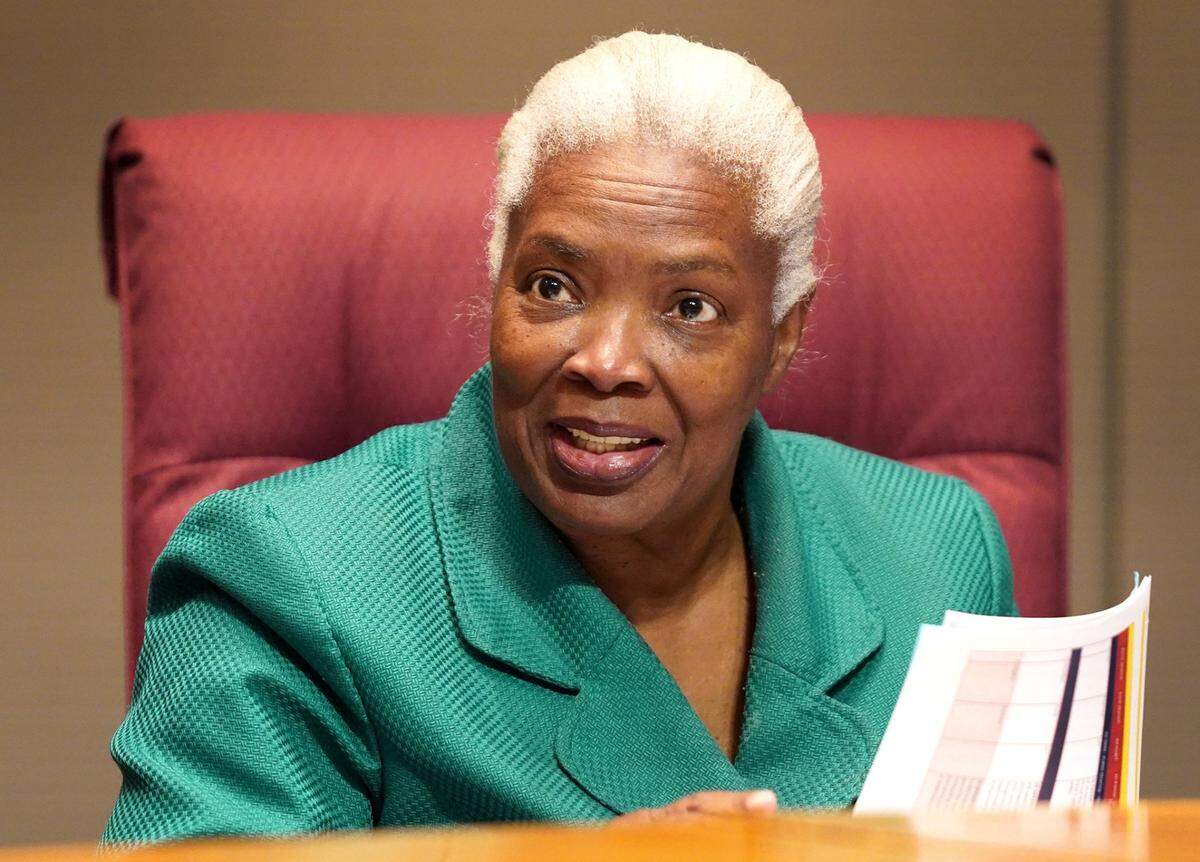
2018 - Scarborough won reelection again in 2018, making the entire Mecklenburg Board of County Commissioners all Democratic.
2020 - Scarborough won reelection for another two-year term on the Mecklenburg Board of County Commissioners.
2021 - Scarborough began to attend meetings remotely during the COVID-19 pandemic, and her mental fitness came into question. Her fellow commissioners did not allow her to join meetings remotely.
2022 - This year, Scarborough took medical leave of absence from the Mecklenburg Board of County Commissioners on Feb. 8.