
From gas to delayed deadlines, Duke’s carbon reduction plan meets opposition in NC
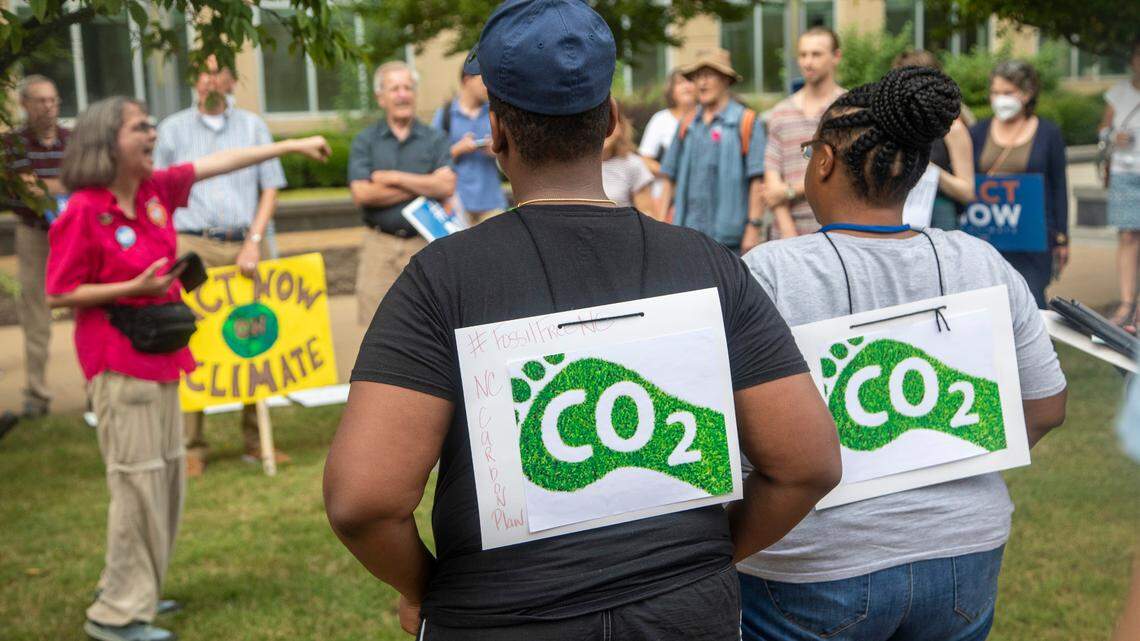
Over the next six weeks, the N.C. Utilities Commission will travel across North Carolina, hearing public comments on a proposal that will guide how the state slashes emissions from the power sector.
Last year’s House Bill 951 required the Utilities Commission to approve a plan by the end of 2022 that will shape how Duke Energy reaches a 70% reduction in carbon emissions from 2005 levels by 2030. The legislation offers some leniency if the commission decides deeper reductions can be achieved by certain projects that might take longer to complete.
Duke filed a draft version of the plan in May, effectively asking the commission to approve steps that leave available four paths that include various mixtures of renewable energy generation, gas-fired power plants and some new technologies like small modular nuclear reactors.
That initial plan has met opposition from environmental groups, which note that three of Duke’s four pathways include measures that allow it to meet the 70% reduction after 2030 and are worried about emissions from new gas plants. Those and other concerns will likely be raised at the hearings, which began Monday evening in Durham.
Forest Bradley-Wright, the Southern Alliance for Clean Energy’s energy efficiency director, said Duke should focus its resources on renewable energy and energy efficiency efforts instead of gas-fired power plants.
“It’s quite simple: If you find yourself in a hole, stop digging,” Bradley-Wright said.
Recent research, including a 2021 report from the United Nations Environment Programme, has found that cutting methane emissions could play a key role in slowing climate change. Methane is a highly potent greenhouse gas that lasts in the environment for about a decade while carbon dioxide can last for hundreds of years.
House Bill 951 only requires Duke to cut carbon emissions. Environmental advocates would like to see the Utilities Commission further consider methane and other greenhouse gases as it crafts the reduction plan.
Lindsey Hallock, Vote Solar’s Southeast senior regional director, said she hopes the commission and Duke will take methane emissions into account.
“We felt like this was an obvious loophole that was built into the law when it was passed and we were hopeful that Duke would do the right thing,” Hallock said, “but so far, in this plan, unfortunately, it looks like methane’s not considered at all.”
Duke officials argue that House Bill 951 requires them to consider reliability in addition to carbon reductions and affordability. The company sees natural gas plants as a key tool in achieving that.
Glen Snider, Duke’s managing director of resource planning and analytics, said the company is “moving from the Ford F-150 to a hybrid SUV and then ultimately we’ll get to being Tesla down the road, but there is still room for gas on your trajectory as a vital transition tool to maintain reliability and affordability.”
Snider added that Duke’s proposed portfolios include either 3.2 or 3.5 gigawatts of natural gas while other new generation ranges from 8.9 to 13.1 gigawatts.
Duke has also committed to a net-zero methane emissions target from its natural gas business by 2030, which it plans to accomplish by monitoring for leaks and using plastic or coated steel pipes, among other measures. Earlier this year, Duke said it was targeting net-zero emissions by 2050 from the places it purchases the gas and the customers who use it.
New technology or ‘unnecessary risk?’
Snider also raised the possibility that natural gas infrastructure could eventually be used to transport a blend of gas and hydrogen. While the technology has not been used at scale in the United States, the U.S. Department of Energy made a $9.5 billion investment in hydrogen in last year’s infrastructure law.
“We can further decarbonize those new plants as hydrogen becomes a more readily available fuel source in decades to come,” Snider said.
But discussions about hydrogen and small modular nuclear reactors are alarming to some groups, who argue it is difficult to determine the prices of technology that isn’t yet available and risky to view that as a key part of emissions reductions even as the window for avoiding the worst impacts of climate change narrows.
A small modular reactor, for example, is about a third the size of a traditional nuclear reactor and, according to the International Atomic Energy Agency, can be built more cheaply and more quickly than their larger counterparts. But none are operating in the United States right now, and all four of Duke’s portfolios include new small modular reactors by 2035.
Joel Porter, the policy manager for CleanAIRE NC, said, “It does add unnecessary risk and I suspect that the prices of renewables will continue to decline in a steady manner that would probably contradict some of the numbers that Duke used in their modeling.”
If models show the price for solar energy continuing to decline, Porter said, it would make more sense to model a plan around even more panels instead of small modular nuclear reactors or new gas infrastructure.
Bradley-Wright also expressed concern about Duke pushing the 70% reduction back to 2032 in one scenario and 2034 in two others. The 2032 instance allows for the construction or purchase of additional offshore wind energy while the 2034 delay allows the construction of a small modular nuclear reactor.
Environmental advocates like Bradley-Wright argue that solar panels, battery storage and other readily available technologies could meet the target by 2030.
“There’s enough time between now and then that the focus should be on how do we reach the target, not moving the goalpost before we’ve even started,” he said.
Another key concern is how the emissions reduction plan could impact low-income customers in North Carolina and those who live near potential new power plants.
“I think there is a lot more they have to do with respect to energy affordability, energy equity, ensuring that the transition from fossil fuels is one that’s just,” Porter said.
Kendal Bowman, Duke’s vice president of regulatory affairs and policy, acknowledged that no matter what path is chosen, the company will build a huge amount of new infrastructure over the next 30 years.
As the company decides where to put new solar farms and potentially new gas plants or small modular nuclear reactors, officials will use environmental justice screening tools from the Environmental Protection Agency and Department of Energy to determine if proposed facilities are being built in places where they exacerbate social inequities. Duke, Bowman said, will also check with local staff to see if there are any concerns.
“You’ve got to look on a case-by-case basis: Is there mitigation required? Is there something that needs to change? Is there more analysis that needs to be done? But this is a new process that we’re still trying to figure out and implement in the company,” Bowman said.
What comes next
After the Monday evening hearing in Durham, the N.C. Utilities Commission will host hearings at the following times and places:
- July 12, 7 p.m., at the New Hanover County Courthouse, 317 Princess St., Wilmington
- July 27, 7 p.m., at the Buncombe County Courthouse, 60 Court Plaza, Asheville
- July 28, 7 p.m., at the Mecklenburg County Courthouse, 832 E. 4th St., Charlotte
- Aug. 23, 1:30 p.m. and 6 p.m. virtually. Only the first 20 speakers who register will be able to speak at these events. Those who would like to talk can register by calling 919-733-0837 or emailing ncucpublichearing@ncuc.net. Those who wish to speak will need to give their name, docket number E-100 Sub 179, the telephone number they will call from and the topic they will address.
The Utilities Commission must approve a carbon plan by the end of the year.
While Duke’s proposal is one version the commission will consider, the Southern Environmental Law Center has said it will propose an alternative plan on behalf of the Southern Alliance for Clean Energy, Natural Resources Defense Council and the Sierra Club. Friday is the deadline for organizations intervening in the case to file alternative plans or technical comments.
This story was produced with financial support from 1Earth Fund, in partnership with Journalism Funding Partners, as part of an independent journalism fellowship program. The N&O maintains full editorial control of the work.
This story was originally published July 12, 2022 at 5:45 AM with the headline "From gas to delayed deadlines, Duke’s carbon reduction plan meets opposition in NC."