‘Left behind’: Charlotte relatives of shooting victims say Congress hasn’t done enough
The Rev. Sharon Risher felt called to advocate for gun reform after losing her mother and other loved ones in the 2015 mass shooting at Mother Emanuel AME Church in Charleston, S.C.
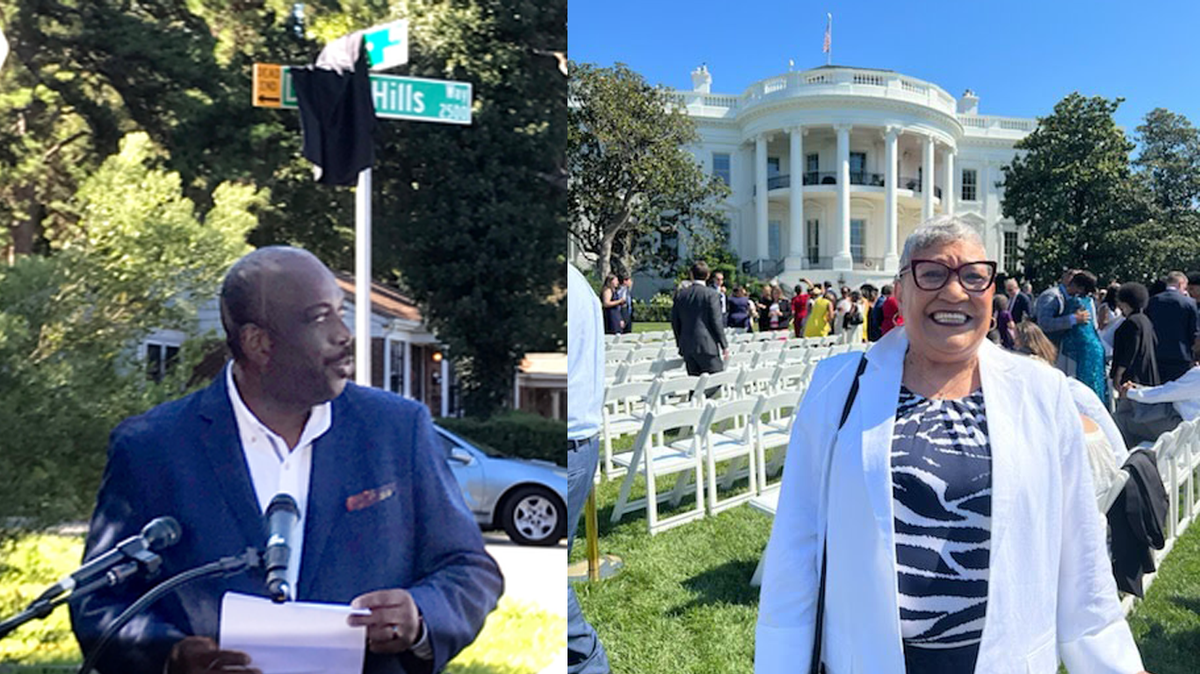
That calling led her to the White House Monday for a celebration of the passage of the Bipartisan Safer Communities Act.
The bipartisan act, signed into law at the end of June by President Joe Biden, aims to prevent future shootings like the one in Charleston. It invests in safety measures for schools, mental health resources and strengthening background checks.
Being able to connect with others impacted by gun violence at the White House and see the impact of their advocacy felt powerful, she said.
“I was glad to be among all of these warriors. And I believe my mom and those angels were right there with me,” Risher said.
But she says more should be done.
“The first thing there has to be is a bill to ban AR-15 and military-style weapons,” Risher said.
Risher also wants to see an end to what’s known as the Charleston loophole, which allows guns to be sold before background checks are completed. That loophole allowed Dylann Roof, the man convicted of killing nine people during the Charleston church shooting, to obtain the gun he used in the attack.
If Roof’s background check were completed thoroughly, he never would have been able to get the gun, Risher said.
“Because you only have a three-day turnaround and the Nexis system (for background checks) is backed up way yonder, there are probably lots of people out there like Dylann Roof that have gotten their hands on weapons where they shouldn’t have,” Risher said.
What does the act do?
The Safer Communities Act sets aside $1 billion for crisis intervention and community-based violence prevention. Some of those funds are for states to make their own “red flag” laws, or laws that allow guns to be confiscated from people deemed dangerous to themselves or others.
The act also adds people convicted of domestic violence to the national criminal background check system so they can’t buy firearms and increases background checks for buyers under 21.
It allocates $2.35 billion for school services and expands access to mental health services through community health centers, telemedicine, Medicaid and the Children’s Health Insurance Program.
Charlotte City Council member wants more action, too
Risher and Charlotte City Council member Malcolm Graham have more than a few things in common.
They both graduated from Johnson C. Smith University in Charlotte. Both were drawn to serving others: Graham as a politician and Risher as a hospital chaplain and advocate.
They both grieve for the lives of their loved ones killed in Charleston.
The shooting killed Risher’s mother, Ethel Lee Lance, her childhood friend Myra Thompson and her cousins Susie Jackson and Tywanza Sanders. Graham’s sister, Cynthia Graham Hurd, was also killed.
“It’s unfortunate that you become a member of a fraternity that you never want to join, the fraternity of those left behind,” Graham said.
After the Mother Emanuel AME Church shooting, Risher connected with Moms Demand Action and became an activist, eventually becoming a spokesperson for Everytown for Gun Safety. She’s spoken about her experience at universities and churches.
Graham started a foundation in his sister’s name to encourage literacy and civic engagement. That foundation hosted a town hall at Johnson C. Smith University on gun violence a few years ago. He’s also traveled the country to speak about gun violence and racism, including places grappling with their own tragedies like Kansas City, where a gunman killed three people at two different Jewish sites.
Like Risher, Graham thinks the Safer Communities Act is a good first step but legislators can take greater action.
“They didn’t do anything about the assault weapons, which are weapons of war,” Graham said. “They didn’t do anything with the ammunition these guys buy that can shoot 50, 60 rounds in a matter of minutes.”
Preventing gun violence in North Carolina
Opponents of gun control measures say stricter laws would infringe on their Second Amendment rights and that red flag laws prevent due process. That attitude affects the political environment in North Carolina, Graham said.
“They see what’s happening in Washington, which is nothing. And so I don’t think the North Carolina General Assembly has the political fortitude to do anything significant in reference to gun laws in our state,” Graham said.
North Carolina doesn’t require registration for any type of gun or background checks for private sales of long guns, which include rifles and shotguns. Previous attempts to pass red flag laws here failed. Gov. Roy Cooper called for a ban on assault weapons earlier this year, but Senate President Pro Tempore Phil Berger and House Speaker Tim Moore opposed it.
As a state senator for Mecklenburg County in 2009, Graham sponsored gun safety bills, including two to impose stricter gun storage requirements to protect minors.
The bills, which would’ve required guns to be locked and unloaded when not in use, didn’t pass. In 2021, researchers from Harvard and Northeastern University found that nearly half of teens in households where at least one gun was unlocked were able to access a loaded gun in less than five minutes.
“There’s probably a shooting every day in Charlotte, and those certainly don’t make national news like a mass shooting. But every day here in North Carolina, people are impacted by guns and I hope that the General Assembly will see that as a problem,” Graham said.
Since municipalities can’t make legislation, cities such as Charlotte are limited in what they can do about guns, Graham said. One of his goals is to pilot the Cure Violence program, which aims to prevent violence before it occurs by mediating conflicts and providing pathways to employment and affordable housing.
“A lot of it is identifying opportunities for jobs and giving people a better education and giving them hope,” Graham said. “A life of violence is not desirable when there’s a city full of opportunities.”
The way forward
The similarities between the Charleston shooting and the May shooting at a Buffalo, New York, supermarket, where ten Black people and three others were killed, are not lost on Graham and Risher.
“I just grieved for them,” Risher said, referring to the family members of those killed in Buffalo. “I knew exactly what they were going through.”
Graham said guns were tools used to commit a crime in both cities, but the crime was “hatred, racism and discrimination.” That added a “sinister” layer to the violence, he said.
“If she (Cynthia) were alive and Charleston had occurred, she would have said, ‘I bore the brunt of what happened that night.’ But the attack was not against her, it was against a race of people,” Graham said. “She would have said this is much bigger than her.”
Both emphasized the importance of calling out white supremacy.
“Continue to call out these people, make it difficult for them to spread that crazy hate propaganda,” Risher said.
She also noted the role of social media in spreading white supremacist beliefs. Graham noted that South Carolina still lacks hate crime laws seven years after the Charleston shooting, and that the United States has hard work to do.
Of the future of gun safety legislation, Graham said, “I am hopeful but I am also a realist.”
Risher’s goal as an advocate is to move hearts. While she’s optimistic more people recognize the impact of gun violence, she’s not sure what it would take to move legislators.
“I don’t understand our Senate and Congress for not wanting to be able to save people’s lives,” Risher said.
Yet, she’s not giving up.
“We just have to keep doing what we do out of love and kindness and a voice for the issues,” she said.
This story was originally published July 14, 2022 at 6:00 AM.