‘There is no script for this role.’ NC’s newest top lawmaker on taxes, abortion, Medicaid
When the legislature comes back into session in 2023 Republicans will have a level of power they haven’t had for years, with a veto-proof supermajority in the Senate, and needing just one Democratic defector to override vetoes in the House.
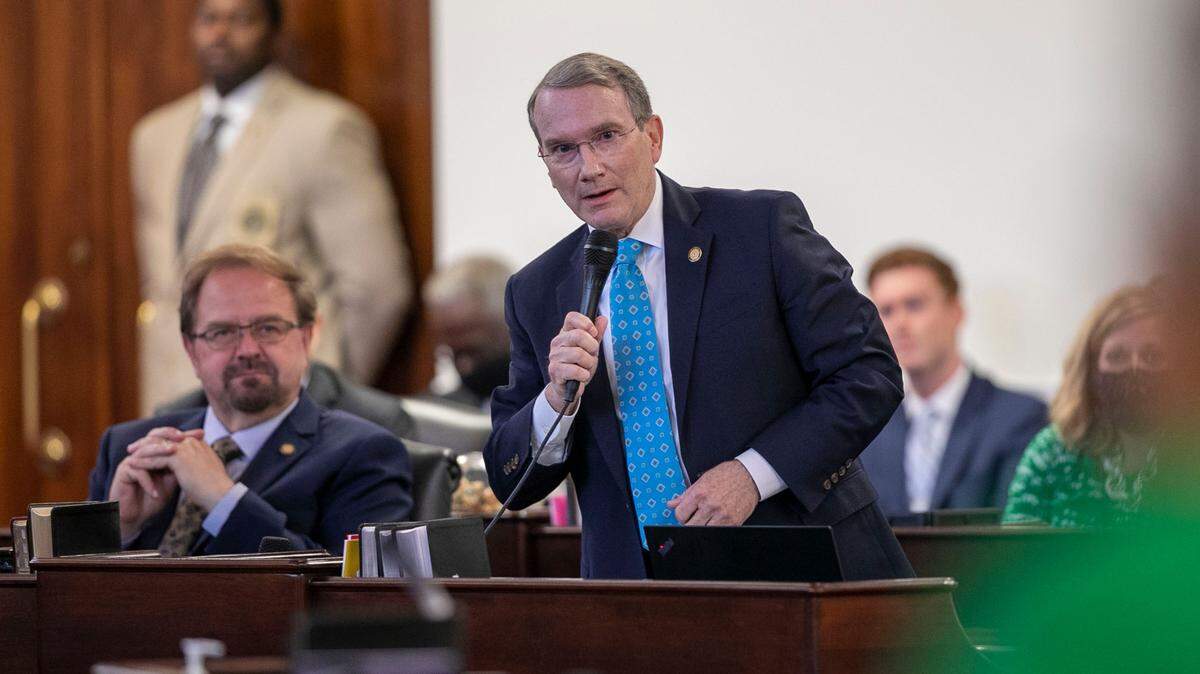
At the same time there’s a new face in GOP leadership, Sen. Paul Newton, a Cabarrus County Republican who was just elected majority leader. In the job, he’ll be a top deputy to Senate leader Phil Berger, who represents Eden, where Newton grew up.
The former president of Duke Energy’s North Carolina operations, Newton has quickly risen to power in the legislature in just a few years, chairing important committees on topics like election law and energy policy, and taking the lead on much of the recent tax policy changes — most notably the recent decision to completely eliminate corporate income tax over the next few years.
The News & Observer sat down for 30 minutes with Newton recently to talk about his leadership style and priorities for the upcoming session. The following has been edited for length and clarity.
Q: You’ve been in the legislature since 2016. I feel like that’s a fairly fast ascent to majority leader. You can correct me if I’m wrong on that, but what do you attribute to gaining your colleagues’ respect in six years?
A: I have made a career of trying to put others first: 25 years at Duke Energy and I never asked for a promotion; I didn’t ask for this promotion among our Senate caucus. But I honestly want everyone who’s in our caucus to be successful, and I’ll try my best to help them be successful. I’m going to be honest with them, every time, all the time, and I think they know that.
I mean, who doesn’t want to work for someone who wants you to be successful, right? They’re not working for me, don’t get me wrong. They’re working for their constituents. But it’s just an honor to help them be successful.
That’s my goal, that’s sort of my leadership column, is to try to help others be successful.It’s an amazing leadership paradox, I have found. When you do that, you yourself become successful.
Q: I think for some people it can be confusing because in the U.S. Senate, the majority leader is the #1 guy, the Chuck Schumers and Mitch McConnells of the world. Obviously you are not overtaking Sen. Berger here with this title. But what do you see the role of majority leader really being most responsible for?
A: There is no script for this role. It is what you make it.
And so I sent all my (Republican) colleagues, all 30, an email asking what should my top three priorities be on their behalf. And so what they want from me is going to define my role.
I think at the end of the day our role of legislators is to effect the will of the people. So we may have individual beliefs on any particular issue we’re grappling with, but listening to constituents is important. And we have a big tent in the GOP, and people with very different opinions on things. And I think my job is to help us find a common landing place.
Phil Berger has been outstanding at that, and will continue to be outstanding as long as he chooses to serve. Our state has been so well-served by Sen. Berger. But if I can help that process by understanding where the divisions, small-d, are in individual issues, and help find a landing spot, then I will have helped serve the caucus.
Q: Is that a big part of it — I don’t want to say, necessarily, “keep the troops in line” — but make sure that the caucus is putting out a unified message?
A: I think one of the strengths of the Senate has been to emulate a family. And I don’t mean a mob family, I mean a family family. We have disagreements, right? But we try to do that behind closed doors and air it all out and find that common ground, so when we walk out of the room, we’re of one voice.
Even if I disagree with a position we may be taking, I don’t come talk to you about it — no offense intended. I don’t come complain to you. I had my say. I may not get my way, but that’s what adults understand, and that’s what leadership structures are about.
Q: I’m going to rewind here, to your days with Duke. What kind of lessons do you take from (Duke)? Because it’s obviously a very different leadership role. Being the president of the North Carolina operations you’re toward the top of food chain, but in the Senate you’re one of 50 who are all equally elected. And now obviously you’re in a leadership role, but are there similarities there? Are there differences? How do you view those two different roles?
A: Yeah, so, the big similarity we’ve touched upon is putting others first. I tried to always do that every day at Duke, and again, that leadership paradox: People don’t want you to fail if they know you care about their career, and you want them to succeed, right?
It is different in the Senate. These folks have already succeeded; they won their elections. So really I’m more of a facilitator.
Think about if you’re in the business world, it’s a matrixed organization. There’s no command and control, there’s no solid lines, they’re all dotted lines. And so your influence, your integrity, your persuasive abilities, the trust you earn from other people, is kind of all you’ve got. You don’t ever want to jeopardize that for short-term gain.
Earning respect is what I think makes you successful in helping lead other very good leaders through disagreements or rough patches, or the good times as well.
Q: That clearly translates to the legislature. I mean, so much that goes on there is built on trust and personal relationships. During your time at the legislature I think there have been two other majority leaders, Kathy Harrington and Harry Brown. And they obviously had very different personal styles. What lessons do you take from them? Things they did well, or things you want to bring a new approach to?
A: Both of those were great leaders and when they spoke, we listened. Harry was maybe a little more vocal than Kathy Harrington, but when she spoke, it was always with crystal clarity. And as a more junior member of the caucus with both, I always knew when they took the microphone we were about to learn something. ... My style will certainly be different, because all people are different, but hopefully I will serve with the level of integrity that they did.
Q: What are some of the things that drive you in politics?
A: What I see at the national level, it feels to me the political parties have forgotten who serves who.
I am crystal clear about the fact that we as politicians — and I hate to even call myself a politician. I still don’t think of myself as one — but I’m crystal clear about the fact that I serve the electorate, I serve North Carolinians. It’s not about me. ... There are headwinds right now, inflation rates and energy costs, a number of things that are headwinds for the pocketbooks of North Carolinians. But I’m going to do everything in my power to make sure that they are prosperous.
And what does that mean? It means lower taxes.
Nothing’s more stimulative to the economy than people keeping their own hard-earned dollars. ... We’ve cut taxes but run budget surpluses for years now in North Carolina. And every time we cut taxes there’s the hue and cry of, ‘You’re taking away availability for X or for Y.’ But again, it’s another paradox.
When you reduce taxes you rationalize the regulatory burdens on businesses and people. People want to be there. They want to make a 50-year bet on North Carolina, put iron in the ground, create hundreds of thousands of new jobs, and be here for the long run.
Businesses operate on signals, and we are signaling as a state that you can be successful here and the employees you need are here because our school system is so great. So what that means is that every single facet of that has to be taken care of, right?
We have got to have great schools, from K-12 to higher ed. There’s no reason North Carolina can’t be best in the nation in education, and create jobs, and continue to attract those jobs. So I think that drives me more than anything, is to help ensure that North Carolinians are prosperous.
Think of it as a multi-generational perspective. You might have young children, I don’t know, Will, or maybe in the future.
Q: I have a 2-year-old, he’s very cute, yeah.
A: Well I want your 2-year-old to self-actualize in North Carolina.
I want him to be able go to school at one of our great universities and be happy there, and challenged there. I want him to get a great job right here in North Carolina so you can visit with your grandkids.
There’s no reason for him to move to another state to get a job. .... I think about CNBC ranking North Carolina No. 1 in the nation for business. That doesn’t happen by chance. That happens over a decade of good hard work and good policy that attracts those companies, and everybody else is chasing after us.
Q: I think that’s a great example you brought up, the best in the country for business ranking that we got last year. ... Both political parties tried to take some credit for it to some extent. You and your colleagues pointed to the low taxes we have here, and some of the folks on the Democratic side pointed to the credit that universities and the public schools got, for our good education system here. Is there a tension between cutting taxes or having more money to spend on things like keeping the roads paved and funding the university system, or things like that?
A: Responsibly cutting taxes has led to excess revenue in this state. We have reduced taxes, and we increased revenue.
So there’s this paradigm that if you cut taxes you’re eliminating availability that could be used. The opposite has been true. Scientifically, mathematically provable. We’ve got to be smart about that, right? We can’t cut bone or muscle. But we’ve been very successful threading that needle and that’s why we are, I believe, so prosperous.
I mean, we spent $6 billion on infrastructure last budget. $6 billion for infrastructure. We also spent almost 60% of our budget, some $11 billion, on education. So I think it’s a hollow accusation that the GOP doesn’t care about education. We’re spending billions more than the last time Democrats were in control of the state. Billions more.
You asked me earlier about the differences between private- and public-sector leadership. And I’m going to give you a very, very important one.
In the private sector when there’s a problem, what you’re driven to do is understand the root cause of the problem. I mean, you can put Band-Aids all over the periphery of the problem and you’ll never solve the problem. So you drive to a root cause so that when you solve that problem, it’s fixed. You can move on from there, and you’ve done something meaningful that’s actually effective.
In politics there’s this notion that if we start hue and cry over X, and we just do X. But it’s not the root of the problem because it’s hard work getting to the root cause of the problem. ... I am not going to stand here and put political icing on something that is not going to solve our problems.
I’m still driven by the private-sector notion that good government solves problems for North Carolinians; great government anticipates those problems on the horizon and solves them before they ever manifest. That’s great government and that’s where I want to be. ... I think North Carolinians are tired with the ideological rhetoric around things, and they want us to do substantive problem-solving. They deserve that, and we should be doing it regardless of party.
Q: Well let’s dive into some of the details on that. The session is going to be starting up soon, early 2023. What are a handful of your top priorities along those lines, of solving problems?
A: We’ve already touched on it. We’re going to be focused on strengthening North Carolina’s economy. I guarantee you. That includes things like lower taxes. It includes things like House Bill 951 which was the energy policy bill we passed last biennium.
In theory we shouldn’t have to touch energy policy for the next couple of decades in North Carolina, but implementation matters so we’re going to be watching carefully to see if our Utilities Commission implements, faithfully, 951.
... And I think, two, we’ve been successful getting the kinds of investments in North Carolina that we’ve seen by rationalizing regulation. We all want clean water, we all want clean air, but you know how bureaucracies work over time.
They grow and they become more powerful and they create fiefdoms, and we would be naive if we were sitting here today we thought that we were as lean and as efficient in government as we could be, so we need to do work on that. ... There are certainly other issues on the horizon. We haven’t met as a caucus to prioritize what we’re going to be tackling in the long session. We will do that.
But clearly the Dobbs decision is going to be one that is addressed in some way, shape or form.
Q: Yeah, I imagine there would be a lot of pressure from within the caucus to act on the issue of abortion. But just looking back to even just the last session, there were a lot of bills on the more social side — and some that were sort of social and fiscal at the same time, you know, things like sports betting and medical marijuana are in that category. But then there’s also the purely cultural things, like abortion and critical race theory and what to do, if anything, on firearms laws. Now that y’all have the supermajority in the Senate and are very close in the House, what sort of issues in that realm do you foresee being big this year?
A: I think those are examples of things that our caucus needs to get together on. We are certainly no monolith. We have a variety and a diversity of opinion on every one of those that you just listed. So we will get together, and I think that is one of our strengths, is to hear each other out.
How many times in life have you gone in thinking you had just the right idea for something, and then after you heard two or three dis-confirming voices you think ‘You know, that is a better idea, we probably ought to go that direction.’ So I would not be serving the caucus well if I tried to guess at where we would land on any of those.
But I think you’re right, we probably will certainly touch on those.
Q: And of course, Medicaid expansion. That’s sort of been the — well, not even the elephant in the room, ‘cause everyone’s very directly addressing it. But it seems there’s still these lingering disagreements between the House and the Senate on the exact details of it. Do you foresee any softening from either side on that? Are we going to see any sort of movement?
A: I think so. We, the Senate, passed Medicaid expansion and we also addressed the supply side of services. It doesn’t do any good to expand Medicaid if you can’t be seen by a doctor or get the kind of treatment that you need.
So we tried to address both those parts of the equation. And the House had a different view of that, and hit the pause button, if you will.
Folks are working on that, trying to work through the rough edges and the differences between the two chambers’ positions. They very well may come out with a better idea for North Carolinians.
But we in the Senate side think it is time and it is in the best interest of the state economically, with the incentives that are out there from the federal government. It’s also important for the care of North Carolinians because we have some great people who are working hard as they can to make ends meet. They may make too much for Medicaid but they certainly don’t make enough to pay for health insurance.
And I think about our tax policy changes. We’re really trying — and we don’t get any credit for it, I’ll be the first to admit that, in the media we get very little if any credit — for our tax policies where we reduced taxes. We weren’t reducing taxes on the rich but you’d never know that. We took 250,000 lower-income North Carolinians off the tax rolls, and their families, because we raised the standard deduction from $21,500 to $25,500.
So you can make $25,000 and not pay a cent of tax. That’s the kind of thing we’re looking for, is kind of at every socio-economic ladder rung, to make them more prosperous.
This story was originally published December 16, 2022 at 5:00 AM with the headline "‘There is no script for this role.’ NC’s newest top lawmaker on taxes, abortion, Medicaid."