NC lawmakers passed term limits resolution for Congress, but not for themselves. Why?
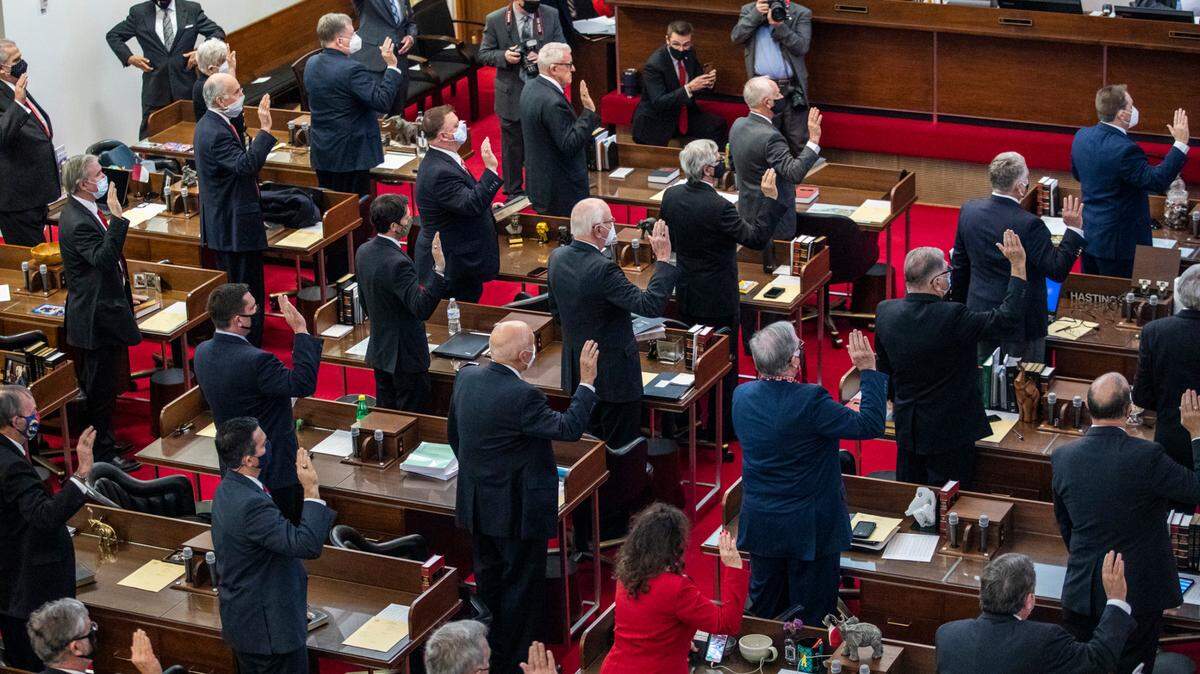
North Carolina recently joined other states in calling for congressional term limits.
But while state lawmakers approved a resolution for a constitutional amendment to limit how long members of Congress can serve, they haven’t set term limits for themselves, despite attempts by some members over the years.
The resolution passed the House in March 2023, with House Speaker Tim Moore as one of its primary sponsors.
It remained dormant until early December, in the dwindling days of the state’s legislative session, when Senate lawmakers revived it, added it to their calendar, and passed it the same day. The GOP-sponsored bill was not subject to the governor’s veto.
The votes in the House and Senate were largely on partisan lines, with the majority of Republicans voting in favor of the term limits bill and most Democrats against it.
Moore, who will join Congress in January, said in a news release after the Senate vote that he has “long been an advocate for this shift away from career politics that would amplify the will of the people over the personal interests of members.”
He added, “the majority of Americans support the additional accountability of term limits for Congress, which would pave the way for more competitive elections, accountability, and positive change.”
State Sen. Jay Chaudhuri, a Democrat who represents Wake County and serves as the Senate Democratic whip, pointed out the different treatment of state and federal lawmakers during a committee hearing prior to the Senate vote.
“The irony is not lost on me that we’re putting term limits on members of Congress, but we don’t put them on ourselves,” Chaudhuri said.
Calls for term limits at the state level
Calls for term limits are not new, nor is their implementation — just not at the congressional level.
Currently, 17 state legislatures have term limits for lawmakers, according to the National Conference of State Legislatures. The first of the current set of state legislative term limits was enacted in 1990, while the most recent was passed in North Dakota in 2022.
Term limits also exist for officials elected to executive office, including in North Carolina, where the governor and lieutenant governor are limited to two consecutive four-year terms.
Perhaps the most widely recognized term limit is for the U.S. president. The 22nd Amendment to the Constitution, ratified in 1951 after President Franklin D. Roosevelt’s four-term presidency, established a two-term limit for the office. Despite this precedent, numerous attempts have been made to repeal the restriction.
The debate over the benefits of term limits — and who should be subject to them — continues.
In North Carolina, that question has been raised regarding the state legislature. House and Senate lawmakers currently have no term limits, and leadership positions in both chambers are also unrestricted. This has allowed some leaders to serve for extended periods.
Over the years, multiple bills have been filed in North Carolina advocating for term limits, with support from both Republican and Democratic lawmakers.
Sen. Mary Wills Bode, the lone Democrat to support the congressional term limit resolution in the House, told The News & Observer that she backs term limits because approximately 80% of Americans favor them. She said term limits could help reduce the influence of partisan gerrymandering and big money in politics.
She said she not only supported term limits in Congress but also in the state legislature.
“We have term limits for our governor, and we have term limits for our president, which is an acknowledgment that dangerous things happen when there’s too much concentration of power for too long,”
“This idea is one that exists within our current political system. I think that there is wisdom in making sure that there are some checks on power,” she said.
Bode, of Oxford, will leave office at the end of the month after a single term representing Wake and Granville counties. She did not seek reelection.

For Bode, term limits would decrease the incentive for influential politicians to draw districts that favor themselves and reduce the power of career politicians with ties to lobbyists who prioritize special interests over voters. They would also open the door for fresh perspectives with more turnover and help reduce gridlock, she said.
“The current system doesn’t work, or isn’t working, in my opinion, for the people,” she said.
While surveys show the vast majority of voters favor congressional term limits, research also suggests they could weaken governance by removing experienced representatives and reducing institutional knowledge.
According to the University of Chicago’s Center for Effective Government, this gap can empower unelected individuals like staffers or lobbyists.
Gerry Cohen, who worked for the state legislature from 1977 to 2014, said he helped draft numerous term-limit bills for the House and Senate, with proposals ranging from consecutive term caps to limits on total years served, along with other variations on the types of limits.
Cohen said that these proposals often failed because it’s difficult to “expect members to push a proposal that could limit their own terms.”
He added that some states have addressed this by specifying that term limits apply only to officials elected after voters approve the amendment, exempting current lawmakers.
Term limits for leadership
Beyond bills proposing term limits for all lawmakers, there have also been efforts to impose limits specifically on legislative leaders.
In 2017, GOP lawmakers introduced House Bill 182, which proposed limiting the speaker of the House and the president pro tempore of the Senate to four consecutive two-year terms in their leadership roles. The bill, which did not receive a hearing in either chamber, would have required voter approval as it called for a constitutional amendment.
Republican Sen. Jim Burgin in 2021 proposed forming a commission to look at pay rates to legislators in North Carolina, which are among the lowest in the nation. He said at the time he also wants the commission to consider term lengths and limits.
While he said he was supportive of the House and Senate leadership, he said he thought 16 years might be a good cap to address voter support for term limits.
Asked about Burgin’s bill in 2021, the president pro tempore, Phil Berger, said at the time it was worth a look, The N&O previously reported.
Cohen said that it hasn’t always been typical for lawmakers to serve in leadership positions for multiple terms. He said that until the 1970s, nobody had ever served more than one term as speaker or president pro tem, “and then we’ve run into a string of multi-year” leaders.
Moore is the state’s longest-serving House speaker and is capping off his fifth two-year term leading the House. Meanwhile, Berger is about to begin an eighth two-year term leading the Senate and is the country’s longest-serving legislative leader at the moment.
Prior to Berger, Democrat Mark Basnight served as the Senate leader for a record 18 years.
As for who broke the centuries-old tradition of one-term speakers, that was Carl Stewart, a Democrat from Gaston County, who in 1979 won a second term as speaker.
Cohen said that before then, it was tradition for the speakership to alternate between an eastern and a western House member. After one term, a speaker traditionally would leave the House and pursue other ventures, such as moving to the Senate, he said.
“The institutional pressure was so high, which is obviously very different now,” he said.
Neither Berger, Moore or Rep. Destin Hall, who will be the House’s next leader, provided comment through their spokespeople for this story.
What’s next for congressional term limits?
While the congressional term limits joint resolution has passed in North Carolina, it does not have any immediate effects.
The resolution calls for a convention of the states, which would be done following Article V of the U.S. Constitution. That section outlines two ways to amend the Constitution.
The most common method, used for all 27 amendments including the Bill of Rights, requires Congress to propose an amendment with a two-thirds vote in both chambers.
The second method, never used, involves a convention called by Congress at the request of two-thirds of state legislatures. There are questions about the rules for such a convention, including whether it would focus on a single issue or a package of issues.
Any proposed amendment started using either method must be ratified by three-fourths of state legislatures or conventions in three-fourths of the states.
This story was originally published December 23, 2024 at 5:00 AM with the headline "NC lawmakers passed term limits resolution for Congress, but not for themselves. Why?."