
NC could be latest state to change who makes the rules. Why health officials are concerned

North Carolina lawmakers are considering changing how a new rule — from the environment to health — can be instilled by the state government.
Their bill would shift power from the executive branch to the General Assembly, while also giving the governor veto power over the new rule.
That could bypass findings by state agency experts and give the decision-making to elected officials, who would need to approve new rules.
And the state health agency is cautioning what it could mean if the legislation becomes law, saying it “could jeopardize health and safety and put NC business out of step with businesses nationally.”
What the REINS Act does in other states
Some Republicans are backing House Bill 402/Senate Bill 290, known as the REINS Act, which would require the General Assembly to approve any new regulation that has an economic impact of more than $1 million. The impact could be both to business and local governments, bill supporters said.
REINS Act stands for “Regulations from the Executive in Need of Scrutiny.”
It has big, conservative, pro-business backers, both in North Carolina and elsewhere: Americans for Prosperity, the John Locke Foundation and Pacific Legal Foundation.
This idea isn’t new to the United States, as some states already have similar regulatory reform laws — nor to North Carolina, where it’s been pushed before.
The influential American Legislative Exchange Council has been pushing it as model legislation as far back as 2012.
The federal REINS Act, which would require congressional approval on rules costing $100 million, has been introduced in Congress every session for more than a decade, most recently in February by Sen. Rand Paul, a Kentucky Republican, with Sen. Ted Budd of North Carolina as a co-sponsor.
Wisconsin passed its REINS Act in 2017, with a threshold of $10 million in “compliance and implementation costs” over two years, according to Ballotpedia. Wisconsin modeled its bill on the federal legislation, and it was part of the national Republican Party’s legislative agenda during the 2010 campaign season, Ballotpedia reports.
Just last year, Kansas passed its version of the REINS Act after Republicans overturned the veto of the Democratic governor.
History of the REINS Act in NC
While the legislation takes control from the executive branch, supporters say it’s not about taking power away from Democratic Gov. Josh Stein.
The conservative John Locke Foundation has been pushing for a version of this bill for a decade, Locke CEO Donald Bryson said. That dates back to when former Republican Gov. Pat McCrory was in office.
Bill sponsor Rep. Allen Chesser, a Nash County Republican, said the legislation is “common sense reform on how North Carolina handles regulations with significant economic impact. This bill ensures that rules costing taxpayers and business owners over $1 million a year don’t just slip through the cracks, that they get the scrutiny that they deserve from the representatives that are elected by the people.”
Chesser said this would be more transparent than state agencies and commissions deciding rules, saying during a news conference that “unelected bureaucrats can impose regulations with major financial consequences without direct oversight from the General Assembly.”

Rep. Jeff Zenger, a Forsyth County Republican, said during a news conference that the state is over-regulated. “Does that mean that every regulation is not valid? No, it doesn’t. But at the same time, we’ve reached the point we’ve got to have a way to measure.”
“We’ve got to have a way to counter. We’ve got to have a way to really see ... what are we paying for? What are we buying?” Zenger said.
The legislation applies to permanent rules, not emergency rules.
‘Business doesn’t want to be regulated’
N.C. Rep. Pricey Harrison, a Greensboro Democrat, said the legislature has already made it difficult for administrative agencies to adopt their own rules, through previous legislation like not allowing agencies to write rules stronger than federal rules.
She described the Republican leadership of the General Assembly as being “very anti-regulatory.”
Harrison sat on the Coastal Resources Commission before running for office, and said watching the rulemaking process is what inspired her to run for office. She’s in her 11th term in the House.
“You try and do something, and the legislature gets influenced by some special interest. It doesn’t want that rule. And then this is what’s going to happen now,” she told The News & Observer in an interview.
For this bill, Harrison said, it’s “just business doesn’t want to be regulated.”
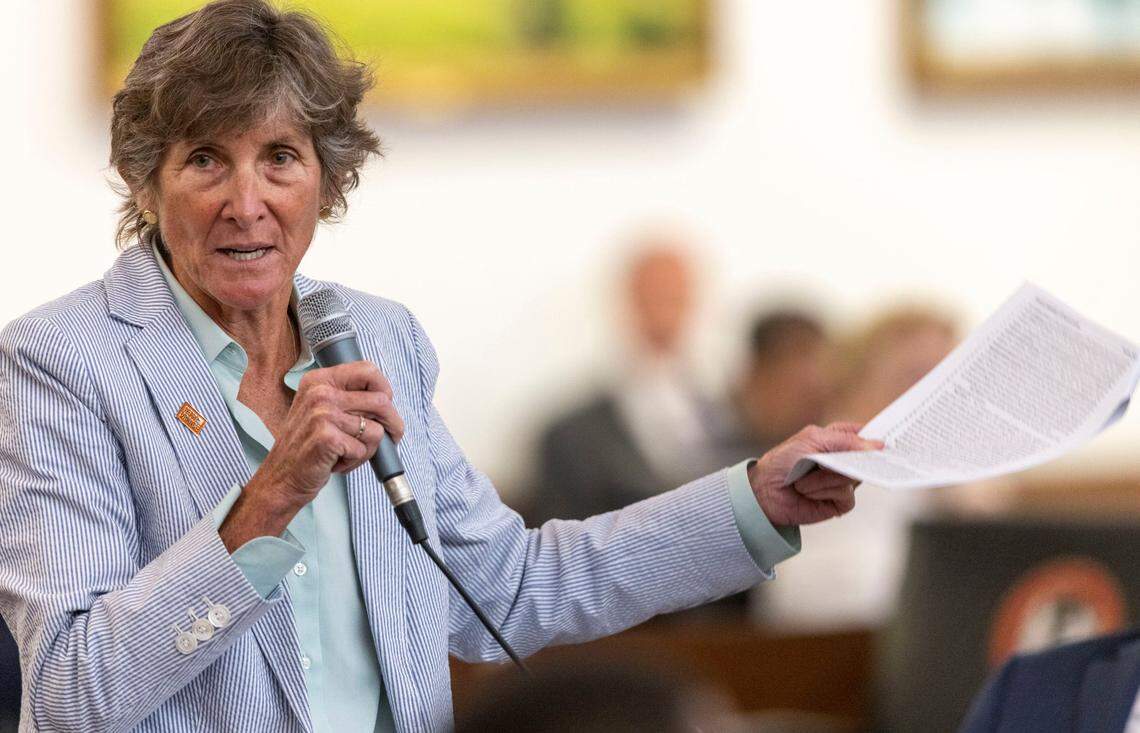
Harrison said it’s another hurdle for making rules from everything from the environment to health.
“On the face of it, the way they sell it makes sense, but the implementation ... We put so many hurdles in the way to make, to pass, rules. This is going to make it a nightmare,” she said.
What DHHS is worried about
In an email obtained by The N&O, the N.C. Department of Health and Human Services shared concerns about the bill with members of the House Regulatory Reform Committee.
DHHS wrote:
▪ “A mechanism is already in place for members of the public and/or industry to make objections and appeal rules to the North Carolina General Assembly.” DHHS outlined the process of how someone may object to a rule after the rule has been approved by the Rules Review Commission appointed by the General Assembly, and noting that if 10 letters of objection are received, the rule then goes to the legislature anyway for further review.
▪ “This proposed legislation creates inefficient operational burdens, and establishes ill-defined processes which would be virtually impossible to successfully complete, resulting in significantly delayed rulemaking, which could jeopardize health and safety and put NC business out of step with businesses nationally.”
▪ DHHS also warned that this could end up in court, writing “This proposed legislation puts the department in jeopardy of being out of compliance with federal rule and law, and thus potentially subject to litigation.”
REINS Act not on radar of many lawmakers yet
The N&O asked Senate Democratic Leader Sydney Batch and other Senate Democrats about the bill, but it isn’t on their radar yet.
Stein has noticed, however, and called Chesser during a committee hearing on the bill.
Harrison said there could be adjustments in a committee. The bill awaits a committee hearing in House Judiciary 1 after it moved there from a regulatory committee. The Senate bill, however, was sent to the Rules Committee, which is often where bills languish, never to be heard from again unless they are brought directly to the floor for a vote.
House Speaker Destin Hall told The N&O that Republicans still needed to discuss the bill before bringing it to the floor, “but it certainly has a chance. I just can’t say for sure yet whether it’s going to pass or not.”
He said there could be changes in committee, and that he knows “a lot of folks are in favor of it; and a lot of groups outside the (Legislative) Building are in favor of it.”
This story was originally published March 25, 2025 at 1:33 PM with the headline "NC could be latest state to change who makes the rules. Why health officials are concerned."
.jpg)