NC lawmakers push to ban DEI in schools and government. How far will the proposals go?
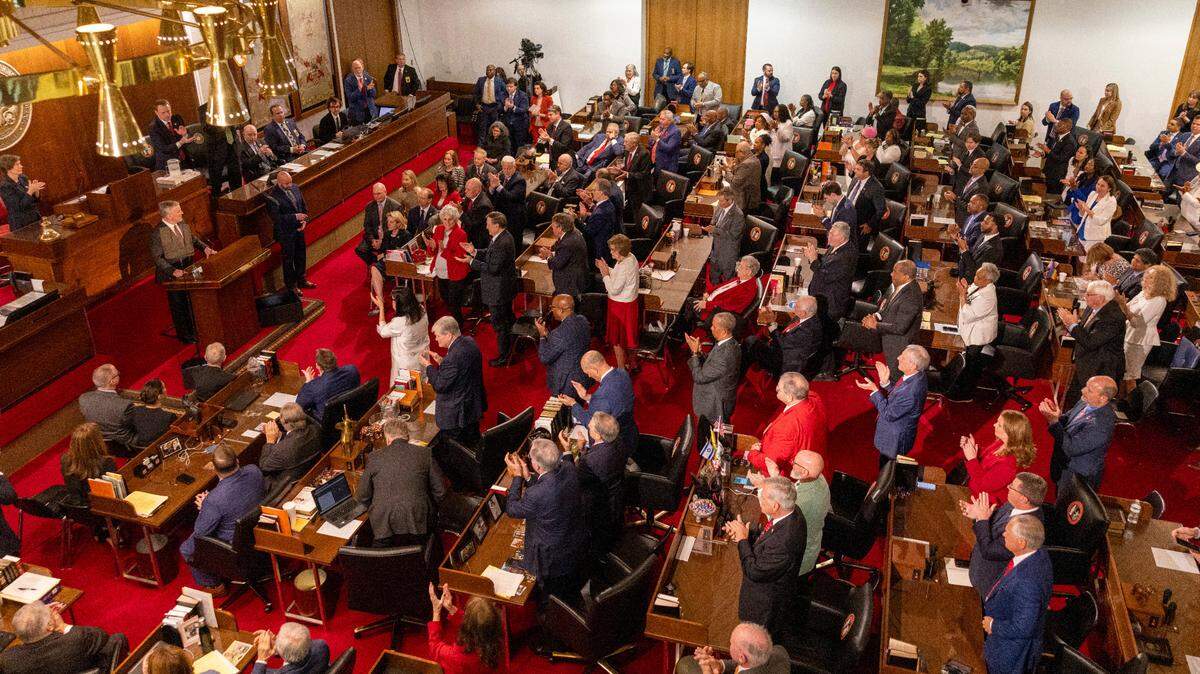
As President Donald Trump seeks to eliminate diversity, equity and inclusion programs from the federal government, North Carolina lawmakers are advancing their own sweeping proposals to target DEI.
Republican leaders in both chambers of the state legislature have introduced bills seeking to ban DEI in public schools, universities and state and local governments.
House Majority Leader Brenden Jones, who sponsored the bill seeking to ban DEI in state government, said Tuesday that the bill does not ban diversity or infringe on free speech protections.
“What it does do is stop government offices from choosing winners and losers based on race, sex or background,” he said at a committee hearing. “It puts an end to mandatory trainings that shame employees into ideology confirmation, and it ensures that taxpayer dollars go toward delivering results — not enforcing ideology.”
Critics, however, have suggested the bills are overly broad and could chill speech on topics such as race and gender while also endangering useful diversity initiatives.
“Diversity, equity and inclusion are good things,” Rep. Lindsey Prather, a Buncombe County Democrat, said at Tuesday’s hearing. “... They are about casting a wider net and finding the folks with the most talent and skills for a job. They are about increasing access and removing unnecessary barriers. They are not replacing merit — they are identifying and protecting merit.”
Here’s what to know about North Carolina’s anti-DEI proposals.
What would the bills do?
The House and Senate have each introduced separate bills seeking to restrict DEI programs.
Senate leader Phil Berger sponsored Senate Bill 227, which would ban DEI and so-called “divisive concepts” — more on that later — from being taught in public schools.
The Senate passed SB 227 along party lines earlier this month, but the House has not yet taken it up.
In addition, Berger introduced Senate Bill 558, which largely targets the same “divisive concepts” and DEI programs but in public universities and community colleges.
In the House, Rep. Jones introduced House Bill 171, which seeks to eliminate DEI in state and local government.
The bill would ban state agencies and schools from using DEI in their hiring decisions or giving differential treatment or special benefits on the basis of race, sex, ethnicity, sexual orientation and more. It would also ban government agencies from using state funds to support DEI programs or applying for federal grants that require compliance with DEI policies.
An earlier version of Jones’ bill was far more restrictive, applying to non-state entities and imposing criminal punishments for violations.
He released an amended version of the legislation on Tuesday, saying in the hearing: “We’ve heard your concerns, so we went in (and) we made reasonable adjustments — we’ve tightened the language. But the core mission of this bill still remains the same: to place merit back in the center of our state government.”
How do the bills define ‘DEI’?
The Senate and House bills define DEI differently.
Rather than giving a singular definition of the concept, the Senate’s bills lists out a variety of “discriminatory practices” and “divisive concepts” that would be banned if enacted.
Among the banned practices are “treating an individual differently solely (due) to (an) advantage or disadvantage that individual has compared to other individuals or groups.”
As for divisive concepts, the bill lists 12 ideas that teachers would be banned from including in instruction.
Among those banned concepts are the ideas that “one race or sex is inherently superior to another race or sex” and that “the United States was created by members of a particular race or sex for the purpose of oppressing members of another race or sex.”
The Senate’s higher education bill does not ban public universities from teaching about “divisive concepts” but does ban them from endorsing them or requiring students to complete courses centered around them in order to graduate.
As for the House’s bill, it describes DEI as any program or policy designed to “influence hiring or employment practices with respect to race, sex, color, ethnicity, nationality, country of origin, or sexual orientation” or “promote differential treatment of or providing special benefits to individuals on the basis of race, sex, color, ethnicity, nationality, country or origin, or sexual orientation.”
The bill exempts guest speakers, student organization activities, Indian education services and several other academic categories from the ban.
Irving Joyner, a law professor at North Carolina Central University, said the House and Senate’s bills “tend to cover just about everything under the sun” and could therefore face legal issues with enforcement, were they to be enacted.
What is the state of DEI in NC now?
The bills come after the state’s university system and several agencies have already sought to restrict DEI programs.
The UNC Board of Governors, which oversees all of the state’s public universities, repealed previous DEI mandates last year.
Shortly after the board’s decision, all DEI offices and administrative roles at North Carolina public universities were eliminated or restructured, the N&O reported.
The newly elected state auditor and state treasurer, both of whom are Republicans, also ended DEI policies in their departments shortly after taking office.
In practical terms, that meant cutting implicit bias training for employees and removing DEI metrics from performance evaluations, Boliek told the N&O.
But questions remain about what exactly constitutes DEI — and who gets to decide.
In a committee hearing last month, Jones brushed off questions from Democratic lawmakers about what programs would be hypothetically banned if his bill passed.
In response to Democratic Rep. Pricey Harrison’s question about whether she could continue highlighting Black History Month in her weekly legislative newsletter, Jones said, “I hope that you’ll keep highlighting our greatest regardless of race, creed or color. We have great North Carolinians and they deserve to be recognized.”
A later draft of the bill included a section excluding the celebration of any “holiday, observance, or remembrance” from the ban.
Rep. Brandon Lofton, a Mecklenburg County Democrat, noted that in 2022, Republican House Speaker Tim Moore created a House Select Committee on Advancing Women in STEM.
“If this law had been in existence when that committee was formed, would that qualify under the concept of DEI?” he asked.
A legislative staff member answered that any allegation that the ban was broken would be determined by a court of law.
Does this affect private businesses and nonprofits?
Per the most recent version of the House’s bill, no.
An earlier version of HB 171 applied not only to state agencies, but also any “non-state entity,” a broad classification that encompasses essentially any business, nonprofit or organization. It would have banned these groups from using public funds to support any DEI programs.
Prior to the bill’s revisions, David Heinen, vice president at the North Carolina Center for Nonprofits, said that nonprofits who received state grants would have to be “very, very careful about how they’re using their funds” because the legislation opened them up to criminal penalties.
The bill also previously required all non-state entities — even those that didn’t receive government funds — to submit a yearly report to the state auditor explaining how they complied with the DEI ban.
Heinen suggested at the time that this provision may have been an oversight when the bill was drafted.
“I mean, that would be every nonprofit, every business, every individual in North Carolina,” he said. “... I doubt the State Auditor’s Office has the capacity to do that much.”
What would the penalties be for having DEI programs?
The Senate’s DEI bills do not specify any penalties for those who break the ban, but they do require schools and universities to certify each year to the state government that they have complied with the law.
The House’s bill says that state employees who violate the DEI ban could lose their jobs and be subject to civil penalties up to $5,000 for each violation.
Employees of state agencies would also be empowered to bring lawsuits against their employers for perceived violations of the ban.
A previous version of the House’s bill included criminal penalties for those found to be in violation. Any state officer or employee who violated the ban would have been subject to a Class 1 misdemeanor, the highest level of non-violent offense.
Non-state entities would also have been subject to criminal charges if they used public funds for DEI programs and could have faced civil suits from individuals who alleged they violated the new law.
Heinen suggested that provision could have prompted a wave of lawsuits from nonprofit employees alleging that their employers illegally engaged in DEI practices.
Are the bills likely to pass?
Republicans have sizable majorities in both chambers of the legislature, but that doesn’t necessarily mean the bills are guaranteed to pass.
First, the two chambers will have to determine which DEI bill to take up — or if they attempt to pass all of them.
Before the House amended its bill, Berger expressed caution about it.
“I don’t know that criminal penalties are the way for us to go,” he told reporters. “But obviously what we’re going to try to do is get a DEI bill across the finish line, and so we’ll have conversations as to how that works.”
There’s a possibility that the three bills could be amended, combined or even placed inside the state budget before they reach a final vote.
And if Republicans do pass a DEI bill, they still must contend with a likely veto from Democratic Gov. Josh Stein.
Senate Republicans have the numbers to override his veto, but the House GOP is one seat short of a veto-proof supermajority.
That means that in order to override Stein’s veto in the House, Republicans would have to either recruit one Democrat to their side or exploit an absence.
This story was originally published April 1, 2025 at 3:15 PM with the headline "NC lawmakers push to ban DEI in schools and government. How far will the proposals go?."