Will another NC election change boot more local Democrats out of office?
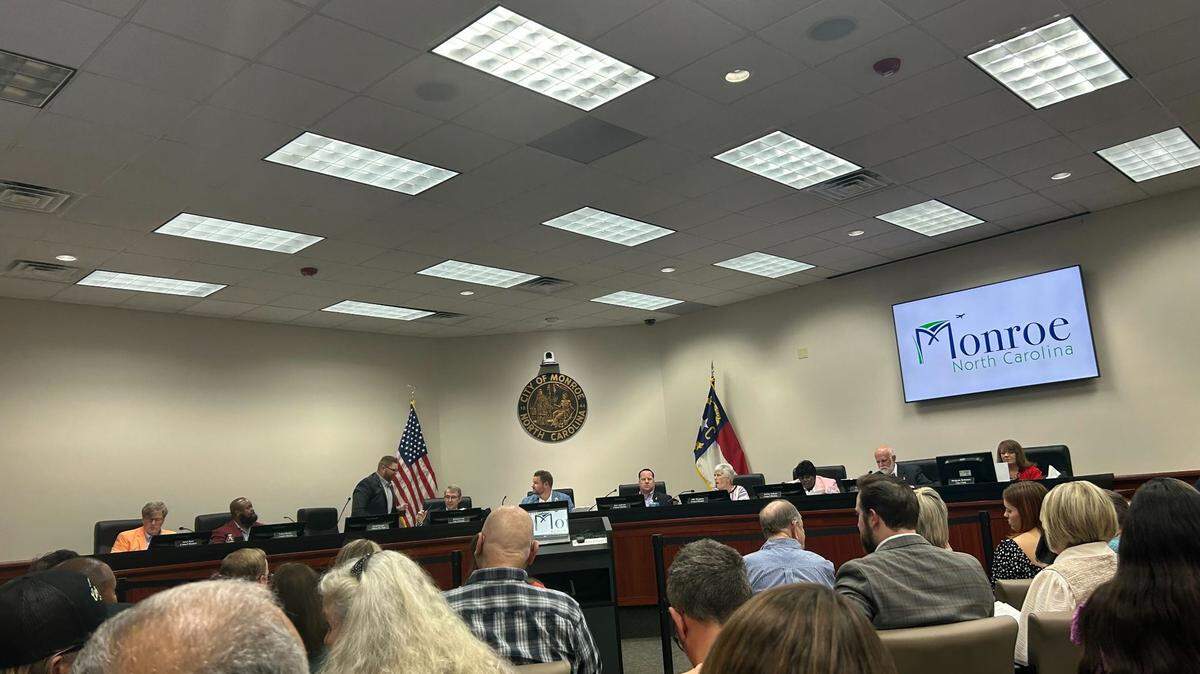
Monroe voters were set to elect a new mayor and City Council this fall. Now, a new state law delays that vote and moves future elections to a partisan system in a shift that could make it harder for Democrats to compete.
Monroe’s changes are part of a growing number of election law revisions in North Carolina that critics say disproportionately affect Democratic candidates. Some Monroe City Council members say they weren’t consulted about the change and didn’t ask for it.
More Republican control
Monroe is the only municipality in Union County now required to hold partisan elections under House Bill 3, which passed the House 62–47 and became law on June 25. The bill was sponsored by Rep. Timothy Reeder of Pitt County.
In addition to requiring partisan elections for the first time, the law moves Monroe’s elections to even-numbered years. The change came less than two weeks before the candidate filing period opened for municipal elections in North Carolina. To align with the new schedule, current Monroe council members and the mayor were each given an extra year in office despite not winning another election.
HB3 also made elections partisan in the Village of Simpson in Pitt County, and on the Pamlico County Board of Education.
Eric Heberlig, a political science professor at UNC Charlotte, said the shift could lead to greater Republican control in Monroe. In nonpartisan elections, Democratic candidates may benefit from name recognition and community reputation, he said. In partisan races, straight-ticket voting tends to boost Republicans in more conservative areas like Union County.
“Some faction of the Republican party … thinks that this is an advantage for them in having a party listed on the local election ballots in Monroe,” he said. “And it’s not just overriding local tradition, but not even consulting with local officials on what their attitude was on making that change.”
Republicans are the largest group of registered voters in Union County with more than 70,000 voters, compared with 67,000 unaffiliated voters and nearly 38,000 Democratic voters, according to state election data.
In Monroe, where all council members are elected citywide rather than by district, those partisan dynamics may be magnified, Heberlig said.
Party identification is not the only change the city will have to make due to the new law. Holding elections during even-numbered years changes the electorate, Heberlig said. Turnout is much higher during even-numbered years when presidential elections or other federal elections take place, he said. In odd-numbered years, voters tend to be more civically engaged and vocal about local politics.
“Politicians can strategically choose when the election is in order to try to select the electorate that they think is most favorable to the outcomes they want,” Heberlig said.
Partisan elections on the rise
Monroe’s change is the latest in a trend of partisan local elections in North Carolina.
Last year, the Cabarrus County school board held its first partisan election due to a change in state law spearheaded by Republicans. Two incumbent Democratic school board members lost their bids for reelection, and only Republicans were elected to the board. Fifty districts in the state hold partisan elections, including in Union and Catawba counties.
The General Assembly passed another bill last year that made most municipal elections in Forsyth County partisan. Another effort this year was House Bill 271, which only passed through the House and would have required municipalities in Cabarrus County to hold referendums this year to ask voters whether they want partisan elections.
“The General Assembly has frequently, over the past decade, involved itself in changing local election rules, whether it’s changing the districts in city council races or changing whether it’s a partisan or nonpartisan election,” Heberlig said.
Monroe Mayor Robert Burns, a registered Republican, said the new law is not about getting more Republicans or Democrats in office, but rather increasing transparency.
“I don’t think giving more information to voters should be a hot topic,” Burns wrote in an email to the Observer. “As the conversation about election integrity is being elevated across the state, more municipal elections are becoming partisan. This isn’t a new idea, it’s a trend.”
What do Democrats say?
In June, Monroe council members Julie Thompson, Surluta Anthony and Franco McGee held a press conference criticizing the bill. Thompson said the council members were not aware of the bill until days before it was slated for a vote, and that members were told by the county’s board of elections rather than lawmakers themselves.
Anthony and McGee are both registered Democrats. The Observer reached out to all members of the Monroe City Council via email and phone call.
“I think it was actually a disgrace and a slap in the face to democracy,” Archie Hansley, the president of the Union County NAACP, told the Observer.
Hansley said lawmakers should have held a referendum, spoken to Monroe residents or at least informed the council. As far as the change goes, he said he views it as a way to get more conservative Republicans elected.
“The law is actually designed to allow and open the door for a lot of MAGA extremists to take seats on city council,” Hansley said. “It also disenfranchises a lot of the independent voters, actually stripping them of their right to be able to choose the candidate which would actually best suit their needs.”
Change to Cabarrus County appointment process
The law also changes how vacancies on the Cabarrus Board of County Commissioners will be filled.
Instead of allowing commissioners to vote for a replacement, the power to fill a vacancy on the board is given to the executive committee of the departing commissioner’s political party.
The change follows months of controversy over a seat on the commission left vacant by current North Carolina Sen. Chris Measmer. The county faced a lawsuit after voting to appoint the Cabarrus GOP’s pick to the seat and struggled to appoint a replacement after a judge barred her from taking office.
After weeks of contention on the board, including accusations of corruption between commissioners, the power to appoint a replacement was eventually given to the Cabarrus County Clerk of Court, who put Commissioner Jeff Jones in the seat.
Heberlig said the change allows for more partisan control over replacements and less public accountability.
“If you have the county clerk who’s not a partisan appointee making the appointment, the political power brokers don’t like that,” he said. “And again, should local elected officials be chosen by political parties, not by voters themselves? Political party executive committees aren’t elected officials. They’re not accountable to the public.”
This story was originally published July 2, 2025 at 5:30 AM.