A unique NC unit helps schools catch warning signs before violence. Here’s how.
AI-generated summary reviewed by our newsroom.
- The SBI’s BeTA unit assesses threats by identifying behaviors linked to violence.
- The NC BIO 25 tool standardizes threat analysis and informs law enforcement training.
- BeTA cases increased annually, with 60% involving juveniles and school-linked threats.
As families in Minneapolis mourned the deaths of two children in a school shooting this week, North Carolina investigators highlighted their efforts to stop such violence before it happens.
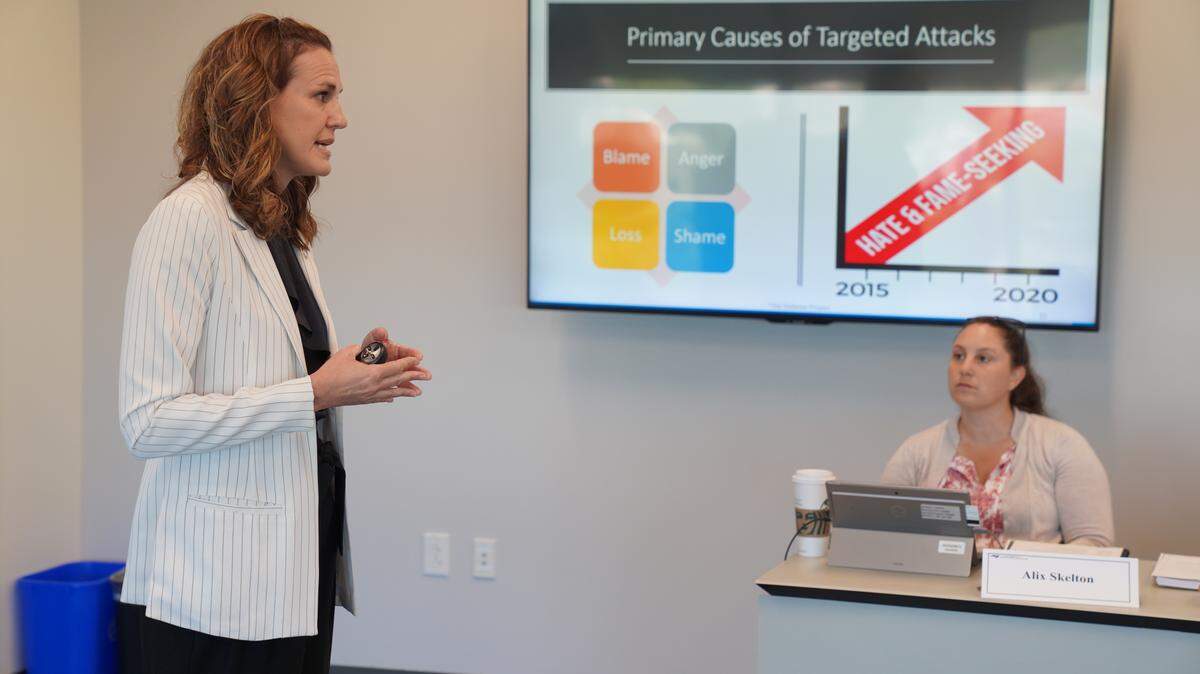
On Thursday, the State Bureau of Investigation spotlighted its Behavioral Threat Assessment Unit (BeTA), a team that works with schools and law enforcement to identify and support people showing signs they may be on a path to violence.
The unit is made up of police officers, analysts and mental health experts who work together to spot, investigate and manage people who might be planning an attack.
As part of its work, the BeTA unit developed the NC BIO 25 tool and provides training worldwide on how to use it proactively.
Nicole Jones, a psychologist in the unit, said the tool “bridges the gap between unstructured options” and “overly prescriptive tools.” She said It does not estimate the probability that someone will commit an attack — since research has not advanced to the point of quantifying how risk factors combine to predict violence. Instead, the tool highlights behaviors and circumstances linked to a higher likelihood of an attack, she said.
Jones said the framework moves threat assessment beyond individual judgment calls, such as one person deciding whether someone seems dangerous, by structuring the factors that need closer review.
“It’s almost like a 360-degree understanding of this individual,” she said.
Earl Sam, the SBI’s assistant special agent in charge of the BeTA unit, said the SBI was one of the first statewide agencies to build such a unit to support local police departments and sheriff’s offices. Local threat assessment teams can handle cases on their own, he said, but if something needs to be elevated, they can bring it to the SBI. For agencies without a team, the SBI provides the service directly. The unit was created in 2018 after the deadly shooting at Marjory Stoneman Douglas High School in Parkland, Florida.
Meredith Webster, director of programs at the Franklin County Sheriff’s Office, said she has been on her office’s threat assessment team for two years. With 17 years of experience in the field, she attended Jones’ training and found it beneficial.
She said the tool provides clear guidance on behaviors and classifications to watch for, and the training included an about 20-page packet of questions and information. For her, the difference is that “I’ve never seen a tool designed so specifically that has gotten it right.”
Without such partnerships, she said, “you would have more serious instances than we’ve had. The shooting that occurred yesterday, that just did not happen, that was something that was planned.”
“We as a society have always been reactive and not proactive, and I think we’ve gotten to a point where we have to be more proactive and work collaboratively,” she said.
Webster added that the tools provide a framework for addressing mental illness, substance use and behavioral issues holistically. “You’re not just saying, you committed this crime, this is what I’m charging you with,” she said.
How investigations work
Jones said cases typically start with a community member, teacher or local law enforcement partner identifying a person of concern. In schools, that often happens after a struggling student makes a direct threat or leaks intentions online, such as on a gaming platform. Social media posts are also looked at, Sam said.
Other warning signs include juveniles identifying with past mass attackers through online forums. Jones added that suicidal thoughts are another critical factor, since people in deep crisis may externalize blame, which can evolve into violent thoughts or a desire for revenge.
Once a case is identified and reported, the BeTA unit can determine whether a behavioral threat assessment investigation actually needs to be done.
“We certainly don’t want to label someone as potentially posing a threat for violence if that’s not truly indicated, and a better system like mental health or the school might be the more appropriate path for that individual,” she said.
If an investigation is warranted, officers collect information, and the multidisciplinary team evaluates the risk. “Why do they think violence is a solution to the problems that they’re experiencing? And then, more importantly, what can we do about it that lowers the overall risk that someone might go on to commit one of these attacks?“ Jones said.
Sam said investigators try to complete cases within eight weeks, though timelines can run longer if court proceedings or mental health treatment are involved.
Jones added that under the right conditions, almost anyone can become violent, which is why understanding triggers is key. After developing a plan with the individual, family and law enforcement, the unit follows up three months later to see if behavior has stabilized.
Growing caseload
The BeTA unit’s caseload has been growing as agencies receive training and make use of the program, according to Chad Flowers, the public information director for the SBI. Here’s the breakdown:
- 2021: 43 cases
- 2022: 74 cases
- 2023: 105 cases
- 2024: 110 cases
- 2025 (to date): 62 cases
Currently, about 60% of BeTA cases involve juveniles and are connected to schools, Flowers said.
Sam said he had “full faith that we’ve made a difference. I have full faith that we have saved lives, and I have full faith that we have moved people in a positive direction .”
This story was originally published August 28, 2025 at 6:13 PM with the headline "A unique NC unit helps schools catch warning signs before violence. Here’s how.."