
Next Charlotte mayor will face challenges in Raleigh
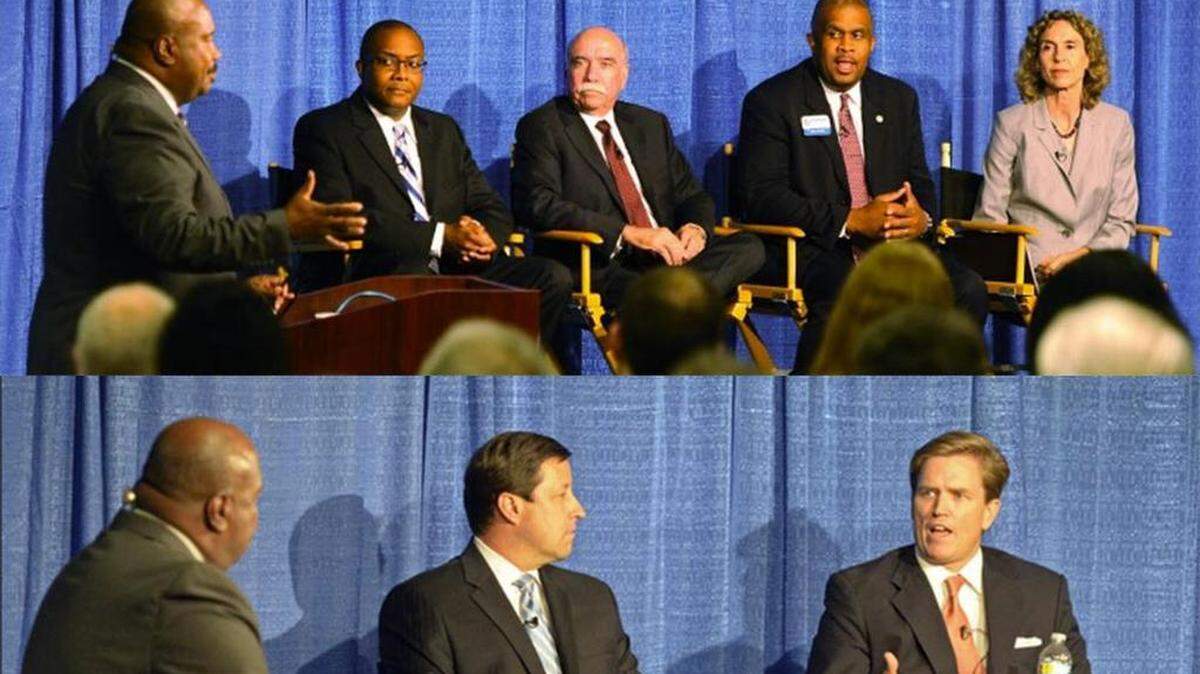
Like an out-muscled sparring partner, Charlotte has usually found itself on the ropes in its frequent bouts with North Carolina’s General Assembly.
The city has fought to keep what it has, from the continuing dispute over its airport to the scramble to save millions in sales tax revenues. It’s also fighting for new tools to meet the needs of a city with the nation’s second-fastest growth rate.
So dealing with the legislature will be one of the main challenges for Charlotte’s next mayor.
Tensions may be unavoidable.
Like the state’s other large cities, Charlotte is governed by Democrats, while the General Assembly is controlled by Republicans.
The urban versus rural discussion is going to continue in Raleigh, and it’s going to manifest itself in many different ways.
Huntersville Mayor Jill Swain
And in a paradox, the legislature has been marked by the re-ascendance of rural power in one of the nation’s most rapidly urbanizing states.
“The urban vs. rural discussion is going to continue in Raleigh, and it’s going to manifest itself in many different ways,” says Huntersville Mayor Jill Swain, who leads the N.C. Metropolitan Mayors Coalition. “It’s going to be very important for Charlotte’s mayor … (to) stand up for the region.”
The battles aren’t restricted to Charlotte.
This year, lawmakers redrew Greensboro’s City Council districts. Earlier, they changed the Wake County Board of Commissioners. In 2013, they transferred Asheville’s water system from city control. All three actions are being challenged in court. Other actions have limited the power of local government.
Just set up and have lunch and just get to know each other; I’ve never had that happen.
Sen. Tom Apodaca
a Hendersonville Republican“The leadership in Raleigh needs to be able to not only talk but to listen and work with Charlotte, and not against Charlotte,” says Sen. Joel Ford, a Charlotte Democrat. “Right now … that’s not happening.”
Sen. Tom Apodaca, a Hendersonville Republican and Senate Rules chairman, says Charlotte could make more of an effort to develop relationships with GOP lawmakers.
“Just set up and have lunch and just get to know each other; I’ve never had that happen,” he says. “I would apply business principles. … Get to know your customers.”
The scope of all the challenges confronting the next mayor won’t be known until lawmakers finish the state budget that was due July 1. But here are five he or she is almost certain to face:
1 Money. Still unresolved is the issue of shifting sales tax revenues from urban to rural areas. Estimates say that could cost the city of Charlotte $20 million over four years and Mecklenburg County $65 million over four years.
Last session, lawmakers did away with the business privilege tax, which cost the city $18 million. Now the city faces an annual loss of $3 million after lawmakers voted to exempt builders’ unsold inventories from property taxes.
Leaders in Charlotte and other cities say that creates more pressure to raise property taxes. And last session, the legislature even tried to cap such increases.
2 The unexpected. The 2013 attempt to transfer control of Charlotte Douglas International Airport from the city to an independent commission caught Charlotte leaders by surprise. More than 2 1/2 years later, it’s still in limbo.
Asheville didn’t expect its water system to be taken from its control. Greensboro didn’t expect its City Council to be upended. Wake County didn’t expect lawmakers to change the way it elects its county commissioners.
School boards in Cherokee, Clay and Rutherford counties were changed from nonpartisan to partisan, sometimes over the objections of the local board.
3 Local authority. Often in the name of easing over-regulation, lawmakers have chipped away at local government authority in several areas.
They have stopped involuntary annexations. They’ve limited local governments’ ability to regulate billboards and even political signs. They’ve barred cities from regulating the type or color of home siding and other design features. And they ended the use of zoning protest petitions, often used in Charlotte-Mecklenburg.
4 Economic development. One of the still unsettled issues is the fate of the Job Development Investment Grants, the state’s main economic incentive tool.
Like the sales tax, it’s part of a tug of war between urban and rural interests. Some GOP senators have complained that Mecklenburg and Wake have gotten the lion’s share of such grants.
Like the governor, city leaders say they’re an important tool with which to lure jobs and compete with other states.
5 Transportation. Whether it’s for rail or roads, the city will continue to be heavily dependent on the state for the money to meet its transportation needs – all the more so as Charlotte continues to grow and look for transportation alternatives.
“We’re always going to be fighting for transportation dollars,” says Swain of the Metro Mayors group.
Jim Morrill: 704-358-5059, @jimmorrill
What the candidates say
Michael Barnes, D
The Rocky Mount native says he understands the way other parts of the state see Charlotte: “Their impression is Charlotte has everything it needs, so it doesn’t need much more.”
Barnes says he would lead the council to meet with officials from the city of Raleigh as well as legislators.
“People view us as insulated from other parts of the state,” he says. “If we build relationships with other cities, that begins to change it. You can’t sit in Mecklenburg County and think that people in Pasquotank County are going to understand your problems. You’ve got to reach out.”
Dan Clodfelter, D
Clodfelter, a former senator, says the city has to show it appreciates the needs of the state. “We’ve got to take ownership in Charlotte of problems in other parts of the state,” he said in a debate. “The dialogue has to change its tone.”
He says he’s already seen the tone begin to change regarding the needs of rural counties. With the state losing court challenges on issues such as Asheville’s water system, he hopes lawmakers will be ready for a new “grand bargain” to redefine the responsibilities of local and state governments.
“We’re having these one-off fights because we’re not digging down underneath to look at the more basic structures of how state versus local responsibilities are allocated,” he says.
David Howard, D
As a council member involved in regional issues, Howard says it’s important to listen to the voices of rural North Carolina. It also can encourage lawmakers to realize their mutual interests. For example, he says, extending mass transit can benefit surrounding counties.
“It’s dialogue, just dialogue,” he says.
During one debate, Howard said “the state wants to know that we get it, that we’re not in it for ourselves.”
Edwin Peacock, R
Peacock says when he was on the City Council, members were never encouraged to go the legislature. “To me, it always felt like it was never a relationship fully developed,” he says.
He would invite local lawmakers to go on retreat with members of council to focus on what he called “shared priorities.”
“We’re both working toward the same objectives for the entire state,” he says, “and not just Charlotte.”
Jennifer Roberts, D
The former county commissioner says she would build on regional relationships and reach out to other groups such as the Metro Mayors.
“I think it would be important to speak as a region because then you would have more voices bring the same views to Raleigh,” she says. “If we’re better at communicating, we can demonstrate that what’s best for Charlotte and our economic centers is best for the state.
“We also have in our region rural counties, and we need to be looking out for them (and) finding common ground.”
Scott Stone, R
Stone says one thing will help him right off the bat: his party.
“The fact that I have those relationships and we’re on the same team is certainly going to help me when I advocate for Charlotte,” he says.
He says he’d try to persuade lawmakers that a strong Charlotte is good for the state. “How goes Charlotte, so goes the entire state in terms of tax receipts and the economy,” he says. “So if Charlotte isn’t doing well, it’s going to be hard for the state to do well.”
This story was originally published September 4, 2015 at 6:49 PM with the headline "Next Charlotte mayor will face challenges in Raleigh."