Democrats could pick up seats in Congress under proposed North Carolina map
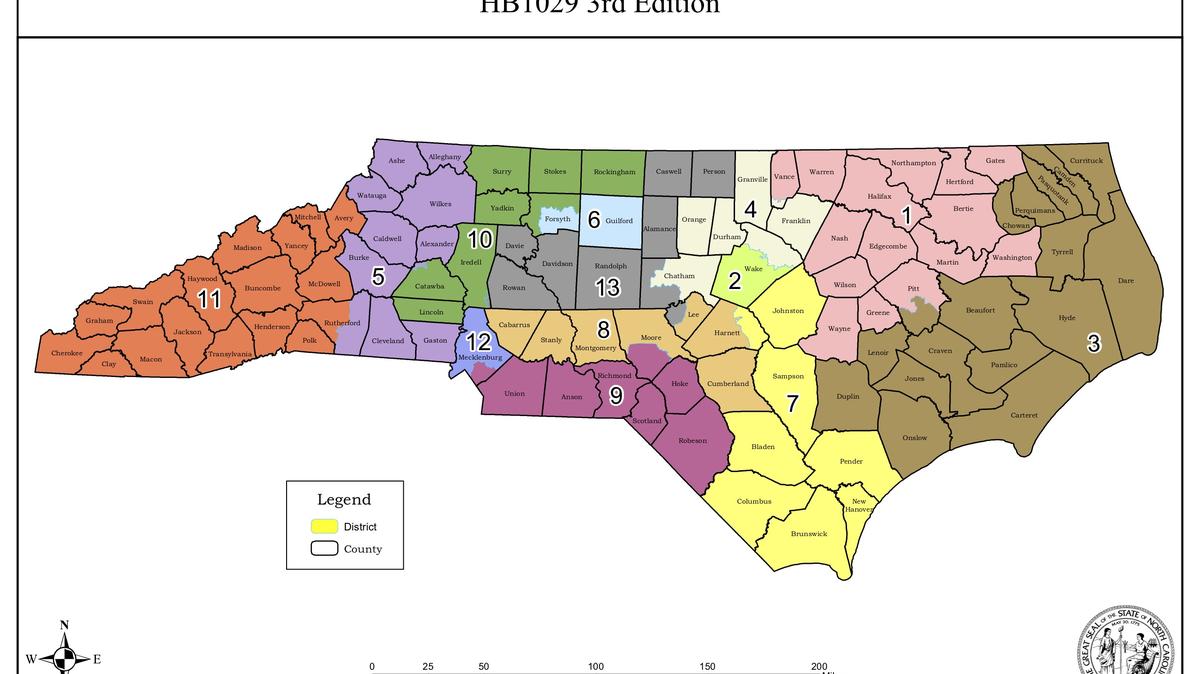
Republicans in the North Carolina General Assembly are advancing a new map for the 2020 U.S. House races that could cost their party seats in Congress.
The map passed the N.C. House Thursday afternoon and was sent to the Senate, which could pass the map into law or come up with a new proposal.
“I do believe this is a fair and honest attempt to address the issues that have been brought up,” said Republican Rep. David Lewis, one of the legislature’s top redistricting leaders. He was referring to a lawsuit that challenged the constitutionality of the current maps.
As it stands now, the state has a 10-3 Republican advantage in the U.S. House of Representatives, even though Democratic and Republican candidates typically get around the same number of votes statewide.
The new map that started advancing on Thursday would likely have an 8-5 Republican advantage. U.S. Rep. GK Butterfield, a Wilson Democrat, said Democrats have little chance of winning a sixth seat.
“To have a fair map we need a 6-7 map or a 7-6 map or a 6-6-1 map. Those would be fair maps,” said Butterfield, who had copies of the map printed out and showed them to other members of the congressional delegation at the U.S. Capitol on Thursday. “This appears on the face of it to be a 5-8 map which doesn’t quite get us where we need to go.”
Democrats at the legislature were also unhappy that there weren’t more competitive districts.
Wake County Rep. Darren Jackson, the top Democrat in the N.C. House, said the map looks like it has five safe Democratic seats, eight safe Republican seats and no swing seats. That means politicians don’t have to be as accountable for their actions, he said, adding that he hopes a court will strike down these maps as it has with other maps passed by the Republican-controlled legislature.
And state Rep. Deb Butler of Wilmington said several districts are highly similar to the shapes they have in the current gerrymandered map.
“I’m wondering why we didn’t take a better effort to get away from what was identified as problematic,” she said.
Holding and Walker in danger
Under the map that started moving forward Thursday, Democrats would be favored to flip the seats held by Republican Reps. George Holding and Mark Walker.
Their districts currently include suburban and rural areas outside of Raleigh (for Holding) and Greensboro (for Walker). Under the new map, however, their districts would be less rural and more urban, with Wake County less carved up and Guilford County kept completely whole.
The state’s three Democratic representatives, Butterfield, Alma Adams and David Price, also appear to retain relatively safe seats in the proposed map. If Democrats in North Carolina were to keep those three seats and also flip the seats held by Holding and Walker, they could put a damper on national Republicans’ hopes of flipping the U.S. House back to a Republican majority in the 2020 elections.
It’s possible that either Holding or Walker, if they don’t believe they could win re-election in their redrawn districts, could run in a primary against one of their fellow Republicans. And there’s even recent history of one of them doing just that.
While voters have to live within a district to vote for its representative, the candidates themselves don’t have to live in their district. Holding doesn’t live in his current district — his home near downtown Raleigh is in Price’s heavily liberal district — but in 2016 he successfully challenged fellow Republican Rep. Renee Ellmers to a primary there.
“No one is entitled to a congressional district. This is the people’s House,” Holding, a Raleigh Republican, said in an interview Thursday. “I’m going to be here and be effective as long as I can be here, but no one is entitled to a congressional district.”
Holding told The News & Observer previously that he would not run except in a district he believes he can represent. Holding said Thursday that he thinks representatives should live in a county that is in the district they represent.
Walker said in a tweet Thursday that “We’ll continue to serve our constituents wherever the trail leads.”
Asheville intact
In far-western North Carolina, the new map puts all of Buncombe County, home to the city of Asheville, in the same district. Currently, the county and city are split into two districts. As a result, Republican Mark Meadows’ district is expected to be less conservative. A similar district was represented by moderate Democrat Heath Shuler, who retired and was replaced by Meadows in the 2012 election in a new Republican-drawn district.
“I love the people in Buncombe County and I’ve had half of it, and if I’m fortunate enough to represent the other half of it, I’ll do the best I can to earn their trust,” said Meadows, the former head of the conservative House Freedom Caucus and a staunch ally of President Donald Trump. “If who I am as a member of Congress is someone that is out of touch with the district they represent, they’ll be sent home and that’ll be the will of the people, and I can applaud that.”
The redistricting is happening so close to the 2020 elections — the primaries are in March and the deadline for candidates to file is just over a month away — because of yet another gerrymandering lawsuit. Judges ruled the state’s legislative maps unconstitutional in September, due to the way the maps increased the power of conservative voters and decreased the power of liberal voters. After that ruling came down, a liberal group quickly sued over North Carolina’s congressional map, making many of the same arguments, and judges issued a ruling that the congressional map would likely be found unconstitutional, too.
Instead of going through a lengthy trial with skeptical judges, the Republican-led General Assembly decided to get to work redrawing the congressional map.
“(Former Attorney General) Eric Holder and (President) Barack Obama have raised a lot of money for this outcome, and they’ve pursued a really aggressive legal strategy for their partisan outcomes, and right now they’e calling it partisan gerrymandering, but what they’re seeking is partisan gerrymandering for the left,” said Rep. Patrick McHenry, a Republican from Denver.
A study by several Duke University professors last month — including gerrymandering expert Jonathan Mattingly, an expert witness for the challengers in the legislative maps case — found that out of thousands of potential ways to draw the state’s maps, an 8-5 split was the most common outcome.
The study used data from various elections in both 2012 and 2016 and found that in the vast majority of maps, Republicans would keep a majority, with Democrats winning anywhere from four to six of the 13 seats.
For more North Carolina government and politics news, listen to the Domecast politics podcast from The News & Observer and the NC Insider. You can find it on Megaphone, Apple Podcasts, iHeartRadio, Stitcher or wherever you get your podcasts.
This story was originally published November 14, 2019 at 3:38 PM with the headline "Democrats could pick up seats in Congress under proposed North Carolina map."