
Senate candidate took money from corporate interests. Now she says she’s ‘unbought’
This story was clarified on Jan. 17.
Democratic U.S. Senate candidate Erica Smith has vowed not to take money from corporate political action committees during her campaign, often railing against what she calls the corrupting influence of money in politics.
“I’m unbought and unbossed. I’m the person that you need representing you. I don’t take corporate money. I have taken the pledge,” she said during a September forum.
Smith, who represents several northeastern counties in the North Carolina state Senate, told The News & Observer that she swore off corporate PAC money before her 2018 state Senate race. On Twitter, she wrote that “bought leadership is never paid for.” She told an Elizabeth Warren supporter worried about Smith “taking big donor fundraisers” the same thing during a Twitter exchange in September. Smith’s Twitter bio says “People, not PACs.”
But in the time between her 2016 election and her entering the U.S. Senate race in late January 2019, Smith accepted money from a variety of committees connected to corporate entities, including CSX Corporation, AT&T, Merck, Charter Communications, Dominion and Duke Energy, according to records filed with the North Carolina State Board of Elections. She accepted $13,000 from corporate PACs in that period. She raised about $50,000 for her 2018 state Senate bid.
In a December interview, Smith acknowledged some of the money.
“There was a Duke Energy PAC check that I received for $3,000, but that was tied to my leadership as the chair of the NC Legislative Black Caucus,” Smith said. “Even that big corporate PAC check donation, it didn’t cause me or influence me to vote. I voted for the people of North Carolina and put the issues over industry.”
She is one of five Democrats running for the seat held by Republican Sen. Thom Tillis, who is running for re-election. Smith led former state Sen. Cal Cunningham in limited public polling early in the race, including a Fox News poll in November. Cunningham leads in a new Public Policy Polling poll released this week, but it showed that 60% of the electorate is still undecided. The CEO of PPP is a Cunningham donor and endorser.
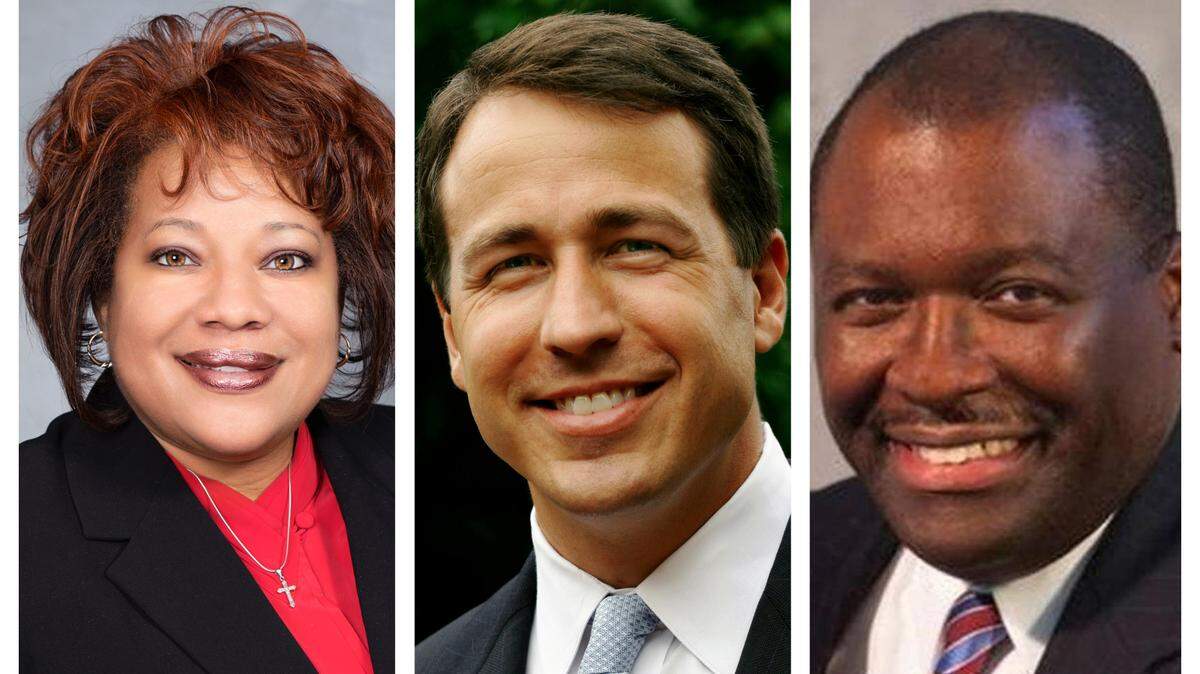
In addition to Smith and Cunningham, Mecklenburg County Commissioner Trevor Fuller, Raleigh physician Atul Goel and Steve Swenson of Bunnlevel will be on the primary ballot. The primary is March 3.
“I’ve not accepted any corporate PAC money in this race. You can see that,” said Smith, who has not received any PAC money for her U.S. Senate race. “I’m not accepting corporate PAC money and when I say that, I’m not. I’m not backdooring contributions. The way Cunningham is doing it is mostly false.”
Smith was referring to a PolitiFact fact check on Cunningham’s claims about corporate money, which said his claim that his campaign “is funded by people like you — not the special interests” was mostly false.
BEHIND THE STORY
MOREWhy we're writing this
The 2014 U.S. Senate race was the most expensive race to that point, and money is sure to pour in now that the seat is up for grabs again with control of the Senate on the line. We’re keeping an eye on the candidates’ money and where it’s coming from. Read our previous stories here:
https://bit.ly/2FT4C6p
https://bit.ly/2FQRL4y
Cunningham’s money
Corporate PACs largely donate to incumbents, so the fact that neither Cunningham nor Smith has gotten money from them for their U.S. Senate race is not that surprising. Corporate PACs gave $166 million to incumbent federal officeholders in the 2018 cycle, but just $4 million to challengers and $7.8 million to candidates running for open seats, according to the Federal Election Commission.
Cunningham, too, has pledged not to take corporate PAC money and has been endorsed by End Citizens United, a PAC that wants to reverse the 2010 Supreme Court decision known as Citizens United that opened the door for corporations and unions to spend unlimited amounts of money in support or opposition to candidates though limits remain on direct donations to candidates.
“Cal Cunningham championed reform as a state senator, rejects corporate PAC money in his U.S. Senate campaign, and has already put forth a bold anti-corruption plan, proving his priority is North Carolinians,” said End Citizens United communications director Patrick Burgwinkle in a statement.
Cunningham took more than $9,000 from corporate PACs while running for and serving in the state legislature from 2000 through 2002, according to North Carolina State Board of Elections filings. A previous version of this story included money from trade and membership PACs in the total above.
End Citizens United’s pledge is solely about federal election dollars. Many candidates who have taken the pledge have accepted corporate PAC money in the past. The group said as many as 60 candidates have taken the pledge this election cycle.
Tillis has not taken the pledge and has accepted money from corporate PACs.
Cunningham, who is vice president and general counsel for WasteZero, has raised more than $3 million since entering the race, including the $200,000 he loaned his campaign. He has not received money from corporate PACs, but has taken money from wealthy corporate executives and from other types of PACs, including more than $124,000 from Democratic U.S. senators’ “leadership PACs.” Many of those PACs in turn have taken corporate PAC money.
Smith said that’s “a way around” the pledge.
Individuals, even CEOs, may be giving to a candidate for reasons that have nothing to do with their company — such as a candidate’s stance on the environment or abortion. The issue of holding fundraisers for high-dollar contributors has become an issue in the Democratic primary.
There is a $5,600 limit on donations to candidates and their campaigns — $2,800 in the primary and $2,800 in the general. PACs and corporations, however, can spend unlimited dollars on independent ads or by giving to other entities, including so-called dark money groups that do not have to identify their donors, to spend on behalf of candidates. They cannot coordinate with campaigns.
Cunningham is endorsed by VoteVets, a group that supports liberal candidates. Vote Vets PAC donated $10,000 to his campaign. The group’s Action Fund is running a biographical television ad in support of Cunningham, which highlights his military service in Iraq and Afghanistan including his Bronze Star.
VoteVets Action Fund is a nonprofit organization that says it focuses largely on education and advocacy for veterans and their families. But it also touts its political work, having spent more than $50 million in television and radio ads. As a nonprofit organization, it does not have to disclose its donors. It is one of the top spending “dark money” groups for Democratic candidates, according to the Center for Responsive Politics.
Smith wants public financing
Smith discussed a $250 check she received from the CSX Corporation Good Government Fund in January 2019, less than a week before she entered the U.S. Senate race, saying it was for an “interconnect in the district I represent.”
North Carolina’s Department of Transportation is spending $118 million for road improvements and to develop a 330-acre site in Edgecombe County where CSX plans a $40 million investment into the Carolina Connector, a terminal where cargo containers will be shifted between trucks and trains, according to previous reporting by The News & Observer.
Smith, a former engineer and public school teacher, represents several counties to the north and east of Edgecombe.
Smith lags far behind in fundraising, having raised a bit more than $133,000 through the end of September. Earlier in her campaign, she asked for supporters to bring food donations for local pantries to her events. She has not reported her fundraising total for the fourth quarter of 2019, which is due by the end of January. Smith called for public financing of campaigns and ending Citizens United.
“That’s when we get candidates based on merit and not based on their willingness to advance an agenda other than the people they are serving,” she said. “In large part because of the decision in Citizens United, it’s unfortunate that we have seen the influence of big money. Now we no longer have congresspersons governed by principles. They’re pretty much governed by purse strings.”
Other candidates
Fuller, at that same September forum, called for legislation or a constitutional amendment to undo the Citizens United decision. He, too, wants public financing of campaigns. Fuller raised $31,000 through September.
“I believe it was wrongly decided. It is wrong that money is speech, and if it is speech, only some people have it and others don’t,” he said. “I believe that is a threat to the First Amendment.”
Goel, a physician who served in the Air Force, said he’s heard in his conversations with voters that “nobody wants big money in politics.” Goel has not filed so far with the FEC. Goel said on Twitter that he would accept money only from people who live in North Carolina “& are not a PAC, lobbyist, or special interest.”
“It would be traitorous to accept hundreds of thousands of dollars from people who don’t live in North Carolina. How can I possibly represent North Carolina if i start taking money from corporations and PACs?” he said in an interview.
What’s a corporate PAC?
In the 2018 mid-term election cycle, PACs of all kinds contributed more than $465 million directly to candidates as part of $4.5 billion in spending on the campaigns.
The Federal Election Commission designates seven different types of political action committees. Two pertain to corporations — one for corporations with stock and one for corporations without stock. End Citizens United counts these two types of PACs for purposes of its “no corporate PAC money pledge.” Those two types account for 40% of all PAC giving, more than $185 million in 2018 with $178 million coming from corporations with stock.
The other types of PACs are nonconnected ($100 million in 2018), trade ($87 million), labor ($53 million) membership organizations ($32 million) and cooperatives ($5 million).
For more North Carolina government and politics news, listen to the Domecast politics podcast from The News & Observer and the NC Insider. You can find it on Megaphone, Apple Podcasts, iHeartRadio, Stitcher or wherever you get your podcasts.
This story was originally published January 15, 2020 at 1:24 PM with the headline "Senate candidate took money from corporate interests. Now she says she’s ‘unbought’."