
N.C. law: No exiting U.S. Senate race this close to election
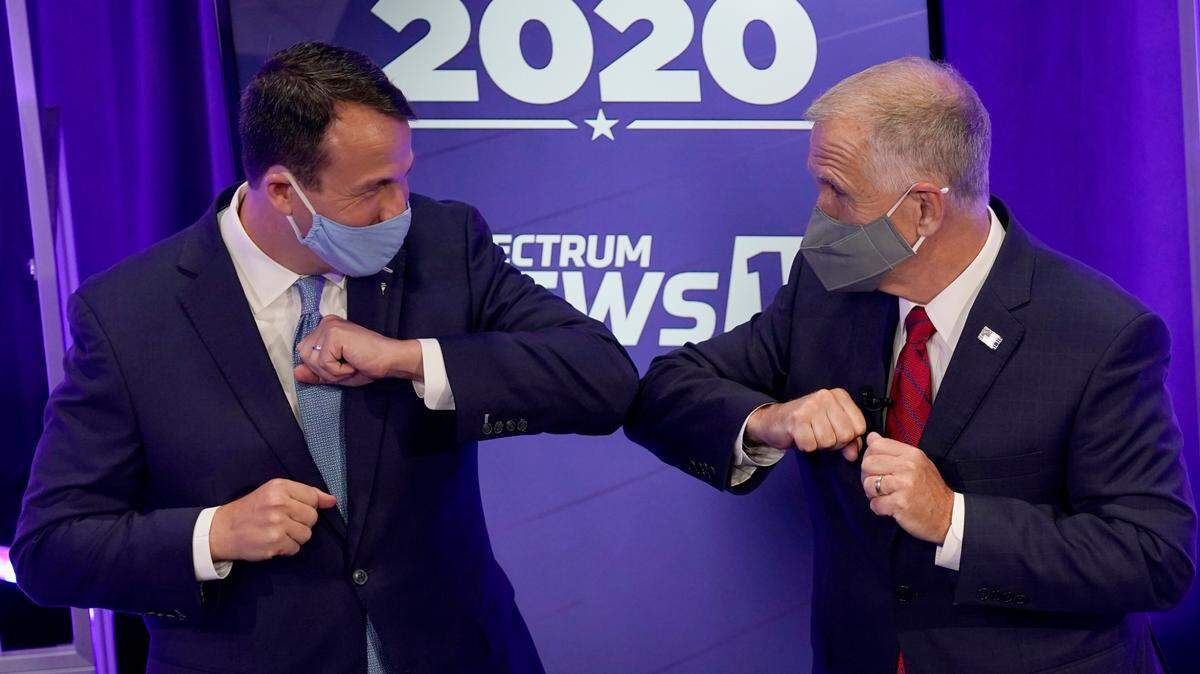
One candidate has sent sexually suggestive texts to a woman who is not his wife. And the other has tested positive for COVID-19.
If the scandal or the sickness get worse, could either Democrat Cal Cunningham or Republican Thom Tillis — or both — drop out of North Carolina’s pivotal U.S. Senate race with Election Day less than a month away?
No, they can’t, not this close to the election. So says an attorney for the N.C. State Board of Elections, citing state law.
“A candidate must withdraw more than 60 days prior to the election,” general counsel Katelyn Love said in a Tuesday email sent to the Charlotte Observer by the state elections board. “After that, withdrawal is not permitted and any votes for that candidate will count for that candidate.”
Last Friday, Cunningham acknowledged and apologized for exchanging the intimate text messages with a woman in California. It was the second bombshell of the night. A few hours earlier, Sen. Tillis, running for a second term, announced that he had tested positive for the virus.
Neither candidate has said he plans to leave the race — Cunningham, in fact, said he won’t drop out, and Tillis said he is now symptom-free — so any talk of what the law allows is still strictly in the category of “What if.”
Elections board attorney Love, citing N.C. statute 163-113, titled “Nominee’s right to withdraw as candidate,” said both candidates lost any right to exit the race in early September. Or, in the words of the law, the deadline to drop out is “the first day on which military and overseas absentee ballots are transmitted to voters.”
This year, that was Sept. 4, when North Carolina became the first state in the country to start sending out requested absentee ballots.
What if, after the deadline, one of the candidates announces he is “suspending” his campaign?
“It doesn’t have any impact from an elections perspective because the withdrawal deadline has passed,” state board of elections spokesman Patrick Gannon told the Observer.
One more hypothetical: What if the winner of the Senate election in November decides to resign before or after being sworn in on Jan. 3, 2021?
General counsel Love’s answer: “If a candidate for U.S. Senate is not sworn in or resigns after being sworn in, then the governor appoints to fill the vacancy until the next regularly scheduled election for General Assembly (in 2022), at which time an election for the unexpired (six-year) term is held. The Governor must appoint from a list of three persons recommended by the state executive political party of the vacating member.”
She cited N.C. statute 163-12, titled “Filling vacancy in United States States Senate.”
Editor’s note: An Observer story posted Oct. 5 on this topic contained incorrect information about the process and was taken down.
This story was originally published October 6, 2020 at 5:16 PM.