
12 things you should know about presidential elections in NC history
For the 57th time, North Carolinians are joining with their fellow Americans to pick a president.
Since 1792, the state has a 38-18 record in backing the national winner.
Over those many years, North Carolina has gone from being dark blue (a Democratic stronghold) to rosy red (a reliably Republican state) to now purple (a battleground where elections are close).
The most popular presidential candidates in N.C. history? Two Democrats and two Republicans polled more than 60 percent. All four were elected — and re-elected — president. Their best N.C. showings:
▪ Democrat Andrew Jackson — 85 percent in 1832.
▪ Democrat Franklin Roosevelt — 74 percent in 1940.
▪ Republican Richard Nixon — 69 percent in 1972.
▪ Republican Ronald Reagan — 62 percent in 1984.
So, in 2020, will the Tar Heel trophy go to Democrat Joe Biden? Or will Republican Donald Trump again claim North Carolina’s 15 electoral votes?
History offers some hints.
Here, then, are 12 (other) things you should know about past presidential elections in North Carolina...
1
Democrats are still ahead, but Republicans are on a roll.
In 56 elections, North Carolina has picked the Democratic presidential candidate 30 times. Make that 31 if you count John C. Breckinridge, a Kentuckian who was nominated by the Southern wing of the Democratic Party in 1860 after Southerners walked out of the Democratic National Convention that nominated Stephen A. Douglas of Illinois.
The state has favored the GOP presidential candidate just 14 times. But in recent decades, Republicans have been on a roll in North Carolina: Their candidate has won the state in 11 of the past 13 presidential elections. Now many political strategists consider the state a must-win for the GOP. No Republican has won the White House without carrying North Carolina since Dwight Eisenhower in 1956.
For the record, North Carolina has also voted for three Whigs and a Federalist. And seven times, the state was in the column of the Democratic-Republicans. That party was founded in the early 1790s by Thomas Jefferson and James Madison as an opposition party to the governing Federalists. Starting with the election of Jefferson in 1800, the party held the White House for 24 years.
2
North Carolina was a no-show for the first presidential election.
George Washington, a Federalist, won the first of his two terms in an election held between Dec. 15, 1788 and Jan. 10, 1789. But because North Carolina had not yet ratified the new U.S. Constitution, it was not eligible to vote in this first-ever U.S. presidential election.
The hold-up, according to “North Carolina: The History of a Southern State” by Hugh Lefler and Albert Newsome, was that Anti-federalist leaders feared that the new Constitution ”would make possible a central government so strong and so consolidated as to impair local self-government, endanger the rights of North Carolina and threaten the civil liberties of individual citizens.”
But with the addition of the Bill of Rights on the horizon, the Federalists in North Carolina managed to win ratification for the U.S. Constitution on Nov. 21, 1789. And the state was there in 1792 to help elect Washington to a second term.
3
N.C. voters’ view of their native-son presidents? Mixed.
Both Carolinas have claimed to be the birthplace of Andrew Jackson, America’s seventh president. But it would be hard to out-do North Carolinians’ support for “Old Hickory.” The populist Democrat won the state three times — 1824, 1828 and 1832.
But by 1844, when Mecklenburg County-born Democrat James K. Polk was running, North Carolina was in the midst of a decade-long romance with Whig candidates. So Polk, a protege of Jackson’s, lost the state to Henry Clay, the Whig Party nominee. Polk did beat Clay nationally, though, becoming the country’s 11th president.
Then there was 1864 — the only other presidential election North Carolina missed, this time because it had seceded from the Union and joined the Confederacy. That meant it couldn’t vote for or against Raleigh-born Andrew Johnson, a Union-loving Southern Democratic senator who had agreed to be Republican President Abraham Lincoln’s running mate that year. Lincoln’s assassination in 1865 made Johnson the 17th president. He was later impeached by the Republican-controlled House, then acquitted (barely) by the Senate. In 1868, Johnson tried but failed to win the Democratic presidential nomination.
Footnote: Jackson, Polk and Johnson all launched their political careers in neighboring Tennessee, not in their native state.
4
North Carolina said ‘no’ to one Catholic candidate . . .
From 1876 to 1964, North Carolina voted for the Democrat in every presidential race except one: 1928.
That year, the state went for Republican Herbert Hoover over Democrat Al Smith, 55 percent to 45 percent. But those results said less about North Carolinians’ enthusiasm for Hoover, who was then the business-friendly secretary of Commerce, and more about their antipathy toward New York Gov. Smith — a cigar-smoking Roman Catholic with a thick Yankee accent, Irish and Italian immigrant roots, and a record of opposing Prohibition.
For many Protestants in North Carolina, voting for this “wet” whom they suspected would take orders from the Pope was enough to make them abandon their ancestral ties to the Democratic Party — at least for one election cycle.
“Top Democrats tried to keep the state in line for Smith. They worried that mass defections to Hoover would hurt other Democrats on the ticket,” writes Rob Christensen in “The Paradox of Tar Heel Politics,” his book about North Carolina pols. “But selling Smith in the Bible Belt was a difficult chore.”
In November, Smith managed to carry six Deep South states, including South Carolina. But Hoover cracked what had long been the Solid South, winning not only in North Carolina, but also in Virginia, Tennessee, Florida and Texas.
5
. . . But ‘yes’ to another, thanks to a key endorsement.
Fast-forward to 1960, when another Catholic was running for president: Democrat John F. Kennedy.
North Carolinians were also electing a governor that year, and Democratic nominee Terry Sanford of Laurinburg shocked and angered many of the state’s party regulars when he endorsed the senator from Massachusetts instead of a fellow Southerner, Sen. Lyndon Johnson of Texas.
Some anti-Catholic voters also felt betrayed. And they let Sanford know it in letters and telegrams, recounts John Drescher in his book, “The Triumph of Good Will: How Terry Sanford Beat a Champion of Segregation and Reshaped the South.” One voter from Chapel Hill lectured the would-be governor: “Apparently you are ignorant of the facts of life regarding international Catholicism. The Vatican philosophy is as dangerous as Moscow’s despotism.”
But Sanford never backed away from Kennedy, Drescher writes, even adopting JFK’s campaign as part of his own. And that November, both won in North Carolina.
6
The ‘Dixiecrat’ challenge to Democrats flopped in this Carolina . . .
Rewind to 1948, the year the Democratic National Convention convened in Philadelphia to nominate President Harry Truman. Things got fiery during the platform debate over a civil rights plank proposed by liberals that called for desegregating the armed forces, passing an anti-lynching law and abolishing state poll taxes designed to suppress African-American voters.
When it passed, delegates from the Deep South bolted. Days later, they reconvened in Birmingham, Ala., to launch the States’ Rights Democratic Party and nominate then-South Carolina Gov. Strom Thurmond for president.
A headline writer for the Charlotte News dubbed the group “Dixiecrats.” The name stuck. But in North Carolina, their rebel campaign flopped.
Leading the charge against Thurmond’s candidacy in the state, according to the Encyclopedia of North Carolina, was the News & Observer in Raleigh, a longtime voice of the Democratic Party in the state. The newspaper’s editor, Jonathan Daniels, was an adviser to Truman. The N&O charged that the Dixiecrat leaders possessed “an arrogance that has been rivaled only by their stupidity.”
That November, Thurmond carried Mississippi, Alabama, Louisiana and his own state of South Carolina, where he garnered more than 70 percent of the vote. But in North Carolina, he got only about 8 percent. Truman took 58 percent.
7
. . . But the ‘Southern Strategy’ delivered NC to the Republicans.
Twenty years later, as the country geared up for another tumultuous presidential election, North Carolina was more open to Thurmond’s pitch. He was not a candidate for the White House in 1968, but he had the ear of Richard Nixon, the Republican nominee.
Thurmond had quit the Democratic Party and joined the GOP in 1964 — the year Democratic President Lyndon Johnson presided over passage of a landmark civil rights bill.
Thurmond advised Southerners to “stick with Nixon,” whose campaign tapped into the white backlash to civil rights that was raging in the South. But Nixon was careful to not be as flagrant in his rhetoric as George Wallace, the segregationist governor of Alabama who was also running for president that year on a third-party ticket. As part of his “Southern strategy,” Nixon used code words like “law and order” and, according to the Encyclopedia of Southern Culture, “complained often and vehemently . . . about court-ordered busing and criminal-coddling judges.”
When the votes were counted, Nixon became the first Republican to carry North Carolina in 40 years. Wallace finished a strong second. And Democrat Hubert Humphrey, Johnson’s vice president and the chief champion of that civil rights plank at the party’s 1948 convention, came in last with less than 30 percent of the N.C. vote.
8
An ex-N.C. governor lost the ‘Dixie Classic’ to a race-baiter.
With Nixon running for re-election in 1972, the Democratic field was crowded and wide-open, ranging from Sen. George McGovern on the left to Alabama Gov. Wallace on the right.
Former N.C. Gov. Terry Sanford, then president of Duke University, sensed an opportunity and belatedly entered the Democratic race. His first goal was to knock off Wallace, whom he regarded “as the wrong kind of Southern politician, a ‘pure hypocrite’ who played the race card for his own benefit,” writes Rob Christensen in his history of N.C. politics. “If he could defeat Wallace in the North Carolina presidential primary in March (1972), then perhaps lightning could strike and he would emerge as a compromise candidate at the Democratic National Convention in Miami.”
But the times were not hospitable to a Southern progressive. With Nixon claiming to represent a “Silent Majority” put off by anti-Vietnam War demonstrations and civil rights protests, conservatism was on the rise — especially in North Carolina and other Southern states.
In the end, the Sanford-Wallace primary contest — dubbed the “Dixie Classic” by the News & Observer — was not even close. Sanford “was humiliated in his home state by an old rabid segregationist,” writes John Drescher in his book on Sanford, losing 50 percent to 37 percent.
9
‘Senator No’ rescued a conservative challenger.
In 1976, President Gerald Ford looked to be well on his way to a coronation at that year’s Republican National Convention in Kansas City. He was being challenged on the right by former California Gov. Ronald Reagan. But Ford had won all the early GOP primaries. And with the support of much of North Carolina’s Republican establishment, including then-Gov. Jim Holshouser, he expected to win the primary there and then accept Reagan’s withdrawal from the race.
But the state’s conservative first-term senator, Jesse Helms, had other ideas, writes Christensen in “The Paradox of Tar Heel Politics.” Helms’s North Carolina Congressional Club ran ads and mounted a get-out-the-vote effort for Reagan. Helms, known in Washington as “Senator No,” also persuaded Reagan to camp out in North Carolina the week before the primary. There, his candidacy finally caught fire with conservatives when he made an issue of Ford’s backing of the Panama Canal Treaty.
Reagan’s surprise win in North Carolina, 52 percent to 48 percent, turned the race for the GOP nomination into a close battle that went all the way to the convention. Ford eventually got the nod, but lost the White House to Democrat Jimmy Carter. Reagan came back in 1980 to win the Republican nomination and unseat Carter.
In 1983, then-President Reagan returned to North Carolina to speak at a dinner honoring Helms. He recalled his rescue:. “I’ll never forget that Saturday before the Tuesday primary. The press was asking only one question: When would I quit the race? Well, we didn’t quit and, thanks to Jesse, we won big — big enough to come close and then come back to win it all in 1980.”
10
She had a chance to become the first female president.
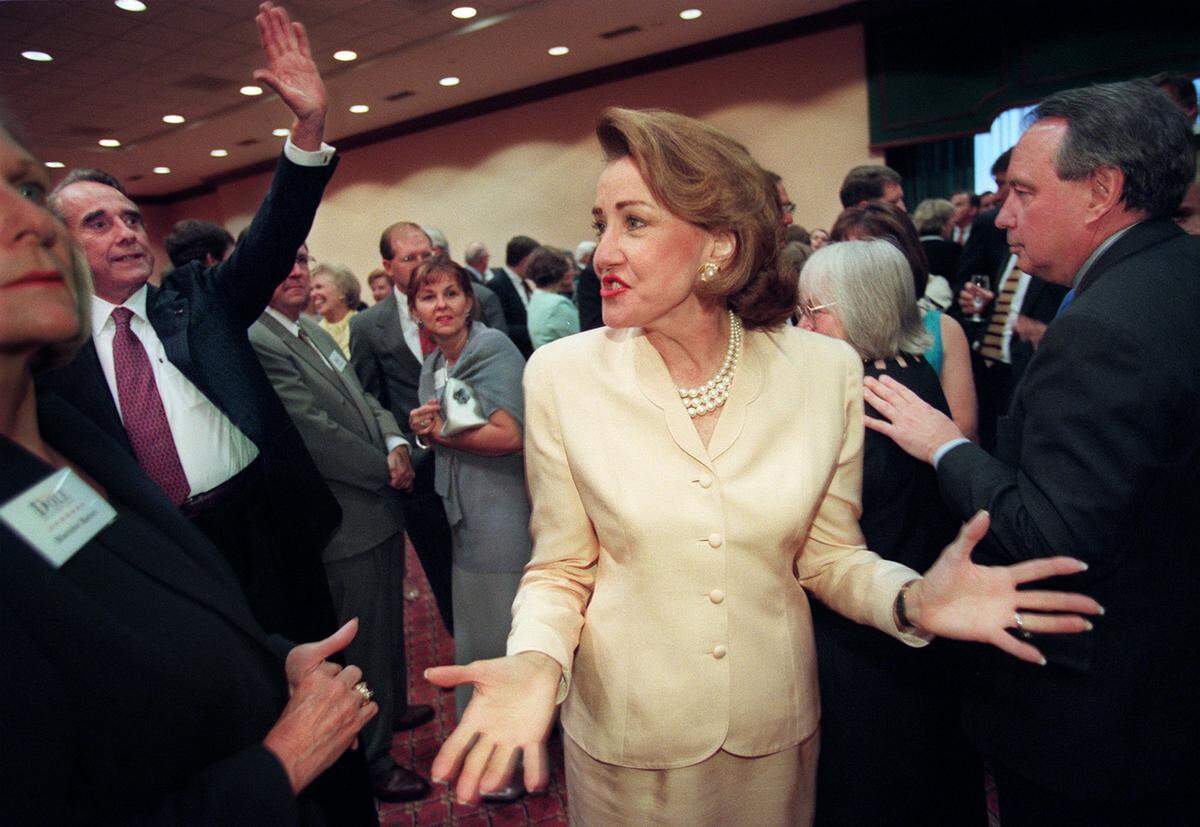
Like Bill and Hillary Clinton, Bob and Elizabeth Dole were a two-politician family. Different party, but same double-dose of presidential ambition.
In 1996, Bob Dole had won the Republican presidential nomination, but lost to Democrat Bill Clinton. In 2000, it was Elizabeth Dole’s turn to run. The Salisbury native, who had served in top posts in three GOP presidential administrations, announced her candidacy in early 1999. And with her national name recognition and contacts within the party’s establishment, she was a serious contender to become America’s first female president. Her campaign events drew large crowds and she finished a respectable third in the Iowa Straw Poll — an early clue about who might win that state’s key opening caucuses.
But Texas Gov. George W. Bush, son of the former president, quickly collected most of the major endorsements and raised $60 million in campaign donations.
In October 1999, before the first votes had even been cast, Dole dropped out, citing what would have been a serious cash disadvantage if she had stayed in the race. “In the real America, it’s more important to raise issues than campaign funds,” she said during a final news conference. “I told Bob that, this time, the odds are overwhelming. It would be futile to continue. And he reluctantly agreed.”
Three years later, North Carolinians would elect Dole to the U.S. Senate.
11
He was born in a small town, then ran for president and vice president.
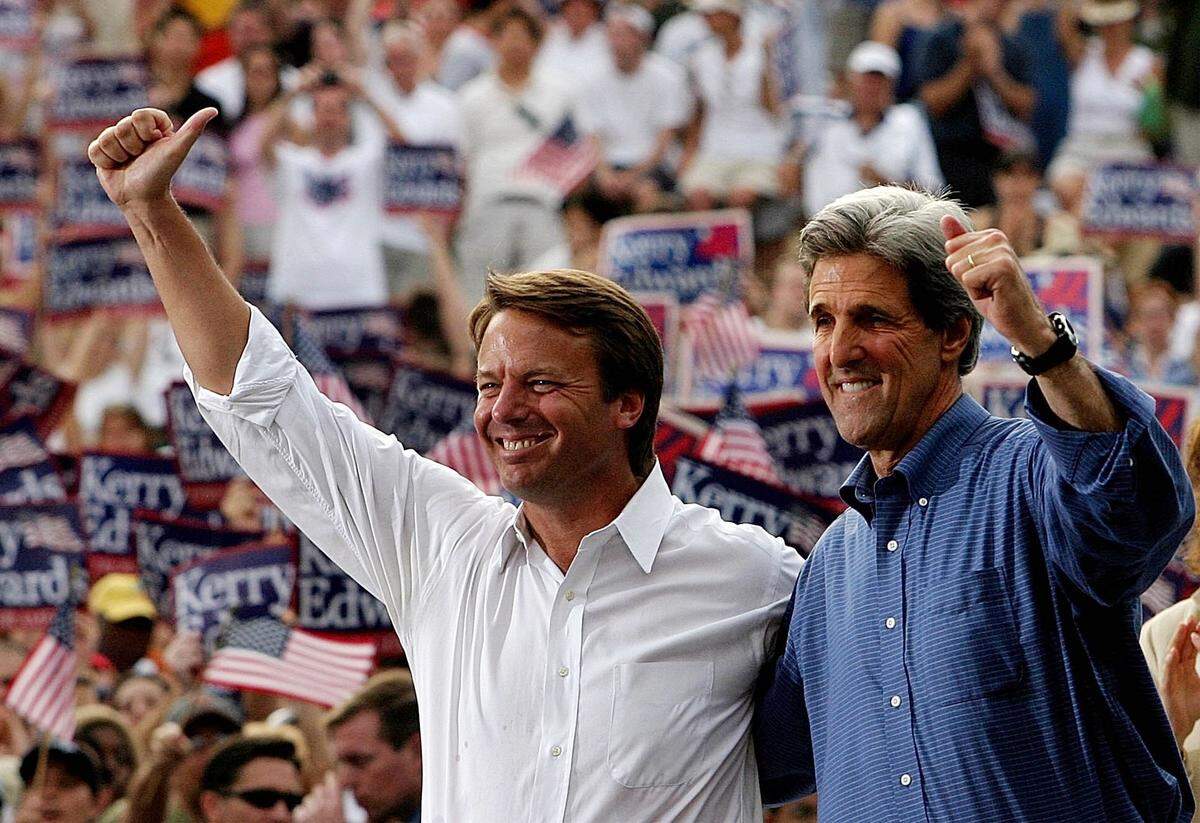
Democrat John Edwards won his U.S. Senate bid in 1998 after a celebrated career in Raleigh as a trial lawyer with movie-star looks. And before his first term was over, he had entered the 2004 presidential race, hoping to win over American voters like he had North Carolina juries. Casting himself as a moderate “son of a textile mill worker,” Edwards stressed his small-town roots (he was born in Seneca, S.C., and grew up in Robbins, N.C.) and delivered a populist campaign speech about “two Americas” that resonated with many Democrats and independents.
After picking up the endorsement of the Des Moines Register, Iowa’s largest newspaper, Edwards finished a strong second to Sen. John Kerry, D-Mass., in that state’s lead-off caucuses. Edwards couldn’t catch Kerry in the subsequent primaries, winning only in his native South Carolina before dropping out. But he was soon back in as Kerry’s running mate.
The hope was that Edwards and his accent would help the Democratic ticket not only win North Carolina’s 15 electoral votes but also appeal to rural voters in the Midwest and West. Kerry-Edwards did come within 2 percentage points of winning the crucial state of Ohio, with its small towns. But in North Carolina, Edwards was no help: GOP President George W. Bush won the state with 56 percent of the vote.
12
He won N.C. by a whisker — and made history.
Edwards ran again in 2008, this time as a liberal. But he dropped out early, yielding the Democratic field to Sen. Hillary Clinton and the eventual nominee — a charismatic Senate newcomer from Illinois named Barack Obama.
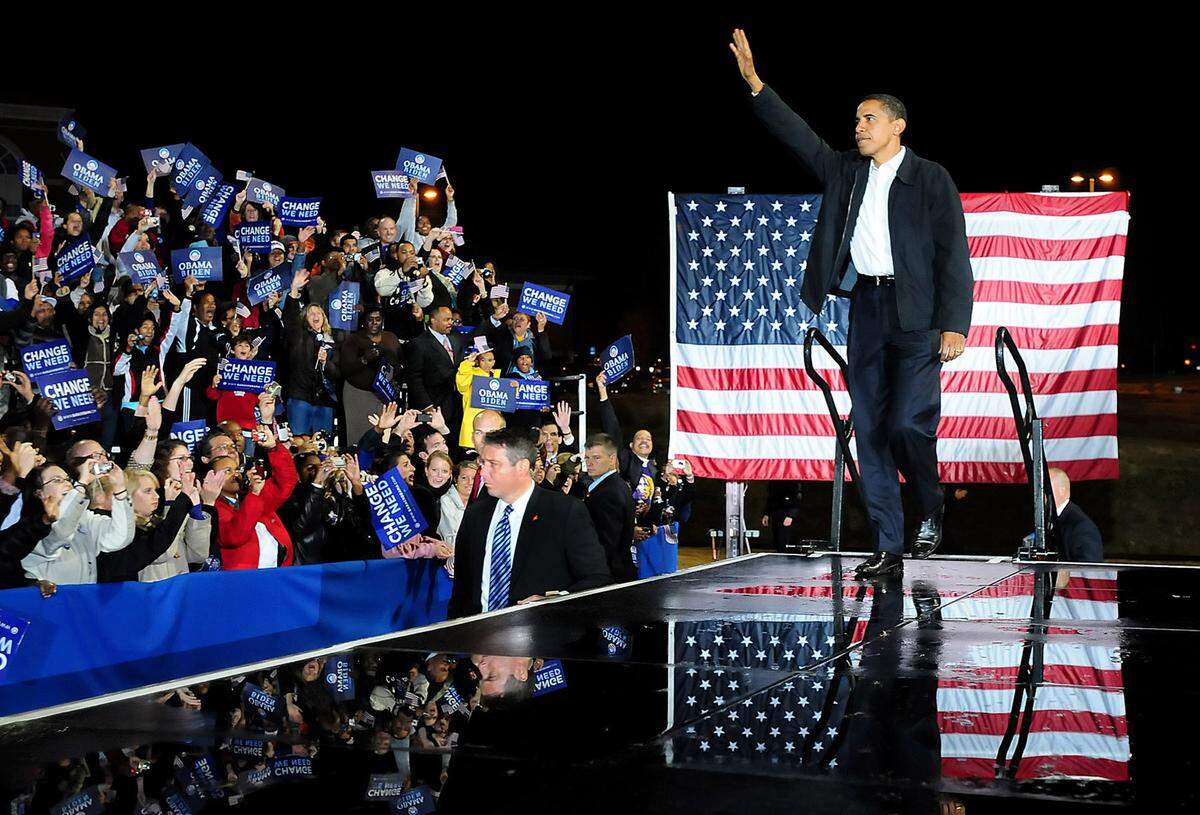
A Democrat had not won North Carolina in 32 years. But Obama, tapping into the enthusiasm of young people and African-Americans, decided to contest the state. On election eve in November, with polls calling North Carolina a toss-up, he showed up in Charlotte.
Addressing 20,000 supporters at UNC Charlotte, he urged them to keep working hard during the last 24 hours and wiped away tears as he talked about the recent death of the grandmother who helped raise him.
Obama also made “an impromptu stop at his storefront headquarters on Elizabeth Avenue, (where) he greeted volunteers clustered into a room amid a throng of TV cameras and reporters,” wrote the Charlotte Observer’s Jim Morrill. “On a day when his campaign canvassed neighborhoods and made last-minute calls, Obama personally telephoned several voters. ‘We need you to go out tomorrow,’ he told one. ‘It’s going to be close in North Carolina. I’m counting on you.’”
The next day, Obama made history as the first African-American elected president of the United States. He also became the first Democrat to carry North Carolina since Jimmy Carter in 1976. Obama’s victory margin in the state: 0.32 percent.
This story was originally published October 19, 2020 at 2:17 PM.