
Closely watched NC won’t finish counting votes for days; some races too close to call
The nation’s attention turned to North Carolina Wednesday as its choice for president remained undecided, its major races split along party lines and its final outcome uncertain until next week.
With record voter turnout, President Donald Trump held a narrow lead in the state over Democratic candidate Joe Biden in a nail-biter contest watched nationwide.
North Carolina is one of several battleground states where provisional and absentee ballots are still being counted, preventing either Biden or Trump from claiming the 270 electoral votes needed to win. The process, spelled out in state law, means it’s likely that the winner of North Carolina’s 15 electoral votes for president won’t be known until Nov. 12 or 13.
As poll workers plowed ahead in North Carolina and other pivotal states on Wednesday, demonstrators marched in the streets from Durham to Philadelphia, New York and Washington, D.C., urging them to count every vote.
A few hundred people gathered Wednesday afternoon at CCB Plaza in downtown Durham, marching to the Board of Elections office, where they raised their fists and cheered in appreciation for those working to count ballots.
As they celebrated the state’s record voter turnout — nearly three-quarters of registered N.C. voters cast a ballot in the 2020 election, according to unofficial state returns — many also expressed disappointment with the results.
Michelle Burton, president of the Durham Association of Educators, said she was “hurt” and “upset” with Trump’s success in the state.
“We know now without a shadow of a doubt that there’s a strong force in this state, in this country, to keep this racial caste system deeply entrenched,” Burton said. “And we know that these forces will do anything to destroy our country to make sure it stays in place, they will do it through voter suppression, they will do it through violence.”
Meanwhile, Trump campaign officials prepared to challenge vote-counting efforts Wednesday in five states, filing lawsuits to stop the count in Michigan, Pennsylvania and Georgia until more Republican poll watchers could get access, asking the court to require a recount in Wisconsin, and intervening in a Supreme Court case over extended mail-in ballot deadlines in Pennsylvania.
The moves followed a post-election speech at 2 a.m. Wednesday in which Trump called for poll workers to stop counting votes.
His supporters echoed that call Wednesday around the country, including in Nevada, where a heckler disrupted a news conference with conspiracy theories about Biden, and in Detroit, where about 30 people chanted “Stop the Vote” and “Stop the Count” outside an elections office while police stood guard and poll workers tried to stay on task.
.png "Election Timeline Presentation (2).png")
North Carolina mail-in ballots
North Carolina’s voters defied poll-watchers’ predictions and did not vote by sweeping party consensus, both re-electing Gov. Roy Cooper, a Democrat, and favoring U.S. Sen. Thom Tillis, a Republican, whose slim lead also hangs by uncounted votes.
But the greatest factor in the state’s 2020 voting is the unprecedented level of voter participation. Turnout topped 74% of registered voters, with 5.4 million ballots cast. Of those, 4.5 million came before Election Day: roughly 3.6 million through one-stop early voting and more than 950,000 by mail. That leaves less than 900,000 votes actually cast at the polls on Tuesday.
The State Board of Elections updated its number of outstanding mail-in ballots Wednesday night. Instead of the 117,460 outstanding absentee ballots, there are now 116,200 people who requested mail-in ballots who have not yet returned them, the state reported. It isn’t known how many of those people decided not to vote or voted in person instead.
A breakdown of mail-in ballots shows that 39% of them were requested by unaffiliated voters, 37% were requested by Democrats and 23% were requested by Republicans, according to Board of Elections data obtained by The News & Observer.
Just over 1% of the mail-in ballots were requested by voters registered in the Libertarian, Green or Constitution parties.
The ballots must be postmarked on or before Election Day and received by Nov. 12 to be counted. The State Board of Elections does not plan to release the results of the additional mail-in ballots as they are received.
So as North Carolina waits, here is where the closest races stand:
U.S. President
Trump held a thin lead over Biden Wednesday. The Republican president carried 50% of the vote with nearly all precincts reporting, edging out Biden, who had less than 49%.
Trump won the majority of early votes and handily took the most Election Day votes, though Biden held the edge with mail-in ballots.
The final result hinges on provisional ballots and absentee ballots yet to arrive. North Carolina remained one of eight battleground states that news outlets have not yet added to either candidate’s total while remaining votes are counted.
U.S. Senate
Tillis has already declared victory in the race he once trailed, holding a small lead over Democratic challenger Cal Cunningham.
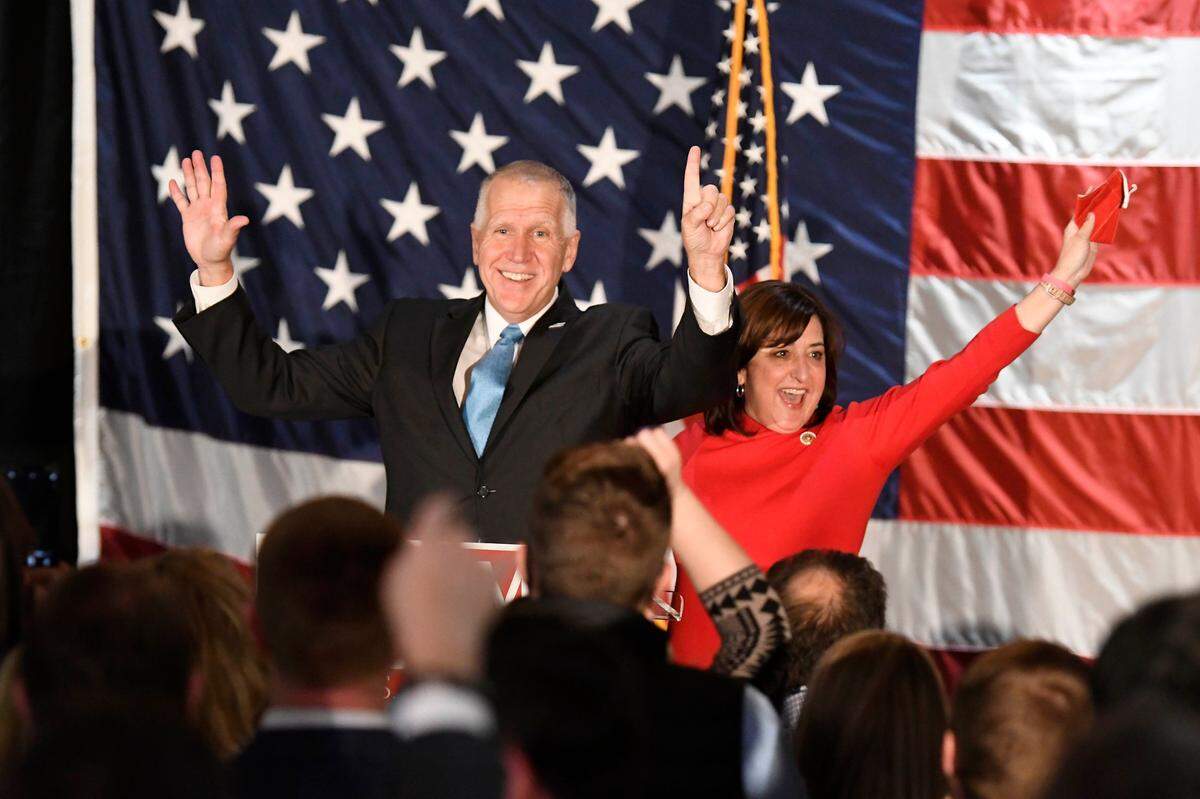
With roughly 5.5 million ballots cast, Tillis held less than 49% of the vote while Cunningham had less than 47%. A Tillis victory would help Republicans keep a Senate majority, but absentee and provisional votes must still be counted.
N.C. Supreme Court
One of the state’s closest races had Republican Paul Newby leading Chief Justice Cheri Beasley by a little more than 3,700 votes for a contested seat on the North Carolina Supreme Court. Beasley is the first African American woman to serve as chief justice.
According to the Board of Elections, a recount is triggered in races with a margin of victory below 10,000 or one-half of 1%, but the runner-up must demand it.
As of Wednesday, the chief justice candidates’ campaigns provided no or limited comments on the race due to the number of outstanding ballots.
“Tens of thousands of North Carolinians still have not had their votes counted and we are making sure that every vote is tallied and every voice is heard,” wrote Beasley campaign manager Benjamin Woods in an email. “Once we have counted every ballot, we are confident about the outcome of this race.”
If a recount is triggered, former Supreme Court Justice Bob Orr, a Republican, said it could delay the results for weeks.
“I don’t think you will get that seat resolved for a good while,” said Orr, who was involved in a recount in 1992. In that case, the vote wasn’t certified until early December.
General Assembly
Republicans kept control of the state legislature. Barring a change from absentee ballots, Democrats will add one member to the N.C. Senate, while the GOP majority in the House increases by four.
Divided power in state government would then continue as Cooper won a second term over Republican Lt. Gov. Dan Forest.
N.C. Council of State
Nearly every race for a Council of State seat came out close, including the lieutenant governor’s chair, which Mark Robinson took in a historic win.
Robinson, a Republican from Greensboro, is the first African American candidate to hold that office. Though he had no prior political experience, he is an outspoken gun rights advocate who got national attention when he spoke on behalf of the Second Amendment at a city council meeting.
He beat Democratic state Rep. Yvonne Holley by a 52% to 48% margin.
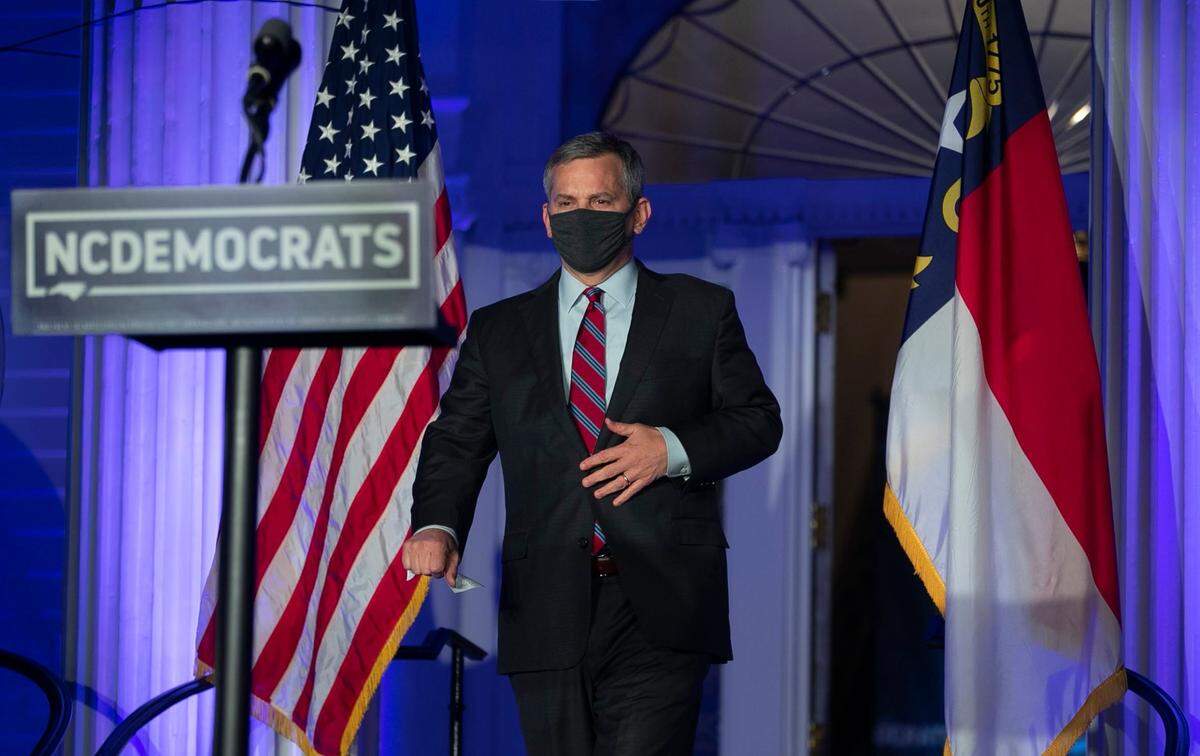
N.C. Attorney General Josh Stein held a narrow lead over Republican Jim O’Neill, which he said he expected to keep as more ballots come in. The margin in that race was 50.1% to 49.9%. Fewer than 11,000 votes separated the men.
O’Neill, the Forsyth County district attorney, thanked his supporters Wednesday afternoon. O’Neill said he’s waiting to hear about absentee ballots.
“We believe there’s a lot more to the race right now, and we’re not going to know till the next week or so how things are really going to shake out,” O’Neill said.
Stein also addressed the close race in a speech Tuesday night at the Democratic Party headquarters in Raleigh.
“Given our margin, I am confident about my reelection,” Stein told his supporters. “We’ll wait until all the votes are counted. That’s how democracy works.”
The most lopsided lead among Council of State candidates came in the race for agriculture commissioner, which Republican incumbent Steve Troxler led by a comfortable margin. He was up 54% to 46% over Democrat Jenna Wadsworth.
U.S. House
Democrats picked up two seats in Congress, giving them five of North Carolina’s 13 seats in the House.
Those races were not close. In Wake County, former State Rep. Deborah Ross defeated her Republican challenger Alan Swain 63% to 35%. And Democrat Kathy Manning of Greensboro also won over Republican Lee Haywood.
Republicans won their eight seats by comfortable margins. In the closest race, Republican Madison Cawthorn beat retired Air Force colonel and Democrat Morris “Moe” Davis in the race for a newly redrawn Western North Carolina district. Cawthorn will become the youngest member of Congress at age 25.
Incumbent Democrats G.K. Butterfield, David Price and Alma Adams all regained their seats. Adams, of Charlotte, ran unopposed for what will be her fourth full term.
Republicans Patrick McHenry, Greg Murphy, Virginia Foxx, David Rouzer, Richard Hudson, Dan Bishop and Ted Budd all won their races.
This story was originally published November 4, 2020 at 8:12 AM with the headline "Closely watched NC won’t finish counting votes for days; some races too close to call."