
GOP falls short in Charlotte area’s ‘tough districts.’ Is Mecklenburg bluer than ever?
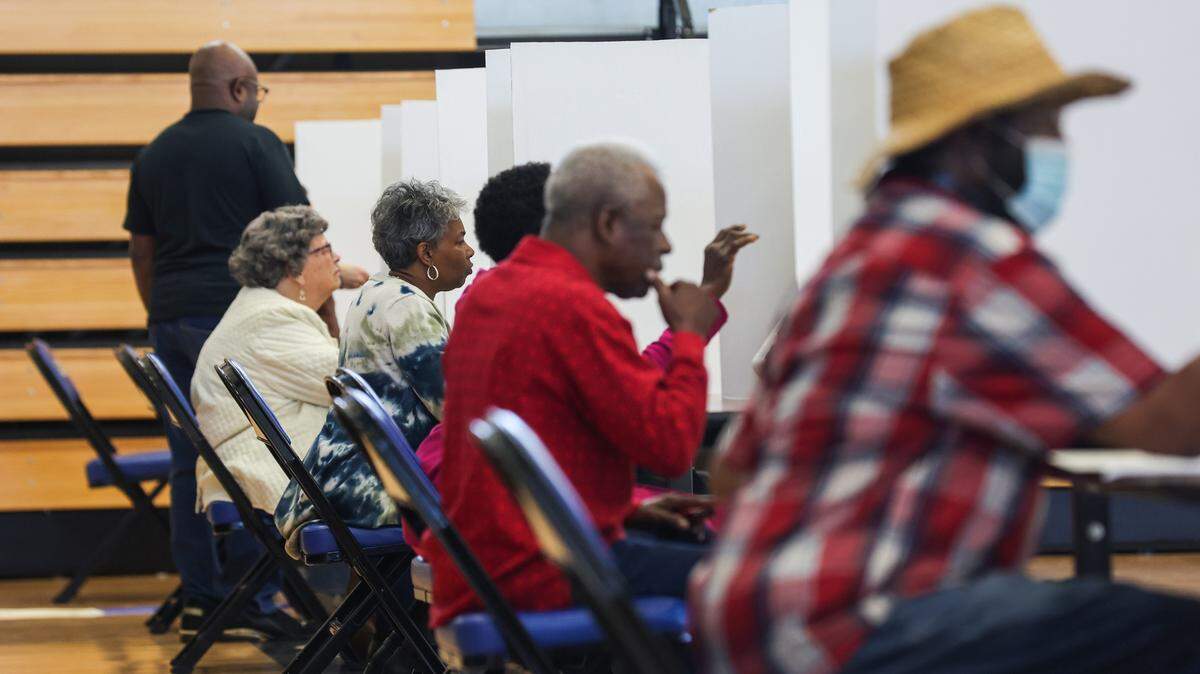
Republicans gained seats in both chambers of the North Carolina General Assembly in Tuesday’s election, but the Charlotte area’s results posed a possibly troublesome omen for the GOP.
Cheri Beasley won far more Mecklenburg precincts than any Democrat running for U.S. Senate since 2014. And as Republicans hoped for a supermajority in both chambers at the statehouse, Democrats won nearly every closely contested district.
The only Mecklenburg Republican who won, incumbent Rep. John Bradford, did so by 861 votes, according to unofficial election night results. His bid to represent northern Mecklenburg’s District 98 was the tightest legislative race in the county (no other Republican came within 1,000 votes). The Democrats also picked up a seat in Cabarrus County, won by Diamond Staton-Williams.
The hopes of a Republican trifecta in North Carolina — the U.S. Senate, the N.C. Supreme Court and supermajorities in both chambers — did not materialize in part because Mecklenburg County’s Democratic voters turned out in the districts where there was a seat to lose.
Several races ‘we should have won’
A Republican supermajority in both chambers would have allowed Republicans to override Gov. Roy Cooper’s veto without buy-in from any Democrats. They fell one seat short in the House and narrowly achieved that in the Senate, with 30 seats, according to the unofficial election results.
As the campaigns progressed, Democrats told voters Republicans would use the opportunity to further restrict abortion rights. Abortion is legal in North Carolina through 20 weeks of pregnancy.
“There were several races in Mecklenburg we should have won,” said Larry Shaheen, a Charlotte attorney and Republican operative.
He pointed to House District 103, in Matthews and Providence, where Republican former legislator Bill Brawley lost to attorney Laura Budd; and House District 73 in Concord, where Williams, a nurse and member of the Harrisburg Town Council, beat Republican Brian Echevarria.
“We had a slate of really good candidates. We had a slate of really tough districts,” NC GOP Chair Michael Whatley said of the Charlotte area Tuesday night. “It’s disappointing that we didn’t get a few more over the table, but at the end of the day this is a great night for Republicans all across North Carolina.”
In Mecklenburg, Beasley outperformed her predecessors
Even as Charlotte-area Democratic voters didn’t give up any new seats, their votes were not enough to give Beasley or Democratic Supreme Court candidates a victory. Turnout in Mecklenburg County was about 44.5%, or six percentage points lower than in 2018.
But Beasley beat her Democratic U.S. Senate predecessors by a long shot in terms of precincts won, turning Mecklenburg County bluer than it’s been in recent history.
Budd won 17 Mecklenburg County precincts Tuesday. Sen. Thom Tillis won 55 in 2020 and 66 in 2014. Burr won 67 in 2016.
Wake County saw a similar outcome.
Budd won 60 Wake County precincts Tuesday to Tillis’ 145 in 2020, Burr’s 118 in 2016 and Tillis’ 76 in 2014.
Beasley saw the biggest gains in southern and northern Mecklenburg County — some of the same precincts Democrats won to keep Republicans from a supermajority in both chambers.
Trump’s role
Shaheen said he knows who’s to blame for Mecklenburg and Wake County’s blue-ing: not the Republican candidates who ran, but former President Donald Trump.
Trump endorsed Budd in the U.S. Senate race and otherwise had a relatively low profile in the contest, visiting North Carolina just once — an October event in Wilmington — to campaign for Budd. Just before Election Day, news outlets began reporting Trump would announce his 2024 presidential run later this month.
As long as Trump is in the picture, Shaheen said, moderate Republicans and unaffiliated voters in urban areas may vote for Democrats.
“He is a cancer,” Shaheen said. “He is an albatross on our party and we have to shake him off.”
Charlotte Democratic operative Dan McCorkle said Democrats’ campaigning strategy also helped secure victories throughout Mecklenburg County, with door knocking, phone banking and other personal voter contacts.
Republicans pumped hundreds of thousands of dollars into the competitive races near Charlotte. Echevarria raised $780,000; Brawley raised more than $796,000; Cheryl Russo, who lost Senate District 42 in Matthews to Rachel Hunt, raised $540,000. It wasn’t enough to win.
Being heard
Along with Democrats’ effective campaign styles, McCorkle said the Republican Party’s rightward post-Trump shift played a role, particularly among moderates in south Charlotte, who reliably voted Republican just a few years ago.
“Who is the Republican Party now? It used to be your dad who drove a Buick and played golf, and it was a moderate person,” he said. “Now the party is this right-wing Trump people.”
Garrett Readling, president of the Young Democrats of Rowan-Cabarrus, reflected on Williams’ narrow victory in Cabarrus County. She won by just 425 votes, or 1.5 percentage points. Without her win, Republicans would have a supermajority in both chambers.
Democrats campaigning for Williams “did deep canvassing, they talked to people and figured out what was top of mind,” Readling said. “Things are better when people feel like they’re being heard, and Cabarrus County felt they were being heard by Diamond.”
This story was originally published November 9, 2022 at 5:16 PM.
.jpg)