Democrats flip seats in NC legislature. It could cost Republicans their supermajority.
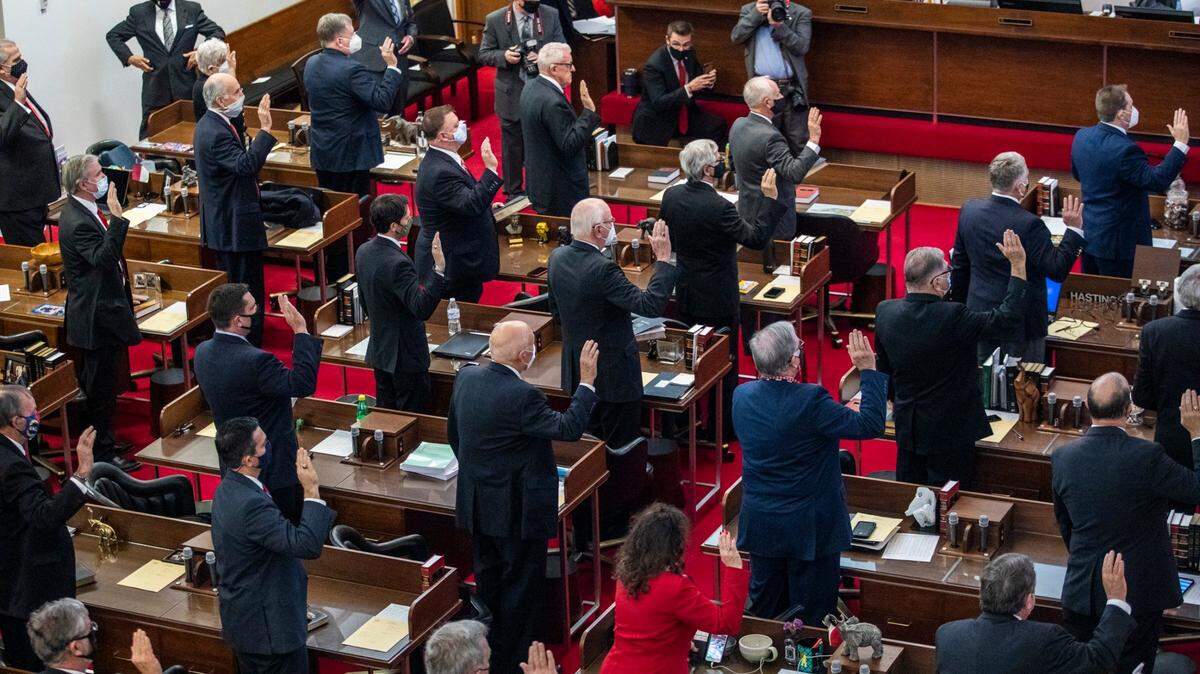
As North Carolina neared full reporting of results across all state legislative districts, Republicans led, but it appeared they had lost their supermajority that allowed them to override vetoes from the governor.
And those results came as voters elected Attorney General Josh Stein as governor, keeping the veto power for Democrats.
Senate leader Phil Berger said in a news release that he could “confidently say Republicans will retain a supermajority in the Senate” but he would only say that his party “will hold a strong majority in the House.” Berger added that he was “thankful for the men and women who put their names forward and ran for office.”
“Senate Republicans had an incredible slate of candidates and they’re going to represent their constituents well. Congratulations are also in order for House Speaker Tim Moore and Rules Chairman Destin Hall on their successes tonight,” he said. Hall is expected to take over as speaker as Moore is heading to Congress.
Democratic Rep. Ya Liu, who represents Wake County, told The News & Observer at a Democratic watch party that she believes Democrats “have a great chance of breaking the supermajority.”
With Stein winning the race for governor, Liu said she thinks lawmakers can stop “bad” legislation.
House Democratic Leader Robert Reives said Democrats were united in their campaigns and would continue “to be one united front that is going to keep pushing back against the tyranny that we have seen.”
“We’re going to keep pushing back against the nepotism that has invaded our state legislature, and we are going to start giving our government back to the people of North Carolina. Because of what you’ve done over the past month, we know that by 2030, we are taking the state legislature back over,” he said.
“Tonight marks a monumental shift in the balance of power in North Carolina,” Democratic Legislative Campaign Committee President Heather Williams said in a news release, calling it a testament to the group’s “work alongside many partners and allies to challenge unchecked Republican power in the state.”
The DLCC is the Democratic Party organization that works to win state legislative seats.
Key seats flip
In the state House, Democrats appear to have flipped three seats. Republican Rep. Frank Sossamon trailed Democrat Bryan Cohn in Nash and Vance counties. Democrat Beth Gardner Helfrich led Republican Melinda Bales in a northern Mecklenburg district currently held by Republicans. And in a race in Nash and Wilson counties, Democrat Dante Pittman led Republican Rep. Ken Fontenot, a first-term lawmaker.
But the GOP also flipped seats. Republican Mike Schietzelt won House District 35 in northeast Wake County, according to AP. The seat is currently held by Democratic Rep. Terence Everitt, who decided to run for Senate rather than for reelection after the district was redrawn during GOP-led redistricting. And Democratic Rep. Diamond Staton-Williams appears likely to have also lost her seat in Cabarrus County to Republican Jonathan Almond.
In another close contest, Rep. Tricia Cotham led her opponent, Democrat Nicole Sidman, with all precincts reporting.
In the Senate, too, some races remained tight, including the one for Senate District 18 among Republican Ashlee Adams, Libertarian Brad Hessel and Democratic Rep. Terence Everitt.
This Granville and Wake County seat was previously held by Democratic Sen. Mary Wills Bode, who is not seeking reelection. Adams led Everitt by just 38 votes with all precincts reporting.
Another tight race is the one for Senate District 42. The race for this southeast Mecklenburg County district is between Democrat Woodson Bradley and Republican Stacie McGinn. The seat, which leans Republican, is currently held by Sen. Rachel Hunt, who ran for lieutenant governor against GOP candidate Hal Weatherman. With all precincts reported, McGinn had 49.99% of the votes while Bradley had 50% of votes.
Republicans gained a supermajority last year when Cotham switched parties to become a Republican. That veto-proof control has allowed Republicans to push through significant legislation without needing support from the opposing party. This included a two-year budget reflecting Republican priorities, changes to the state’s abortion laws, and funding for private school vouchers, among many other laws.
The Republican State Leadership Committee (RSLC) — an organization that works to elect Republicans in state legislatures — celebrated early victories. The Associated Press has not yet called all races and many precincts across districts are still reporting results.
“Tonight, North Carolina Republicans blocked millions in outside Democratic spending to keep their House and Senate majorities,” the RLSC said in an email news release.
“National Democrats made it very clear at the beginning of this cycle that they would invest the necessary resources needed to overtake GOP majorities in Raleigh,” said RSLC President Dee Duncan in the release.
“Despite flooding the airwaves with millions of dollars in outside spending, state Republicans held the line and focused on the winning issues that matter to North Carolinians. Tonight’s results are a testament to North Carolina Republicans’ ability to lead in Raleigh and deliver a reasonable path forward that will continue to grow the local economy and keep their constituents safe,” she said.
Why it matters
Lawmakers shape daily life and the state’s future through their policies, so shifts in the makeup and control of the state’s General Assembly can lead to significant change.
And in North Carolina, all the state’s legislative seats are up for grabs this year, though most are fairly safe seats for Republicans, who led the redrawing of House and Senate district maps in 2023.
Currently, Republicans hold 72 seats and Democrats hold 48 seats in the state House. In the Senate, Republicans have 30 seats compared to 20 for Democrats.
A supermajority consists of three-fifths of lawmakers and allows the ruling party to override the governor’s veto of a bill. Currently, for the GOP to override Gov. Roy Cooper’s vetoes, most, if not all, members need to be present to vote, unless Democrats choose to side with the GOP or do not attend a voting session.
There are over a dozen legislative races across the state that are not guaranteed for either party (though not all are particularly competitive), meaning who wins or loses could determine the makeup of the legislature going into 2025. Democrats would need to gain just one seat to break the supermajority.
Wake County’s competitive races
Among other competitive races in Wake County:
▪ House District 37: In this southwest Wake County race, Republican Rep. Erin Paré defeated Democrat Safiyah Jackson and Libertarian Christopher Robinson. Paré has represented this district for two terms.
▪ Senate District 13: Democratic Sen. Lisa Grafstein defeated Libertarian Susan Hogarth and Republican Scott Lassiter in southern Wake County. Grafstein, a first-term lawmaker, relocated to run in this newly redrawn district. Lassiter attracted notice after suing Speaker Moore alleging that Moore had a relationship with his then-wife, a state employee. Lassiter later dropped the lawsuit.
The other House and Senate races on the ballot in Wake County lean Democratic and were considered safe seats for the party. Similarly, races in Durham County were largely secure for Democrats, with some being guaranteed, as no candidates from other parties ran.
Other competitive House races
Here are some other key House races:
▪ House District 5: This district includes portions of Camden, Gates, Hertford and Pasquotank counties. Republican Rep. Bill Ward, a first-term lawmaker, fended off a challenge from Democrat Howard Hunter, a former House member.
▪ House District 25: This Nash County race includes Democrat Lorenza Wilkins, Libertarian Nick Taylor, and Republican Rep. Allen Chesser, a first-term lawmaker. With all precincts reported, Chesser appears to have won.
▪ House District 47: Republican Rep. Jarrod Lowery, a first-term lawmaker from Robeson County, kept his seat in a race against Democrat Eshonda Hooper.
Other key Senate races
Here are some other key Senate races:
▪ Senate District 4: This race includes parts of Greene, Wayne, and Wilson counties. Republican Sen. Buck Newton, who has served four terms in two different stints in the Senate, defeated Democrat Raymond Smith, a former House member. The district leans slightly Republican.
▪ Senate District 7: Four-term Republican Sen. Michael Lee defeated Democrat David Hill and Libertarian John Evans in a New Hanover County district that leans slightly Democratic.
▪ Senate District 11: Republican Sen. Lisa Barnes, representing Franklin, Nash, and Vance counties, fended off a challenge from Democrat James Mercer.
▪ Senate District 24: Republican Sen. Danny Britt, who has held the seat for four terms, defeated Democrat Kathy Batt in a district in Hoke, Robeson and Scotland counties that leans slightly Republican.
This story was originally published November 5, 2024 at 8:10 PM with the headline "Democrats flip seats in NC legislature. It could cost Republicans their supermajority.."