
Science Briefs: Length of Saturn’s day, prolong life for mobile battery, role of small wetlands
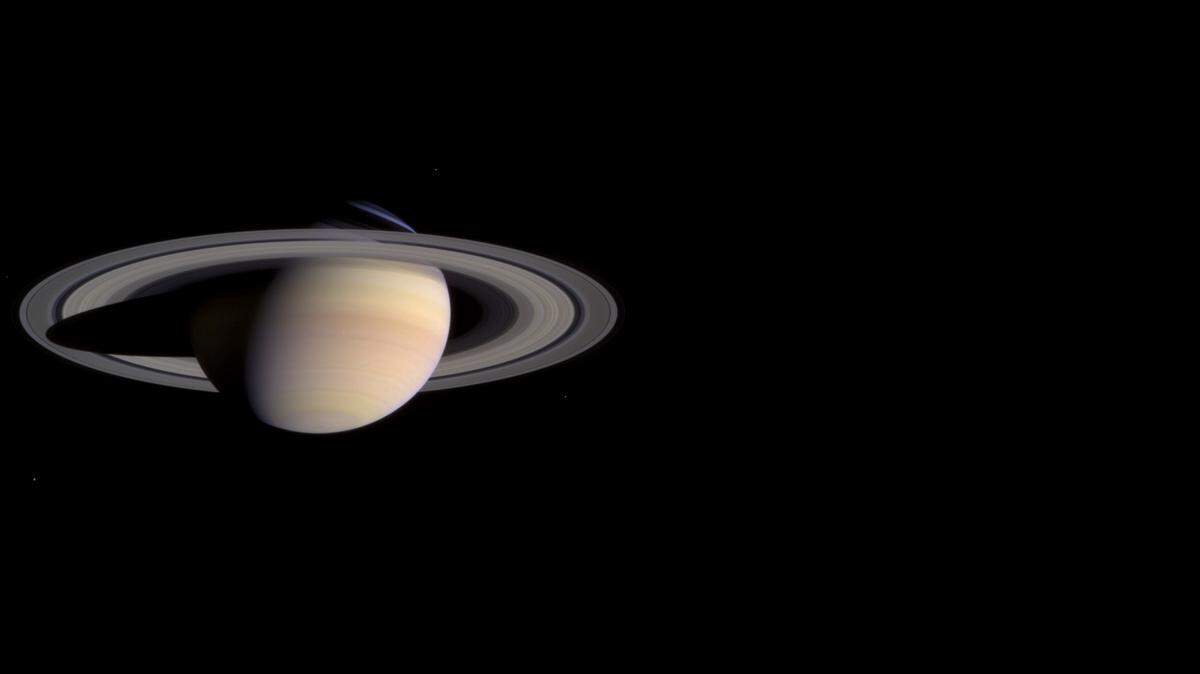
The precise measurement of Saturn’s rotation has been a big challenge: Different parts of that sweltering ball of hydrogen and helium rotate at different speeds, though its rotational axis and magnetic pole are aligned. A new method devised by a researcher at Israel’s Tel Aviv University proposes a new determination of Saturn’s day length.
“In the last two decades, the standard rotation period of Saturn was accepted as that measured by Voyager 2 in the 1980s: 10 hours, 39 minutes, and 22 seconds,” said Ravit Helled. “But when the Cassini spacecraft arrived at Saturn 30 years later, the rotation period was measured as eight minutes longer.”
According to the new method, Saturn’s day is 10 hours, 32 minutes and 44 seconds long.
Helled’s method is based on a statistical optimization method that involved several solutions that had to reproduce Saturn’s observed properties (within their uncertainties), its mass and gravitational field. Then the researchers harnessed this information to search for the rotation period on which the most solutions converged.
When applied to Jupiter, whose rotation period is well-known, the results were identical to the conventional measurement, reflecting the consistency and accuracy of the new method. The method was published recently in the journal Nature. aftau.org
System settings affect energy use, lifespan of mobile battery
Mobile devices have a large number of adjustable system settings whose energy impact can be difficult to understand for the average user and even for an expert. Some system settings have a direct and significant correlation with energy consumption – for example screen brightness and network connectivity.
Findings by Finnish researchers at the University of Helsinki’s Department of Computer Science include:
▪ Wi-Fi signal strength dropping one bar can cause more than 13 percent loss of battery life.
▪ High temperature can cause even 50 percent loss of battery life, and high temperature is not always related to high CPU load.
▪ Automatic screen brightness is in most cases better than the manual setting.
▪ In addition to CPU, battery temperature and distance traveled together offer a good predictor of battery lifetime. helsinki.fi/university
Think smaller and isolated when working to save wetlands
A study by doctoral students at Canada’s University of Waterloo shows wetland loss follows a strong pattern, with smaller, isolated wetlands being lost in much greater numbers than larger wetlands.
Their paper, published in peer-reviewed journal Ecological Applications, argues that not only have we drained large numbers of smaller, isolated wetlands, but that the remaining wetlands have much simpler shapes, leading to an extensive loss of wetland perimeter.
Smaller wetlands also function best as a group, forming an interconnected “landscape mosaic” that provide unique habitat and safe breeding grounds for species such as salamanders and migratory birds. uwaterloo.ca
This story was originally published March 28, 2015 at 8:00 PM with the headline "Science Briefs: Length of Saturn’s day, prolong life for mobile battery, role of small wetlands."