How to spot the ‘Signal for Help’ popularized on TikTok that saved a missing NC girl
A hand signal made popular on TikTok helped lead to the rescue of a missing North Carolina teen last week.
Police in Laurel County, Kentucky, reported that a driver traveling on Interstate 75 noticed a female passenger in the car in front of them “making hand gestures that are known” on the social media platform TikTok to signal that the person needs help.
Using information the driver provided to dispatchers, police were able to identify the car and perform a traffic stop, where they discovered that the 16-year-old female passenger had been reported missing from Asheville, North Carolina, two days prior.
Police arrested the male driver, identified as 61-year-old James Herbert Brick of Cherokee, North Carolina, and charged him with unlawful imprisonment and “possession of matter sex performance by a minor over the age of 12 but under age 18,” reported McClatchy News.
So, what exactly is the hand signal the girl used to flag down help?
Here’s some information on it, including how it started and how to use and recognize it.
What is the hand signal for help?
In an interview with Louisville, Kentucky, TV station WHAS, a spokesperson for the Laurel County Sheriff’s Office identified the signal used by the rescued girl as the “Signal for Help,” created by the Canadian Women’s Foundation, which has since become popular on TikTok.
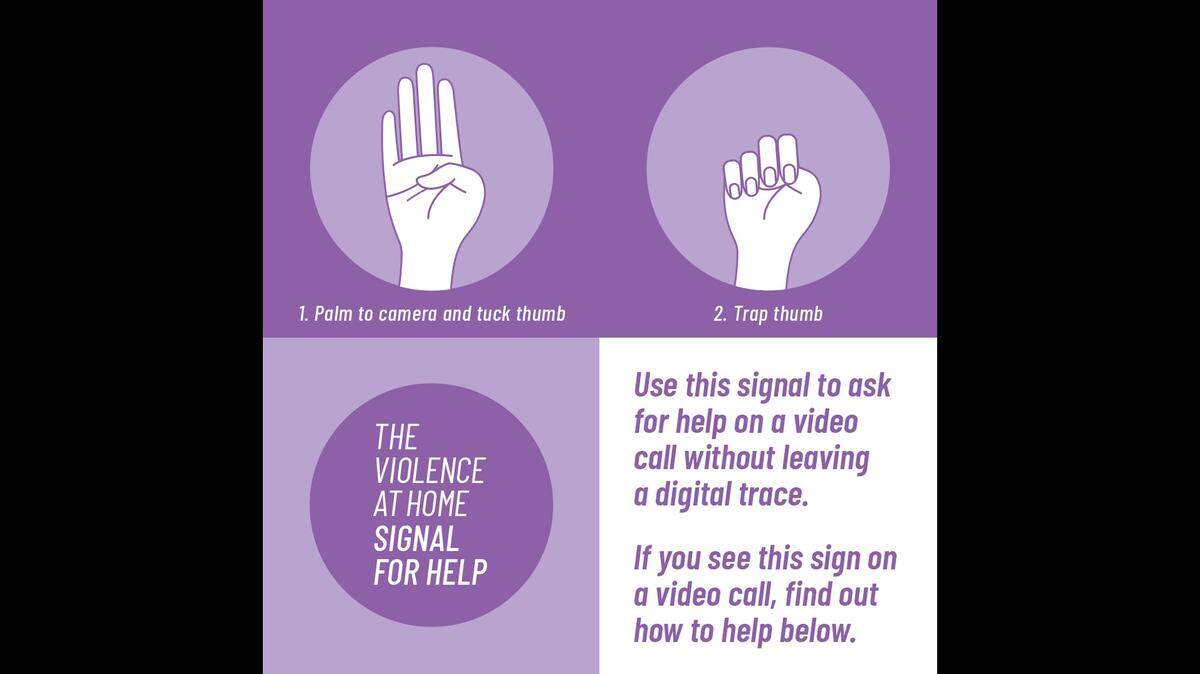
To make the signal:
- Hold one of your hands up to show all of your fingers, as if you are showing the number five.
- Tuck your thumb into your palm, as if you are showing the number four.
- Fold your other fingers down to cover, or “trap,” your thumb.
The following video includes a demonstration:
How did the Signal for Help start?
The Canadian Women’s Foundation (CWF) created the Signal for Help in response to the increased social isolation during the pandemic, which has been linked to increased gender-based and domestic violence.
▪ The signal is a “simple one-handed sign” a person can use to silently show they need help and want someone to check on them in a safe way.
▪ The signal was designed to be used without leaving a “digital trace” — that is, to leave no signs, such as in writing through text messages, email and other electronic communication, that the person has asked for help. This is helpful for people whose abusers may monitor their electronic communication.
▪ Originally, the signal was created for people to use on video calls, which were a popular way to stay connected during the early stages of the pandemic. In the case of the rescued North Carolina girl, though, it’s clear that the signal can work in other scenarios — such as in-person and in public places — as well.
The signal spread to the social media app TikTok, where users began sharing the signal and demonstrating to their viewers how to use and recognize it.
The hashtag “signal for help” (#signalforhelp) on TikTok has almost 24 million views, and the hashtag “hand signal” (#handsignal) has almost 7 million views. Both hashtags include numerous videos with the signal, some with hundreds of thousands of views each.
What does the Signal for Help mean?
The Signal for Help indicates that the person using the signal needs help or is in distress and wants someone to check on them in a safe way.
The person could want or need a variety of things from you, including:
▪ Someone to talk to about their situation.
▪ Finding them information about their situation or something else.
▪ Finding them the appropriate support services.
The signal does not automatically indicate that the person wants you to call 911, though such action may be appropriate if you learn that the person is in immediate danger.
How do I check on someone in a safe way?
If someone uses the signal with you, you should follow up with them by checking on them in a safe way.
To check on someone safely:
▪ Call them and ask yes or no questions. This can reduce the risk the person faces if their abuser or someone else is listening to your conversation. Examples of helpful yes or no questions the CWF suggests include:
- “Would you like me to call 911?”
- “Would you like me to call a shelter on your behalf?”
- “Should I look up some services that might help you and call you back?”
▪ Use another form of communication and ask general questions. If calling the person isn’t a good option, you can use texting, social media and email to talk with the person, but always ask general questions in case someone is monitoring their account activity. Examples of helpful general questions and phrases include:
- “How are you doing?”
- “How can I help you out?”
- “Get in touch with me when you can.”
▪ Ask if they need additional help. Regardless of which mode of communication you are using, you can ask the person if they would like additional support from you after your initial conversation. Ask them:
- “Do you want me to reach out to you regularly?”
- “How else can I support you?”
If someone uses a signal that looks like the Signal for Help and you are uncertain about what they mean or whether they may be in danger, the CWF recommends considering the context in which they are using it.
▪ Wait until it is safe to approach the person, or follow up with them later, to clarify what they meant by using the signal and what support they need from you.
If you or someone you know is in immediate danger, call 911 or your local emergency services.
What if an abuser finds out about the signal?
As the Signal for Help becomes more widely known, there is a chance that abusers may become aware of the signal.
People in abusive situations may also be closely monitored and may not feel comfortable using the signal.
The CWF says the Signal for Help is a tool that “some people may be able to use, some of the time, to indicate they need help without leaving a digital trace.”
If someone cannot use the Signal for Help, additional resources are available through the National Domestic Violence Hotline.
▪ To get help for yourself or another person, you can:
- Visit thehotline.org/get-help
- Call 1-800-799-7233
- Text “START” to 88788
▪ Additional resources on supporting survivors of domestic violence are available at thehotline.org/support-others.
The CWF recommends always following the lead of the person who may be experiencing violence. They will know what is safest for them and their situation.
Is the Signal for Help sign language?
The Signal for Help is not part of American Sign Language (ASL) and is not meant to refer to any words, letters or ideas in ASL or other sign languages. The CFW says deaf community members were consulted on the Signal for Help prior to the launch of the signal’s campaign.
The Signal for Help may look similar to the “brain in the palm of the hand” signal taught by Social and Emotional Learning (SEL) programs.
▪ These programs may teach participants to use an open hand, trapped thumb and fist to communicate and regulate their emotions.
▪ If someone uses a signal that looks like the Signal for Help and you are uncertain about what they mean, wait until it is safe to approach the person to clarify what they meant by using the signal.
Additional resources
▪ Learn more about the Signal for Help by visiting canadianwomen.org/signal-for-help.
▪ You can learn more about the signs of domestic violence and access additional resources by visiting the National Domestic Violence Hotline at thehotline.org. If it is unsafe for you to visit the website, you can call the hotline at 1-800-799-7233.
▪ A list of North Carolina-specific domestic violence resources is available from the N.C. Coalition Against Domestic Violence at nccadv.org/get-help.
This story was originally published November 8, 2021 at 2:36 PM with the headline "How to spot the ‘Signal for Help’ popularized on TikTok that saved a missing NC girl."