
NC fertilizer plant fire caused air pollution five times higher than EPA limits
A Forsyth County environmental official was shocked when he learned how much pollution an inferno at a Winston-Salem fertilizer plant was sending into the air.
Between midnight and 6 a.m. on Feb. 2, an Environmental Protection Agency air monitor set up at the Wake Forest University Police Station detected that particulate matter, called PM2.5, at an average level of 1,750 micrograms per cubic meter. That’s more than five times the 300 micrograms the EPA considers hazardous over eight hours during a fire.
“I had a panic attack,” Minor Barnette, director of Forsyth County’s Office of Environmental Assistance and Protection, told a state environmental committee Wednesday. “I’ve never seen numbers like that anywhere in North Carolina that I was aware of, and this was right here in our community and within the jurisdiction of our agency.”
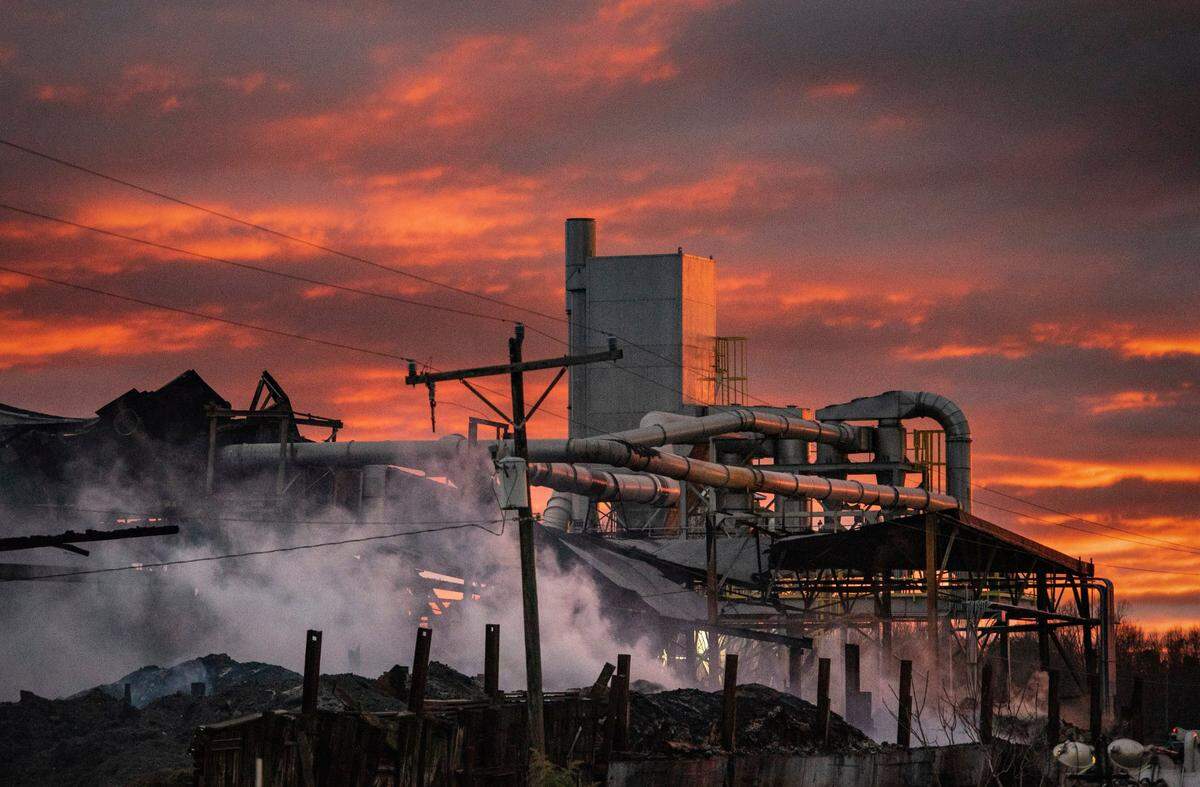
The inferno that destroyed the Winston Weaver plant in northern Winston-Salem started around 6:45 p.m. on Jan. 31. About 30 hours later, the EPA had set up monitors within a mile of blaze, looking for substances like nitrogen dioxide and PM2.5, which is particulate matter about 30 times smaller than the diameter of a human hair.
Levels of particulate matter stayed hazardous in parts of Winston-Salem through the evening of Feb. 2 before dropping to unhealthy levels through the morning of Feb. 4, Barnette said. The fire drew widespread attention because of the high levels of ammonium nitrate on the site. The substance, a common fertilizer ingredient, can turn violently explosive when it is heated or experiences a shock.
Within two hours of arriving on scene Jan. 31, firefighters had sprayed more than 600,000 gallons of water on the fire, Barnette said. Yet that had little effect, and the blaze continued to grow.
Firefighters learned that there were roughly 500 tons of ammonium nitrate in the plant, with roughly 100 more loaded onto a rail car near the fire. That led to Forsyth County and Winston-Salem authorities calling for residents living within a mile radius of the plant to evacuate, with firefighters also falling back.
“They were in an extremely densely developed area of our municipality,” Barnett said.
The News & Observer previously reported that per capita annual income around the plant is $17,423 compared to Forsyth County’s $30,769, and that about 51% of the people living around the plant are Black and 26% are Hispanic.
Barnette also showed the committee a list of the 20 chemical compounds that were present at Winston Weaver, including diammonium phosphate, potassium nitrate and urea, among others.
“It looks like a list of things you would see in a college chemistry textbook,” Barnette said. “Obviously not the kind of things you would like to have involved in a very large, hot fire.”
After the fire, a consultant working for Forsyth County found high background levels of chemicals in water upstream of the Winston Weaver plant.
That traced back to a storage facility with one open side where Winston Weaver had been storing materials used to make fertilizer. When rain fell on the piles, what the Winston-Salem Journal described as “a steady stream of white liquid” ran into a nearby storm drain.
Forsyth County environmental officials issued a notice of violation against the company and ordered that it place the materials under the roof, preventing runoff.

Several members of the Environmental Management Commission’s Air Quality Committee called upon Barnette and N.C. Department of Environmental Quality officials to explore long-term monitoring for health effects the fire could cause in nearby residents.
“It seems like there should be some kind of long-term monitoring plan because the levels weren’t just above hazardous, they were so high,” said Suzanne Lazorick, a commitee member who is also a professor pediatrics and public health at East Carolina University’s Brody School of Medicine.
As the smoke plume from the plant settled, Barnette said, ash from the fire was visible on cars and patio furniture downwind from the plant. Barnette recalled that most of the compounds at the facility were irritants, with some being oxidizers.
Marion Deerhake, an environmental scientist who sits on the Air Quality Committee, asked DEQ officials to check with the N.C. Department of Health and Human Services to see if any monitoring programs were in development.
Deerhake said, “I do worry about indoor air exposure and what settled inside these people’s homes.”
This story was produced with financial support from 1Earth Fund, in partnership with Journalism Funding Partners, as part of an independent journalism fellowship program. The N&O maintains full editorial control of the work.
This story was originally published March 9, 2022 at 5:58 PM with the headline "NC fertilizer plant fire caused air pollution five times higher than EPA limits."