For only the second time, a hurricane has earned an NC highway historical marker
AI-generated summary reviewed by our newsroom.
- North Carolina will install a highway marker for Hurricane Floyd in Princeville.
- Floyd joins Hazel as the only named hurricanes with NC highway historical markers.
- Markers require 25 years of hindsight and proof of statewide historical impact.
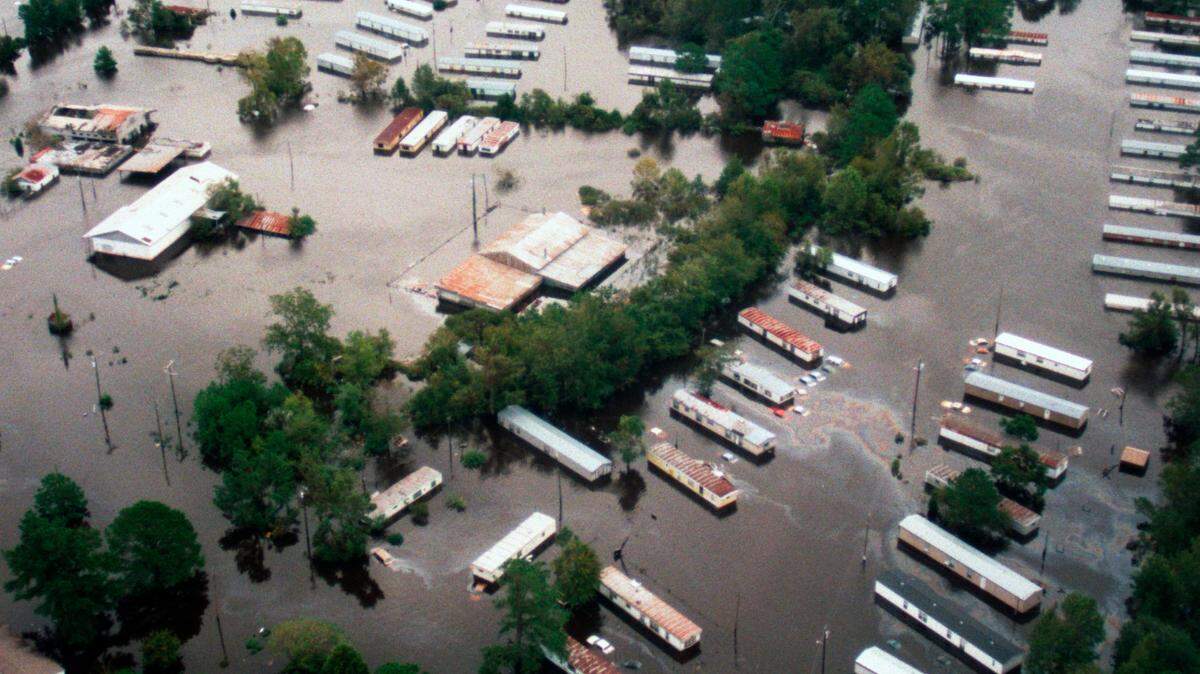
The state will unveil a highway historical marker next week to commemorate Hurricane Floyd, the storm that caused catastrophic flooding in Eastern North Carolina in 1999.
The marker will be located in Princeville, the historically African-American community in Edgecombe County that was flooded when the Tar River breached a levy. No one died in the town, which dates to the end of the Civil War, but every home, business and building was inundated.
The silver cast-aluminum marker with black lettering will be unveiled Tuesday, Sept. 16, exactly 26 years after the storm made landfall near Cape Fear. The marker will stand along N.C. 33 near Powell Park and the bridge over the river to Tarboro.
Floyd becomes only the second named hurricane to be remembered with a highway historical marker. The other is Hazel, which in October 1954 caused the worst coastal flooding in North Carolina history and killed 19 people in the state. That marker was placed on Oak Island, where a 17-foot storm surge swept away all but three of 357 structures.
Both the Hazel and Floyd markers were proposed by Jay Barnes, the retired director of the state aquarium at Pine Knoll Shores and author of four books on hurricanes, including one on Floyd. As years pass, the markers are reminders of events that had a profound effect on North Carolina and its people, Barnes said.
“People tend to forget about these storms,” he said. “And a historical marker in a small way I think will help us remember.”
The N.C. Highway Historical Marker Program was created by the General Assembly in 1935 and is run jointly by the state Department of Transportation and the Department of Natural and Cultural Resources. The secretary of Natural and Cultural Resources approves the markers, based on the recommendations of an advisory committee of historians from North Carolina colleges and universities.
To earn a marker, a person or event must resonate across North Carolina, says Leslie Leonard, a research historian who administers the program.
“Not all hurricanes or natural disasters would be eligible for markers,” Leonard wrote in an email. “Applicants must demonstrate that an event has statewide significance.”
In the case of Floyd, not only did the storm cause 52 deaths and unprecedented economic damage, but it led to changes in policies and state laws aimed at making the state more resilient in future storms. One example: The state banned ground-level burial vaults after caskets from 36 of them floated to the surface in a flooded cemetery in Goldsboro.
Another requirement to earn a marker: Twenty-five years must pass before an event is eligible. That means it will be a while before big storms such as Matthew, Florence and Helene might be considered.
While Floyd and Hazel are the only named storms with highway historical markers, there are two markers for the “Flood of 1916,” one in Gaston County and another in Biltmore Village near Asheville.
Both commemorate flooding that devastated Western North Carolina after two hurricanes came ashore in South Carolina and the Gulf Coast and moved to the mountains. The flooding stood as the worst in the region until Hurricane Helene a year ago.
Remembering those storms may do some good in the future, Barnes said.
“I think that the more we learn about what’s happened in the past, it will help us to really better prepare for what we’ve got in the years ahead with more storms,” he said.
This story was originally published September 10, 2025 at 10:58 AM with the headline "For only the second time, a hurricane has earned an NC highway historical marker."