
New Alligator River bridge taking shape in Eastern NC faster than expected
AI-generated summary reviewed by our newsroom.
- Skanska finished 682 of 710 foundation piles. Final piles will be in place this month.
- New 3.2-mile bridge rises to 65 feet, widens lanes and adds 8-foot shoulders.
- Project uses precast concrete, GPS positioning and noncorrosive GFRP components.
Workers will soon drive the last of hundreds of concrete columns into the bottom of the Alligator River that will hold up a new 3.3-mile bridge connecting the Outer Banks with the rest of North Carolina.
Work on the new bridge began nearly a year ago, and as of Monday contractors had completed 682 of the 710 piles that will make up the foundation. The last should be in place by the end of the month, according to Skanska, the general contractor.
The work has taken much less time than the N.C. Department of Transportation had expected. A year ago, NCDOT said the bridge wouldn’t open until the fall of 2029. Now it could open a year earlier, said Pablo Hernandez, the department’s resident engineer based in Manteo.
“This is my fourth multi-mile bridge, and for the pile-driving to be this far ahead of everything else is pretty remarkable,” said Hernandez, who credits Skanska’s planning and decisions about equipment and subcontractors.
.jpg "26-1-12 Media Presentation- Photo 6 (1).jpg")
The bridge will replace the Lindsay C. Warren Bridge, which carries U.S. 64 over the river between Tyrrell and Dare counties. The old bridge opened in 1962 and is out of date. About halfway across is a swing-span that brings traffic to a halt when it opens to let boats pass or occasionally breaks down and needs repairs.
The replacement will rise up to 65 feet above the channel, high enough to let boats pass underneath without stopping traffic.
The new bridge will have two 12-foot travel lanes like the old one. But it will have higher guardrails and 8-foot shoulders on either side, compared to barely two feet on the existing bridge.
In some ways, building a bridge hasn’t changed much
The basics of building a bridge over a body of water haven’t really changed since the Lindsay C. Warren Bridge in the early 1960s, says Phillip LeFave, the Skanska executive in charge of the project. Skanska still uses cranes and hammers to drive bridge supports into the river, LeFave said during a boat tour with reporters Monday.
“Those are just driven piles with caps on them, and precast beams on top,” LeFave said, looking toward the old bridge. “So very similar.”
But technology has changed the design and the construction process in several ways. For starters, prestressing the beams, a process that compresses the concrete and makes it stronger, means they can be longer, reducing the number of supports in the river. The concrete girders holding up the deck of the new bridge will be twice or more as long as on the old one, LeFave said.
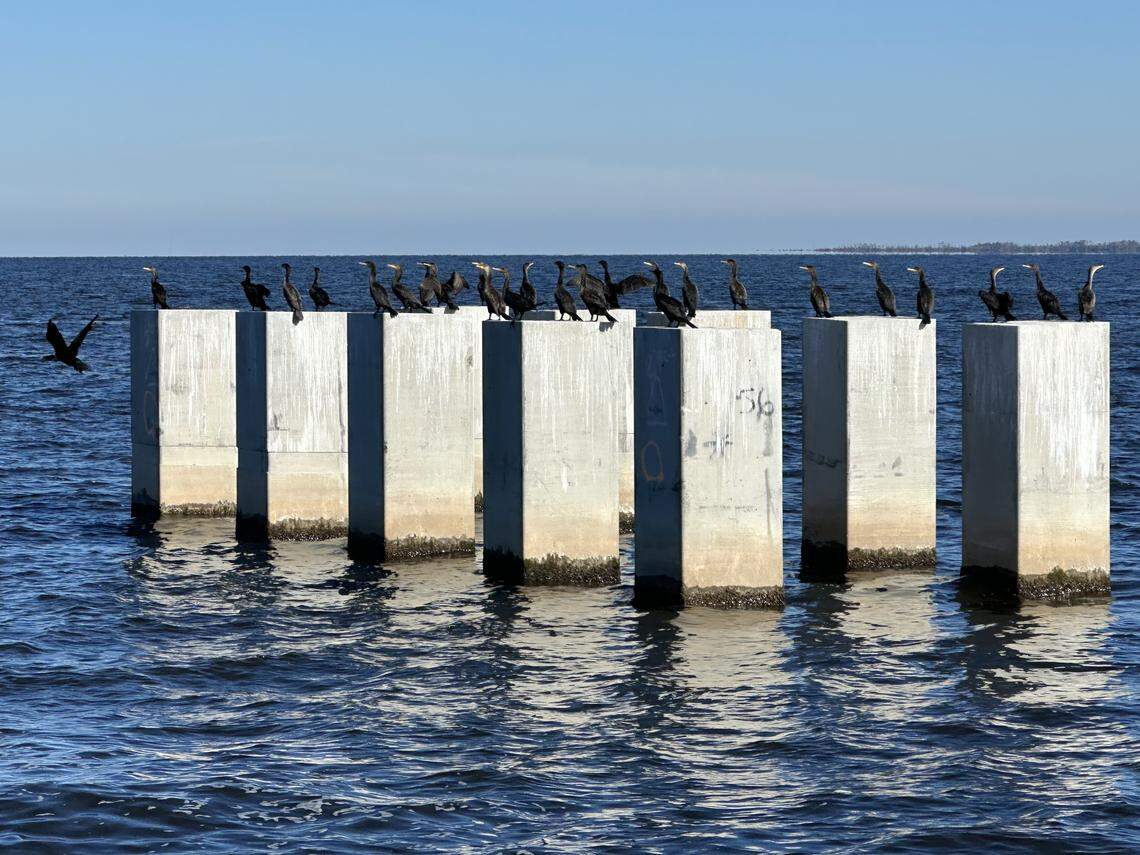
Most of the concrete piles are 36 inches square, about the dimensions of a refrigerator, and between 90 and 125 feet long. They’re driven 80 to 100 feet into the ground, through a layer of soft muck down to dense sand.
There is no bedrock, but Hernandez said the sand is just as good. He likens it to when people stand still in the surf and let the sand and water rush over their feet. After a while, he said, you can’t pull your feet out.
“That’s the friction and that pull pressure that we look for to lock these piles in,” he said.
A crane lifts each concrete pile into a brace, then raises a giant, single-piston sledgehammer on top of it. The hammer weighs 40,000 pounds, as big as any used on an NCDOT project, Hernandez said.
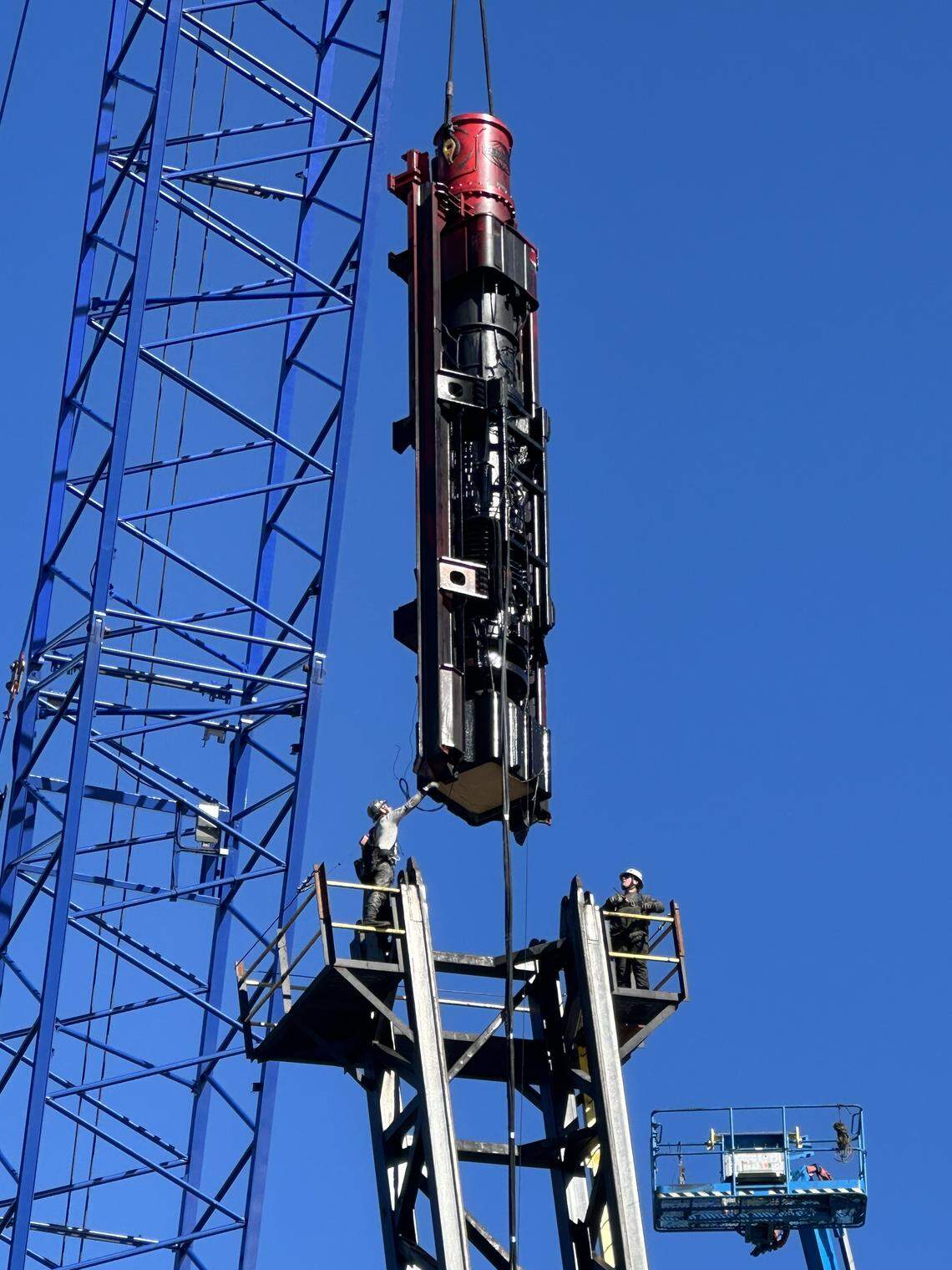
“You have to be measured about how you use that sledgehammer,” he said. “We don’t damage the pile but also we want to get it to the right spot.”
The depth of the piles may vary a few feet. A giant saw is used to cut the tops off some so they’re all at the proper height.
Bridge will be built without steel
Technology helps in other ways. Skanska and its contractors use GPS and a system of anchors and winches on the barges to ensure the piles are driven into precisely the right spot. Instead of steel inside the concrete, they’re using glass fiber reinforced polymer, a composite material that doesn’t contain any iron and won’t corrode in the salty water.
”It’s very ideal for the marine environment because it’s immune to rust and chlorides,” said Eduardo Restrepo, the project manager for Skanska.
The material also weighs about a quarter as much as steel, Restrepo said, which allows workers to assemble components on shore and lift them onto barges, rather than put them together on the river.
Skanska is having the piles, girders and other concrete components precast in Chesapeake, Virginia, and brought to the bridge by barge.
“Performing work on the Alligator River is touch and go weatherwise,” LeFave said. “If you can do more of that work on land and bring the pieces out and put the Legos together, for lack of a better phrase ..... that limits our exposure out on the water.”
Skanska has a $450 million contract to build the Alligator River bridge. North Carolina received a $110 million federal grant for the project from the infrastructure law passed by Congress in late 2021.
When the new bridge opens, demolition of the old one will begin. That’s expected to take a year or longer. Steel inside the bridge will be recycled, Hernandez said, and the concrete will be collected and crushed for use on other NCDOT or local road projects.
This story was originally published January 13, 2026 at 4:00 PM with the headline "New Alligator River bridge taking shape in Eastern NC faster than expected."
