Why four NC legislative leaders are teaming up on a $50M housing proposal
AI-generated summary reviewed by our newsroom.
- House Bill 1072 would create a $50 million revolving loan fund inside NCHFA.
- The loans would provide below‑market interest rates to eligible nonprofit developers.
- Bill funds target site readiness costs like land acquisition and infrastructure work.
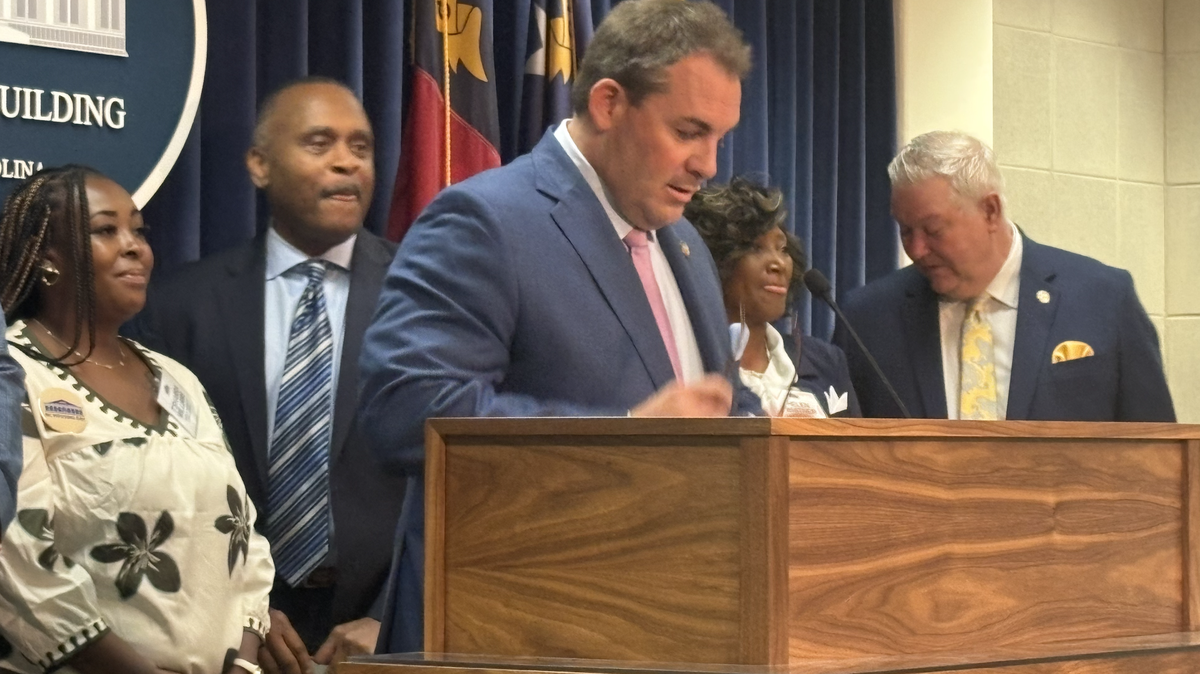
A Republican and a Democrat stood side by side at the General Assembly on Wednesday — NC Housing Day — to promote a statewide $50 million affordable-housing loan fund, a rare bipartisan move that could signal a shift in how lawmakers are approaching the state’s growing affordability crisis.
House Bill 1072 has four primary sponsors — Republicans John Bell from Wayne County and Chris Humphrey from Lenoir, and Democrats Robert Reives of Chatham County and Carla Cunningham from Mecklenburg.
It would create a $50 million loan program inside the North Carolina Housing Finance Agency (NCHFA), offering below‑market interest rate loans to eligible nonprofits, like Habitat for Humanity affiliates, to acquire, develop and improve sites for affordable housing. A portion of the fund would be available every year, with funding revolving as loans are paid back by borrowers.
“Affordable housing” refers to homes intended for households making no more than 80% of the local median income, as defined by the U.S. Department of Housing and Urban Development.
“We can all agree, housing is one of the most pressing challenges that families face across our state,” said Bell, the House Republican leader and Rules Committee chair, at a press conference the lawmakers held Wednesday.
“This is a one-time investment of a self-sustaining fund and represents a meaningful and practical step forward in closing that gap.”
The announcement came on NC Housing Day, when nearly 200 advocates from across the state filled Halifax Mall and the halls of the General Assembly to press lawmakers on rising housing costs and the need for stronger state investment. The timing underscored the bill’s significance: As advocates met with legislators, the sponsors of HB 1072 were making a rare bipartisan push to target one of the biggest barriers to affordable housing production in the state — the cost and scarcity of developable land.
“We can’t simply ask how to make homes affordable after they’re built. We’ve got to figure out what’s preventing them from being built at all, and that’s what this bill takes seriously,” said Reives, the House Democratic leader.
Reives emphasized the complexities involved, particularly the “pre-construction valley of death” that includes costs for land, surveys, permits and utilities. He also highlighted the challenges faced by nonprofit affordable housing builders with limited margins. “I’m grateful to Rep. Bell for the chance to be able to support this bill,” he said.
North Carolina is facing a massive housing supply gap. The number of households in the state is projected to increase by 5% (218,160 households) between 2024 and 2029, according to analysis by Bowen National Research.
The result: an estimated housing gap that will grow to 764,478 units — 322,360 rental units and 442,118 for-sale units, the report said.
A closer look at HB 1072
House Bill 1072 focuses on site readiness, not vertical construction.
Eligible uses include land acquisition, predevelopment costs (surveys, engineering, permits); infrastructure work such as water, sewer, utilities, stormwater, roads, clearing and grading.
It does not provide funding to build housing units or rehabilitate existing units.
It defines eligible borrowers as nonprofits that meet several criteria, including using sweat equity, volunteer labor and donated materials.
HB 1072 is at the very beginning of the legislative process. It must clear three House committees before it can even reach the floor, and each step is a potential bottleneck.
On Wednesday afternoon, Paul Reeves, executive director at Habitat for Humanity of North Carolina, held a separate press conference at Halifax Mall, where he urged lawmakers to treat housing as essential infrastructure.
The organization, which consists of 56 affiliates, builds 300 new homes and repairs 1,000 annually. To scale production, he said, they’re transitioning to subdivision development, facing challenges like high infrastructure costs — $500,000 for a 10-home subdivision and over $5 million for a 100-home project.
“This bill has the potential to impact 1,000 units in the first five years, and because it’s a revolving loan fund, it will do it again in the next five years and the five years after that,” he said. “We enthusiastically support this effort.”
Stephanie Watkins-Cruz, director of housing policy for the NC Housing Coalition, also lobbied in support. “We understand the challenges,” she said. “Advancing solutions will take sustained leadership.”
This story was originally published April 30, 2026 at 11:23 AM with the headline "Why four NC legislative leaders are teaming up on a $50M housing proposal."