
Did deputies falsify incident report? Key question surfaces at SC sheriff’s trial
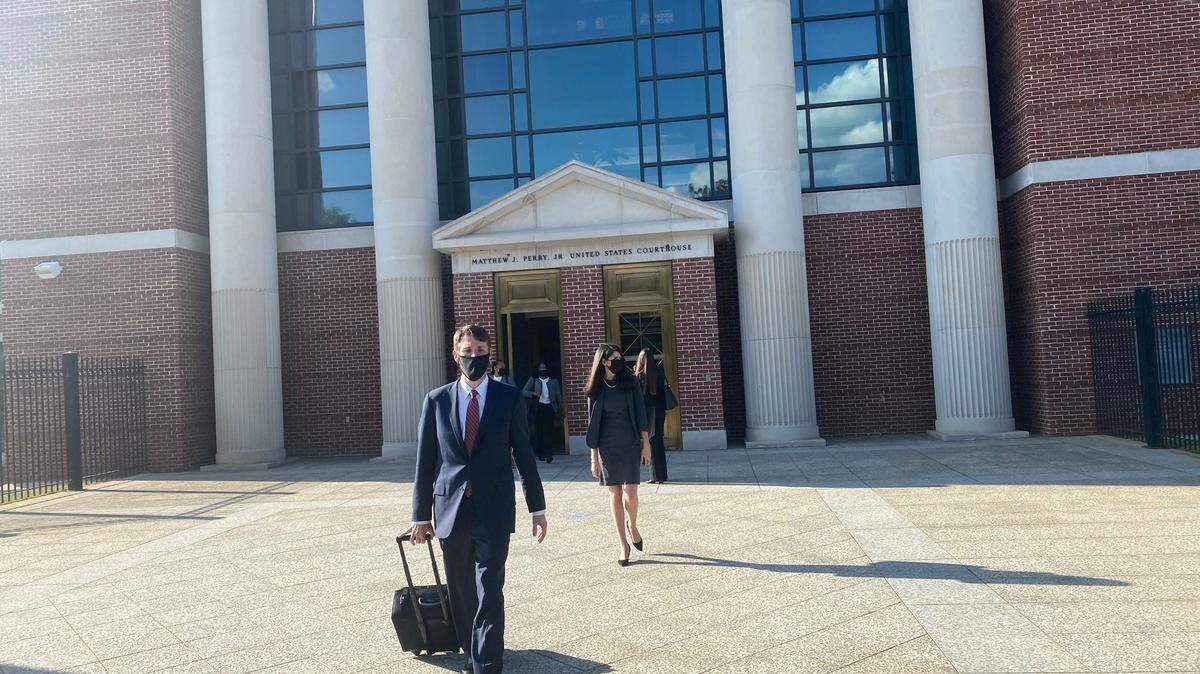
A top Chester County deputy created an incident report about a 2018 controversial arrest involving an alleged civil rights violation only after being contacted by an FBI agent, the agent testified Monday.
The testimony came on the sixth day of the ongoing public corruption trial of former Chester County Sheriff Alex “Big A” Underwood and two of his former top deputies: Deputy Chief Robert Sprouse and Lt. Johnny Neal.
“This was created less than an hour after I contacted him,” FBI agent Julie Yelk testified, referring to Sprouse, as a jury of 12 and four alternates listened in a courtroom at the federal courthouse in Columbia.
The prosecutors’ case against Underwood, Neal and Sprouse, contained in a 17-count indictment, includes various unrelated charges: alleged civil rights violations of a suspect, alleged skimming of government money, alleged misuse of deputies to work on the former sheriff’s private bar and alleged misuse of county money to fly Underwood’s and Sprouse’s wives to Reno with their husbands for a convention.
Not all charges apply to all three men.
Monday morning’s testimony focused on one of the prosecution’s central concerns: the allegedly unlawful arrest of Kevin Simpson on Nov. 18, 2018 — a chaotic law enforcement event involving a horrific crash on S.C. 9 just outside the mobile home where Simpson lived with his mother and other relatives. The Simpson matter also involves alleged falsification of documents after the arrest, according to prosecutors.
Sprouse waited about six weeks to create the report about Simpson’s arrest on disorderly conduct and resisting arrest charges, Yelk told the jury. Sprouse created the report on Jan. 3, 2019, she testified.
It is highly unusual for law officers, including the FBI, to wait six weeks to create a report about an incident, Yelk testified. Usually officers write reports within a day so they won’t forget anything, she said.
“Mr. Sprouse said they had been so busy they did not get to it,” Yelk told the court, under questioning by federal prosecutor Rebecca Schuman. “That was concerning to me.”
Yelk was the 20th prosecution witness so far in the trial.
Yelk testified her cell phone records showed that she telephoned Deputy Chief Sprouse at 9:52 a.m. on Jan. 3, 2019, to ask him about Simpson’s arrest and the incident report. Earlier, she had been told by a county official that the county sheriff’s office had no records of the arrest.
According to a log of documents created in the sheriff’s department, Sprouse created the first incident report about the Simpson arrest at 10:46 a.m. on Jan. 3, 2019 — 54 minutes after Yelk called him and said she wanted to see the Simpson incident report.
Ongoing investigation
Yelk also testified that when she was assigned to look into the alleged civil rights violations at the sheriff’s office in December 2018, she learned there already was an ongoing investigation into possible corruption at the sheriff’s office.
When she and another agent, Rodney Naramore, went to Chester County to interview Sprouse and Neal, they had the two deputies sign “admonishment” forms in which the lawmen acknowledged that they could be charged with a crime if they knowingly lied or falsified documents in connection with an FBI investigation.
During the agents’ interview with Spouse, he denied knowing anything about a cell phone that was seized from Simpson on Nov. 18, 2018, Yelk testified.
“Mr. Sprouse said that there was no phone taken from the residence that he was aware of,” Yelk testified.
However, another deputy, Burley McDaniel told the FBI agents in a later interview that Sprouse had given him Simpson’s cell phone after the incident and that the phone was now on McDaniel’s desk in an envelope.
According to an indictment in the case, Underwood, Sprouse and Neal are charged with concealing the existence of Simpson’s cell phone to carry out a cover-up in Simpson’s case.
In earlier testimony Monday, Chester County Sheriff’s Office IT officer Doug McMurray told the jury the exact time that Sprouse created the incident report on Simpson’s arrest. The office’s computer history log records the time a document is created, as well as the name of the creator, McMurray testified.
Under questioning by prosecutor Schuman, McMurray also read some of the written narrative from the Simpson incident report created by Sprouse.
The Sprouse incident report described Simpson as “running back and forth into the roadway” from his property, McMurray testified.
The report’s narrative about Simpson being in the roadway sharply conflicted with testimony last week given by former Fort Lawn volunteer fire chief Allen Culp. Culp said he witnessed the entire half-hour encounter with Simpson and sheriff’s department officers and said Simpson never was in the road.
The sheriff’s department contends that Simpson was in the roadway interfering with officers, which justified his arrest.
Video contradicts story
At the time, Simpson was live-streaming a video on Facebook Live of an unfolding scene on the highway to the east and west of his home. The scene involved a manhunt for a fugitive, an automobile crash where an elderly woman was critically injured and a helicopter making an emergency landing on the highway to take the woman to a hospital.
Simpson, who also testified last week, played his 27-minute video, which appeared to back up his testimony to the jury that he was on his property the entire time and that he never went into the roadway and obstructed officers.
McMurray also testified that once the incident report had been created on the morning of Jan. 3, 2019, the report was “edited many times throughout the day.” Shortly after the report document was created, it was put in to “protected” status — meaning others in the department could not view it, he testified.
“Every revision is saved,” McMurray said.
Candice Lively, deputy solicitor for Chester County, was another witness testifying for the prosecution. As deputy solicitor, she is a top prosecutor and handles major crimes.
Under questioning by federal prosecutor William Miller, Lively told the jury that her office had become aware of the Simpson matter in late 2018. She said she became concerned because the sheriff’s department normally turns over records of a case to the solicitor’s office within 15 days of an incident.
Eventually, Lively said, she learned about a television news account of the Simpson arrest and became concerned enough that she thought it would be better to turn the case over to the State Attorney General’s Office to avoid any possible conflicts. She had also heard from Simpson’s lawyer, Everett Stubbs, she testified.
When she told Sprouse that she had given the case to the Attorney General’s Office, Lively testified, “He was a little frustrated with me. ... He was not happy.”
Once the case is “conflicted out, I had no control over it,” Lively testified.
Gill Bell, one of Underwood’s defense attorneys, asked Lively about what happens when cases are sent to the Attorney General’s office. “Typically, that’s where cases go to die, isn’t it?”
Lively replied, “No.”
‘What the sheriff wanted’
A common thread linking the indictment’s 17 counts with all three defendants is an alleged conspiracy that Underwood, Neal and Sprouse used their official positions to abuse power and “to enrich themselves..., cover up their misconduct and to obstruct investigations into their misconduct,” according to the indictment.
In Monday’s testimony, McMurray, the IT administrator, told the jury that when Underwood first began sending deputies to refurbish his private barn, the limited number of people who knew about it only referred to it “the special project.” Later, as the work became common knowledge, deputies just “referred to it as ‘the barn,’” McMurray said.
McMurray also testified that no one in the department objected when Underwood spent money in questionable ways. “It was common knowledge you did what the sheriff wanted,” he told the jury.
In cross-examination of McMurray, Underwood attorney Jake Moore asked if he knew that Underwood was a state employee as sheriff, not a county employee, and thus county rules about spending money and other policies did not apply to him.
“I can’t answer that,” replied McMurray.
“The sheriff’s position was that he was not subject to the county’s rules because he was not a county employee, right?” Moore asked.
“Yes, sir,” replied McMurray.
Moore then asked about Underwood’s use of deputies to refurbish his private barn. “If you had thought that the sheriff’s deputies were violating the law by working on the barn, you would have been duty bound to arrest them, right?”
“Yes, sir,” McMurray said.
“And you didn’t arrest them, right?” Moore asked.
“No, sir,” McMurray replied
Reporter Andrew Dys contributed.
This story was originally published April 19, 2021 at 4:40 PM with the headline "Did deputies falsify incident report? Key question surfaces at SC sheriff’s trial."