
His friend was killed by police outside Burger King. Here’s what he knows for sure.
First, here’s what I don’t know.
I don’t know what happened in the moments leading to the fatal police shooting of my friend, Danquirs Napoleon Franklin, at a west Charlotte Burger King on March 25.
I know only the conflicting narratives swirling through the news and social media: that he was either a well-meaning bystander police mistook for the gunman, or that he was so emotionally distraught over a break-up that he took a gun to confront his girlfriend, a Burger King employee, over her new relationship with a co-worker.
I can’t say what’s fact or fiction.
This is what I can say for sure.
The Danquirs Franklin I wrote about for the Observer a nearly a decade ago entered the world with three strikes against him – an absentee father, a drug-addicted mother, and cocaine coursing through his bloodstream.
I know he loved his grandmother, the late great Mary Boyd, as fiercely as she loved him. I know she took him with her to St. Paul Baptist, where she served as an usher and a cook. I know she raised him to stay out of trouble, to work hard, to ask for help when he needed it.
I know he listened. Teachers and social workers, moved by his willingness to out-hustle his many deficits, worked overtime themselves, finally teaching him to read in high school and helping him become the first in his family to enroll in college.
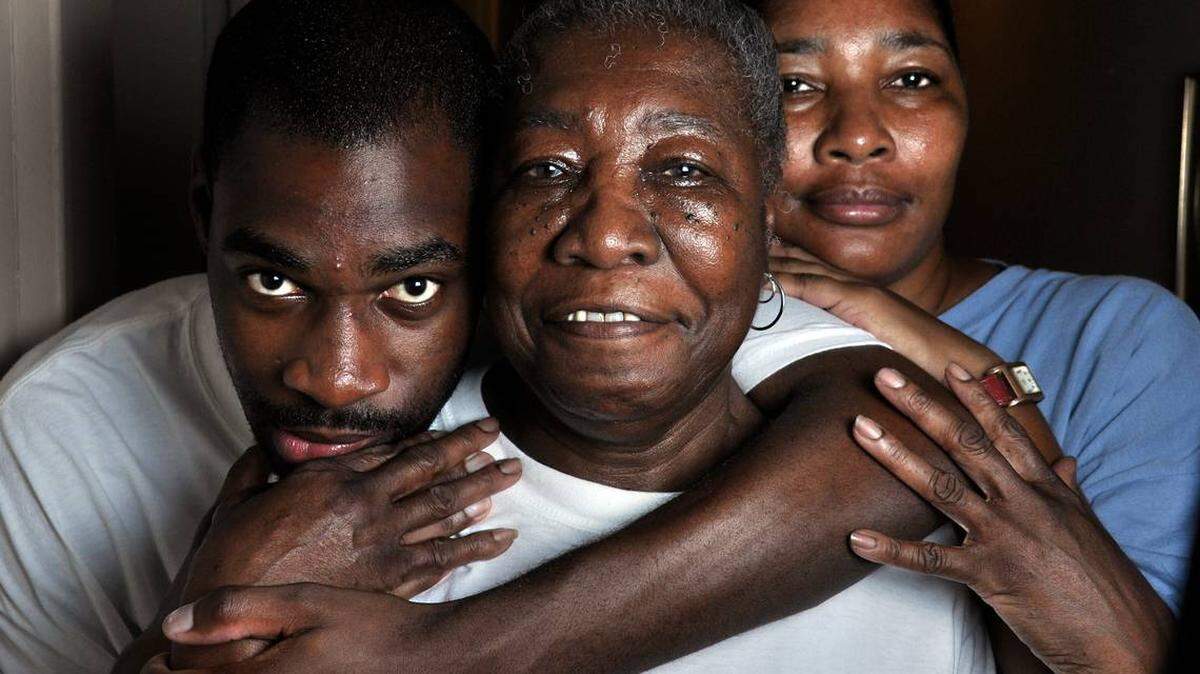
I know he loved his three children. I know he forgave and loved his mom Deborah, who beat her addiction to become a positive force in his life.
I know that he spent the last eight years working at a Charlotte restaurant, that he was a blue-collar guy who loved rap music and Marvel comics and video games and, most of all, basketball. He never stopped dreaming of making it to the NBA.
They held his funeral Saturday at St. Paul. As mourners filed in, a montage of scenes from his life flashed on screens above the sanctuary. One video snippet showed him playing a friendly game of basketball with uniformed Charlotte-Mecklenburg police officers.
That’s the only kind of interaction I would have ever expected between Danquirs and the police. He was as well-meaning as they come.
His friend and mentor James Barnette told mourners these truths: Danquirs was not a criminal. He was not a deadbeat dad. He was not a liability to society.
My last communication with Danquirs came in February on Facebook, when I wished him a happy birthday. He said thanks. I wish I’d said more.
I left St. Paul heavy hearted, wondering how many other Danquirses are out there, teetering between light and darkness.
I hugged his mom and wished her well. Deborah told me she intends to find the truth. I hope she does.
I originally told Danquirs’ story because I saw in him the story of anonymous black boys in inner-city neighborhoods across Charlotte and America, striving against the odds. Too often, we fail to see them until their frustrations explode into disciplinary problems at school or headlines in the newspaper.
I wanted to make him seen – them seen – before it was too late.
And now it is, for Danquirs at least. What does the full arc of his life tell us?
I believe it tells us a black boy born into poverty, crime and drugs can rise above hopelessness. It means he can be carried safely to adulthood by a strong, steady, loving family member or two, but they need help from selfless allies in schools, charities and government.
And perhaps, given his untimely death at 27, it tells us success will always be fragile.
This story was originally published April 1, 2019 at 11:05 AM.