
Don’t whitewash history. Learn from it.
I grew up just outside of Richmond and worked my first post-collegiate job for the city’s afternoon newspaper.
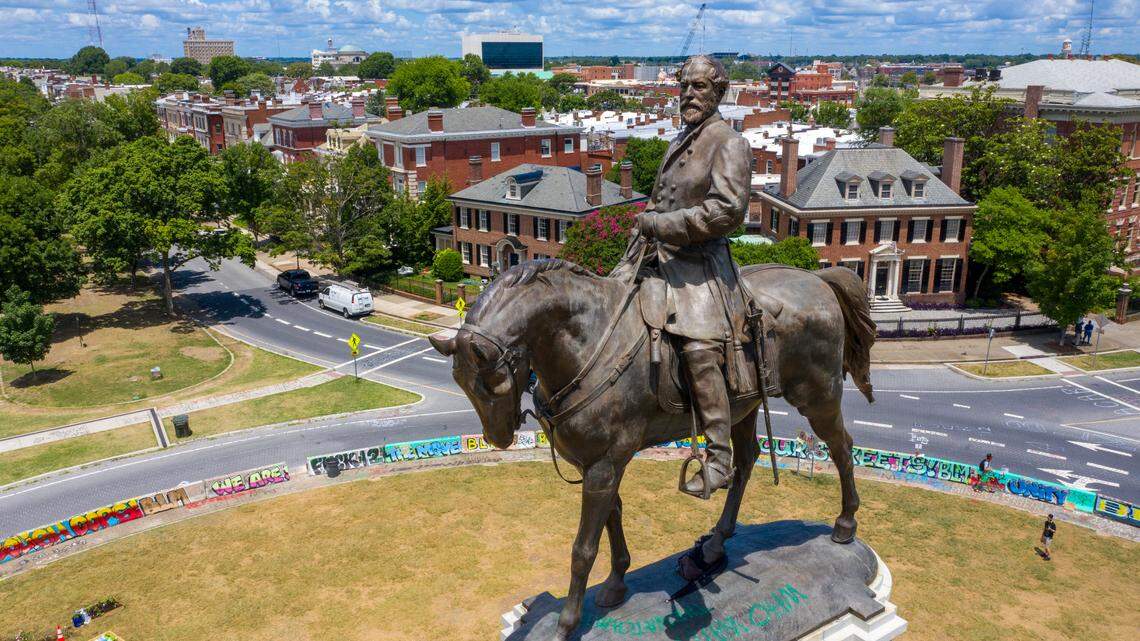
The lofty statues along Monument Avenue and similar remembrances of the “Lost Cause” were intertwined with the city’s ethos. But they weren’t the only way that mythology was elevated over truth.
A history teacher had us memorize the prologue to “Gone with the Wind” as part of the course work. For a time, the state celebrated Lee-Jackson-King Day, an unsubtle combination of passive-aggression and embittered disrespect toward the memory of Martin Luther King Jr., who was added in the 1980s to a holiday recognizing Robert E. Lee and Stonewall Jackson.
For a state that loves its history, so much was remarkably ahistorical.
The unyielding refusal by way too many people to recognize who we have been, who we are and why we are now here takes many forms. A significant number among us want to fade more than 400 years of history into genteel, sepia tones and to recast the last four years as something other than the build up to an insurrection.
Told accurately, history can make our lives healthier, safer and fuller. Ignored or denied, we risk our collective well-being.
Some choosing ignorance are now urgently advocating unity, apparently having appointed themselves as healers of divisions despite their lack of qualifications.
The timing is politically convenient for them, but the rationale is flawed and the goal unattainable. Failing to confront white supremacy and all the ways it breathes within in our systems and our culture makes genuine unity impossible. A more sincere path would be the commitment to truth telling, the work it requires, and the institutional changes it demands.
Similar calls to forgive and forget ask everything of those who would do the forgiving and forgetting and nothing from the proponents of communal amnesia.
Still others wrap themselves in love of country to gloss over systemic oppression dating back to this nation’s beginnings and continuing to this day.
They fail to recognize that an inability to love through imperfections and to work toward betterment isn’t really love. It’s infatuation and just as shallow.
It’s crushing on someone’s charming smile or glib flirtation but ignoring their bullying as long as it isn’t directed at you.
But you are drawn in, too, if you normalize their conduct. Bad behavior has no incentive to stop if no one confronts it, if there are never consequences.
As a child, I learned infinitely more about slavery and its aftermath watching “Roots” and “The Autobiography of Miss Jane Pittman” on television than in any classroom. Neither made me love my country less, but both made me wonder why my teachers didn’t know history.
Virginia still has so much more work to do, but some things are different in ways I never imagined possible. The face of Monument Avenue is forever changed, and a statue by Black artist Kehinde Wiley now rises in front of the Virginia Museum of Fine Arts.
Lee-Jackson-King Day stopped being a thing in 2000, and this year, Lee-Jackson Day was not celebrated as a state holiday, although King Day was. More significantly, the Virginia General Assembly just voted to abolish the death penalty, which is deeply rooted in an unequal justice system.
Beyond the statues and symbols, history is, sometimes grudgingly, being heard.
For systems and institutions to change, to manage the threats to our democracy, for individuals to live fully, we have to do more than pay lip service to traits like honesty and integrity.
Unity and forgiveness cannot be our true goals if we won’t stop lying about our past.
This story was originally published February 16, 2021 at 12:00 AM with the headline "Don’t whitewash history. Learn from it.."