State appropriations vs. net tuition revenue per full-time equivalent student, North Carolina, 2008-2020
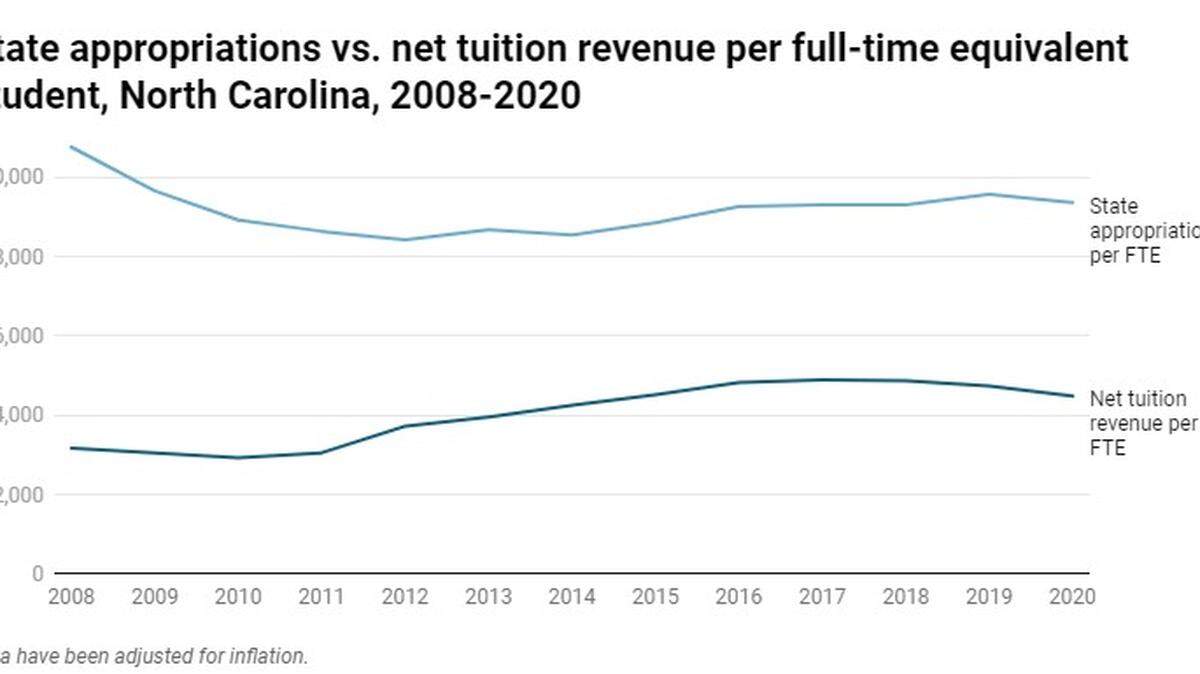
Like most other states, North Carolina cut funding to higher education during the 2008 financial crisis. But while most states slowly began to restore that funding once the economy recovered, North Carolina did not. Instead, the state has continued to fund higher education as if money is tight. Per-student appropriations for higher education in North Carolina decreased by 13% between 2008 and 2020, when adjusted for inflation.
After more than a decade of Republican leadership, the burden of financing higher education has slowly shifted away from the state and onto students and their families. While state appropriations per student have fallen, net tuition revenue per student grew 41% in the same 12-year period — meaning that students are paying a bigger share.
Hover over the lines on the graph below to see figures for each year.
This story was originally published February 6, 2022 at 5:00 AM.