
Are the latest NC maps fair? The GOP may have just offered a hint.
.JPG "Congressional maps can be seen on the computer screen of Rep. Rachel Hunt before the start of a House Standing Committee meeting on redistricting at the Legislative Office Building in Raleigh, N.C. on Wednesday, Feb. 16, 2022.")
New versions of North Carolina’s congressional and legislative maps have been released. They certainly look different than the original maps, which the state Supreme Court struck down earlier this month because they were unconstitutional partisan gerrymanders.
But will they be good enough for the court? Republicans may have just offered a hint at what they think.
The House and Senate released separate versions of new congressional maps Wednesday, with a few key differences. House Speaker Tim Moore said that the Senate version of the U.S. House map will be the one that moves forward. But — and here’s where it gets even more complicated — that map is going to be revised to better meet the criteria set forth by the court. A new version of the map will be considered Thursday morning, Sen. Warren Daniel, who co-chairs the redistricting committee, said Wednesday.
Other North Carolinians were quick to blast the initial maps on social media, calling them “horrendous,” “trolling,” and “hilariously bad.”
At first glance, both versions appear to strike a fairer partisan balance than the maps deemed unconstitutional by the court. Those maps would have given Republicans a 10-4 or 11-3 advantage in the state’s congressional delegation, largely by diluting Black votes in the northeastern part of the state and splitting the three most populous counties more than once.
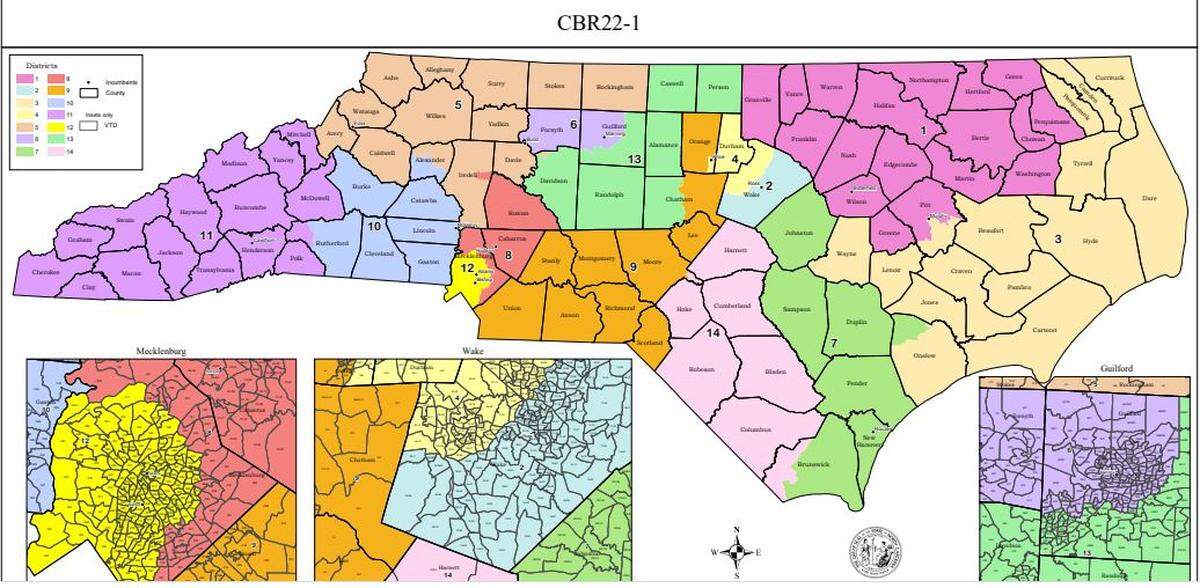
The newest versions add two solidly blue congressional districts, as well as a few swing seats. There’s still data to be analyzed — and the final version could be different — but the maps still appear likely to elect more Republicans than Democrats in a state that is nearly evenly divided politically.
There’s also some questionable districting going on: the congressional map proposed by the House includes an oddly shaped district that stretches from Union County to Orange County, with U.S. Rep. Dan Bishop as the likely incumbent. The Senate’s version is even more strange — it puts Orange County in a district stretching all the way to Tennessee. Rep. Virginia Foxx would be the incumbent in that proposed district.
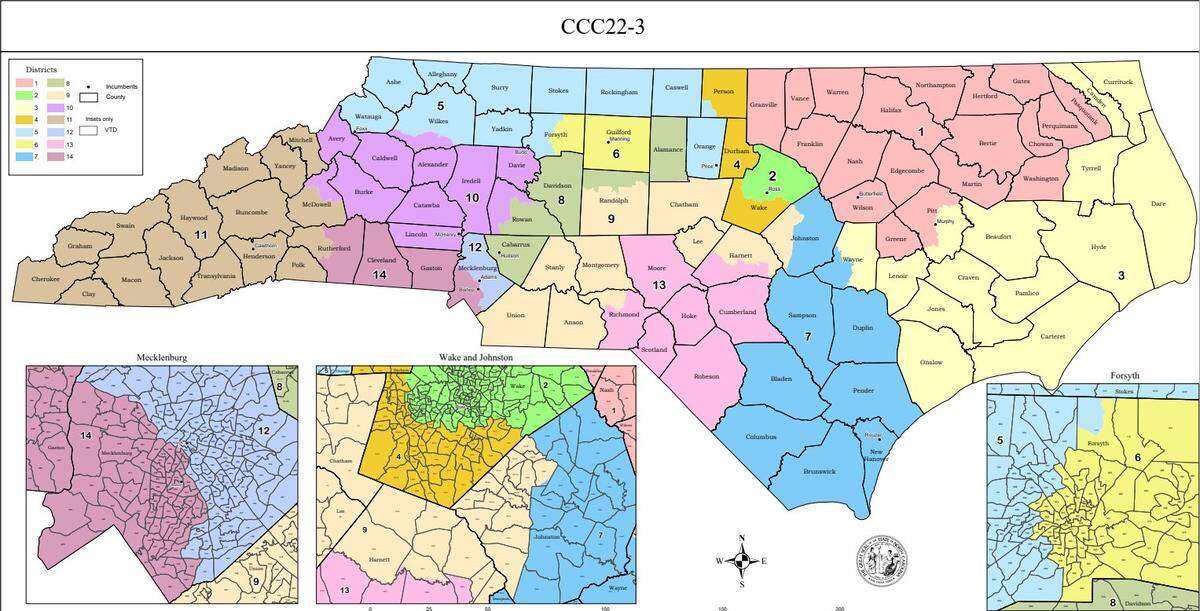
“Orange County has some strange bedfellows, regardless of which map carries the day. And what that means, I don’t know, but that’s certainly an important difference,” Chris Cooper, a political science professor at Western Carolina University, said. “The Watauga to Orange is one, I think, that’s going to get brought up a lot as a piece of the map that gets criticized.”
Unlike in the first round of redistricting, which Republicans lauded as the “most transparent redistricting process in state history,” the new maps were drawn using a more secretive approach. Republican leaders said there was no time for public hearings this time around due to the tight schedule. Meanwhile, some Democratic lawmakers said they did not even see the maps until a matter of hours before they were scheduled to be discussed in committee.
If the court decides the legislature’s maps are not sufficient, it can order a completely different set of maps to be used, or just change a few districts. What happens after that is a matter of discussion, Cooper said. If Republicans keep control of the legislature and gain a majority on the state Supreme Court in November’s elections, they could try to redraw the maps again next year.
They also haven’t ruled out an appeal to the U.S. Supreme Court, as the News & Observer previously reported.
“We don’t know what’s gonna happen when filing supposedly opens later this month, much less what the maps are going to be in four years,” Cooper said.
We do know this: these latest maps are different, and they may even be better. But they make a case once again for a more independent redistricting process that brings North Carolina somewhere closer to fair.
BEHIND THE STORY
MOREWhat is the Editorial Board?
The Charlotte Observer and Raleigh News & Observer editorial boards combined in 2019 to provide fuller and more diverse North Carolina opinion content to our readers. The editorial board operates independently from the newsrooms in Charlotte and Raleigh and does not influence the work of the reporting and editing staffs. The combined board is led by N.C. Opinion Editor Peter St. Onge, who is joined in Raleigh by deputy Opinion editor Ned Barnett and in Charlotte by deputy Opinion editor Paige Masten. Board members also include Observer editor Rana Cash and News & Observer editor Nicole Stockdale. For questions about the board or our editorials, email pstonge@charlotteobserver.com.
This story was originally published February 16, 2022 at 3:34 PM.