
NC elections board was right to reject a Republican bid aimed at ‘election security’
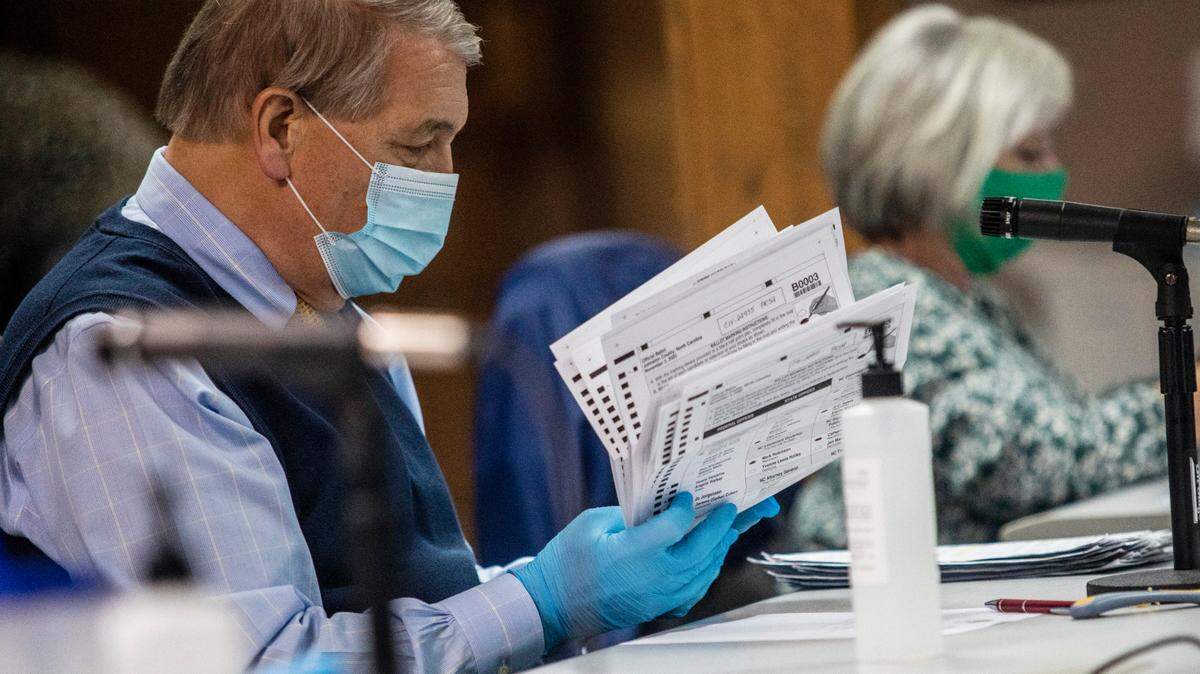
On July 14, the North Carolina State Board of Elections refused a request from the N.C. Republican Party to implement a new “election security” measure that research shows would have had the opposite effect. It would have thrown out legal absentee votes without providing significant benefit to election security.
The State Board of Elections (SBOE) followed the facts and rejected this anti-voter proposal. But, unfortunately, the N.C. GOP is considering appealing the decision to the courts. That would be a mistake.
Absentee voters in North Carolina already have to take significant steps to prove their identities, namely by finding either two witnesses or a notary public who can verify their ballot.
The Republican Party asked the SBOE to allow counties to take one more step to verify ballots by having election workers match voter signatures to the signature file on record. While this might sound like a sensible layer of additional security, our research at VoteShield demonstrates that it actually throws out legal votes without identifying significant cases of fraud.
We have expertise analyzing complex elections data to study the effect of election administration decisions, including in North Carolina. Our nonpartisan team uses voter and absentee ballot data to identify problems that could affect the administration of, or confidence in, an election.
We have also used our data to research signature matching. Our work has revealed that signature matching, as a means of verifying absentee voters’ identities, is flawed in three significant ways.
First, research overwhelmingly demonstrates that election workers will not be able to effectively identify fraudulently signed ballots. Even trained handwriting experts cannot reliably identify fraudulently signed signatures.
Research also suggests that even if experts conducted signature matching, only 1 in 167 ballots identified as having non-matching signatures are likely to be fraudulently signed. The remaining 166 would be “false-positives” — legitimate voters whose ballots would have a good chance of not counting.
County election administrators are not trained handwriting experts. Nor are they adequately equipped to process signature comparisons on a mass scale in a short period of time. Both of these factors would likely contribute to heightened rates of rejecting legitimate signatures.
Second, signature matching will introduce inconsistency across precincts and elections, and result in voters being treated differently for arbitrary reasons. Our comparison of the 2020 Georgia general election and 2021 Senate runoff demonstrates such a lack of standards.
Finally, the processes put in place to allow voters to fix or “cure” their incorrectly rejected ballots would impose even greater burdens on already taxed local election administrators — not to mention voters — during a time when the public expects prompt, accurate reporting of results.
Voters often face a very narrow window of time between when they are notified of their rejection and the end of the ballot curing period, making it difficult for them to avoid submitting late responses. Delays in finalizing election results caused by the added administrative work of curing falsely rejected ballots would exacerbate the declining confidence in our electoral system.
It is also crucial to note that in states across the country there is little evidence of absentee ballot fraud. According to the Heritage Foundation, there have been only 118 documented cases of voter fraud in the past decade.
Were Republicans to appeal and succeed in instituting signature matching, it would lead to rejecting a significantly higher number of valid ballots than identifying fraudulent ballots, increase the workload of election administrators already at their limits, and introduce highly subjective standards into the process of securing N.C. elections. All of this for a policy that shows no evidence of significantly contributing to election security.
We are pleased that the SBOE recognized these facts and we urge the N.C. Republican Party to cease pursuing a failed policy that could very well throw out valid absentee votes from their own constituents.